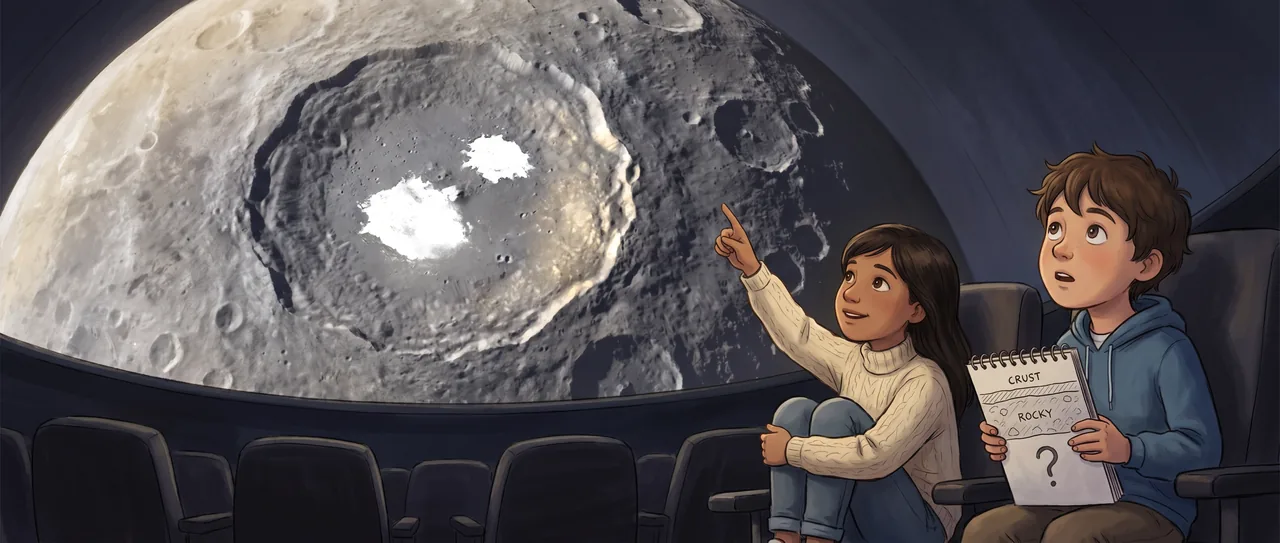
The Bright Spots That Should Not Be There
The planetarium went dark at exactly the wrong moment.
Mr. Hadani had been mid-sentence, pointing at the dome where a polished NASA animation of the asteroid belt was supposed to appear. Instead, the projector stuttered, and the dome filled with something raw. Unprocessed. A gray, cratered surface, pockmarked and ancient, with two brilliant white patches blazing near the center of a wide crater.
"Well," Mr. Hadani said. "That's not the slideshow."
He started tapping at the laptop. The rest of the class pulled out phones, the way they always did when technology failed. Maya didn't. She was staring up.
"Those are too bright," she said.
Soren, two seats over, had his notebook already open. He'd been sketching the asteroid belt diagram from the earlier slide. Now he stopped. He looked up.
"Too bright for what?" he asked.
"For rock." Maya pointed. The two spots glowed against the battered gray surface like someone had punched holes in the crust and let light through from inside. "Everything else up there looks like the moon. Old. Beat up. Those look wet."
"They can't be wet," Soren said. But he wrote it down.
Mr. Hadani was still wrestling with the laptop. "Give me two minutes, folks. The rendering software crashed, so you're seeing raw Dawn mission imagery. Just, uh, sit tight."
"Dawn mission," Soren repeated. He flipped back three pages in his notebook. "That's Ceres. The dwarf planet."
"Biggest thing in the asteroid belt," Maya said, still looking up. "So what's glowing?"
Soren studied the image. The crater was enormous, maybe ninety kilometers across based on the scale bar in the corner of the raw data. The bright patches sat inside it like eyes. Not reflecting light the way ice would, not exactly. More like the surface itself was made of something different there. Something that scattered light in all directions instead of absorbing it.
"Ice would sublimate," Soren said slowly. "Ceres has almost no atmosphere. If that were water ice on the surface, it would just, it would go straight to vapor. It wouldn't last."
"So it's not ice."
"I didn't say that. I said ice wouldn't last on the surface."
Maya turned to look at him. "But something keeps showing up there anyway."
That was the piece that snagged. Soren underlined the word "keeps" in his notebook. Because Maya was right. If the bright material couldn't survive long on the surface, and yet the bright material was there, then something was replacing it.
"Mr. Hadani," Soren said. "What's the bright stuff in the crater?"
Mr. Hadani looked up from the laptop, grateful for a question instead of a complaint. "Sodium carbonate, mostly. Salt deposits. The Dawn spacecraft confirmed it with its spectrometer. The crater's called Occator."
"Salt," Maya said. "Like ocean salt?"
"Different salt, same idea. Dissolved minerals left behind when liquid evaporates."
He went back to the laptop. Maya was already ahead.
"If there's salt, there was liquid," she said. "And if ice sublimates off the surface fast, then the liquid wasn't sitting there for millions of years. It came up recently."
Soren nodded. He was drawing a cross-section in his notebook now. Crust on top, rock below, and then, deeper, a question mark.
"Salt doesn't end up concentrated like that from a single event," he said. "If brine came up once and dried, it would leave a thin layer. That looks thick. Built up."
"So it happened more than once."
"It's still happening," Soren said. He looked at Maya. "Or it was, recently enough that the deposits haven't been buried by impacts yet."
The planetarium was quiet around them. Most of the class was watching videos on their phones. Mr. Hadani was rebooting the software. The raw image of Occator crater blazed overhead, patient and unbothered by the fact that nobody had asked it to appear.
Maya pulled her knees up onto her seat. "There's an ocean under there."
"We don't know that it's an ocean."
"There's a reservoir. Liquid. Salty. Under the crust. And it pushes through sometimes." She paused. "Like a geyser. Like something pressurized underneath cracking the surface open and spitting brine out into space, and then the water part vanishes and the salt stays."
Soren thought about that. He thought about the scale. Ceres was small, roughly nine hundred and fifty kilometers across. A fraction of Earth's moon. And yet somewhere inside it, liquid had survived. Not on the surface where the sun could strip it away, but deep enough to stay warm. Deep enough to stay liquid. Pushing up through cracks in rock that was billions of years old.
"That's not supposed to work," he said. "Ceres is too small to hold much internal heat. There's no tidal heating like Europa. Where's the energy coming from to keep it liquid?"
Maya shook her head. "I don't know."
That sat between them. Two bright spots on a world that was too small and too cold and too far from anything to have liquid water, and yet the salt was there. The evidence was there. The answer was "we don't fully know how" and that wasn't a failure. It was a door.
"There's a whole ocean," Maya said again, quieter. "In the asteroid belt. Not on a planet. Not on a moon orbiting a giant. On a little dwarf planet made of rock and ice that everyone skips over on the way to Jupiter."
Soren looked at his cross-section drawing. He added arrows pushing upward through the crust. Then, below the question mark, he wrote another word. He wrote "reservoir" and then, after a long pause, he drew a second question mark below that.
Because if Ceres could hold liquid beneath its surface, if something that small and that cold could manage it, then the number of worlds in the solar system that might hold hidden water had just gotten larger. Not by one. By a principle. Every small body with the right chemistry, the right insulation, the right pressure.
Mr. Hadani finally got the slideshow working. The polished animation returned, labeled and narrated and tidy. Occator crater disappeared.
Maya and Soren both looked at the pretty, curated version of the asteroid belt now circling the dome. Thousands of objects drifting in the dark between Mars and Jupiter, each one a sealed gray world.
"How many of those," Maya whispered, "do you think are wet inside?"
Soren turned to a clean page.
Read the interactive version, listen to the narration, and earn a gold star →
A science-verified short story for curious kids · Curiosity Land