The Break That Wouldn't Break
The sample shattered on the first drop.
That was expected. Dr. Ruiz had left them a tray of mineral tiles and a drop-weight tester with a two-kilogram steel ball. She was three rooms away, arguing on the phone with someone about a grant deadline, and she had told them they could break anything on the tray as long as they wore the safety glasses and wrote down what happened.
Soren wrote down what happened. Calcite tile, four centimeters square. Drop height: thirty centimeters. Result: two clean pieces and a spray of white dust.
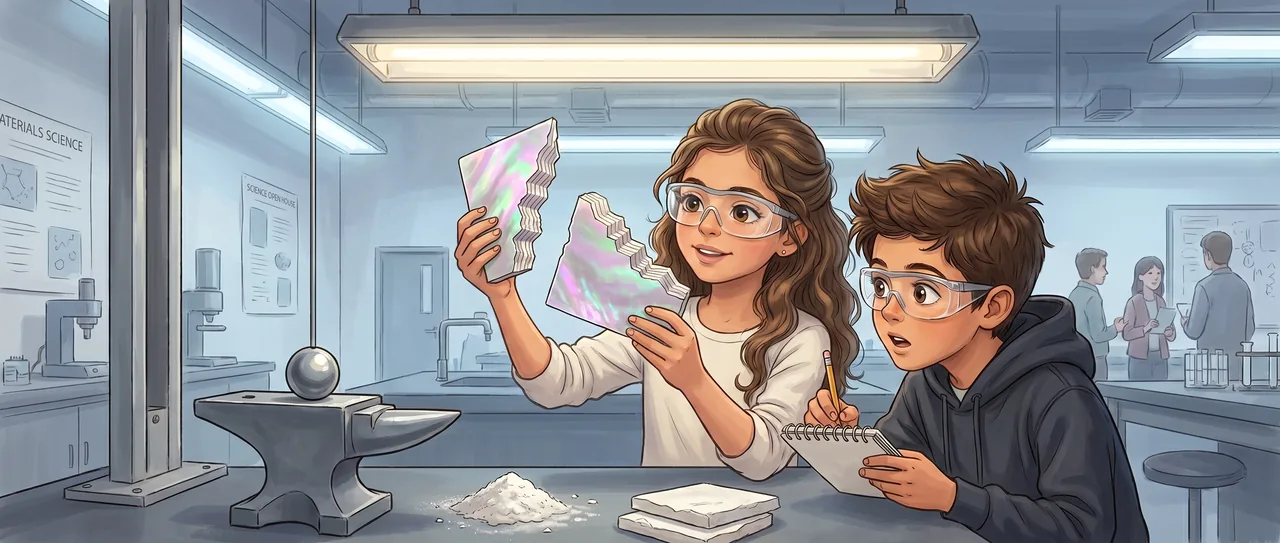
Maya picked up the next tile. It looked different. Same chalky white on the edges, but the top surface caught the overhead fluorescent lights and threw back a slow ripple of pink and green, like gasoline on a puddle but prettier. Much prettier.
"That one's labeled N," Soren said, checking the tray. "And the first one was C."
"Same material?" Maya asked.
"Dr. Ruiz said the tray was all calcium carbonate."
Maya placed tile N on the anvil. Soren released the ball from thirty centimeters.
The ball bounced. The tile didn't break.
Soren picked it up and turned it over. A tiny white mark, like a fingernail scratch. That was all.
"Same material," Maya repeated, but now it was a question.
"Same material," Soren confirmed, reading the label on the tray again. He dropped the ball on tile N from forty centimeters. Fifty. Sixty. At seventy centimeters the tile finally cracked, but it didn't shatter. It bent along the crack like a hinge, the two halves still connected by something, threads or layers or something he couldn't see.
Maya held the broken halves up to the light. The iridescent surface was still there, still throwing color, even along the fracture line. "Look at this."
Soren looked. The cross-section of the break was not smooth like the calcite had been. It was stepped, terraced, like a wall made of thousands of tiny bricks. He could almost see individual layers, each one catching light at a slightly different angle.
"It's not one thing," he said. "It's a lot of very thin things stacked together."
"And the color," Maya said. She tilted the broken edge back and forth. Pink. Green. White. Pink again. "There's no paint. There's no dye. So where's the color coming from?"
Soren thought about this. He took tile C's broken pieces and held them up the same way. Dead white. Flat. No color at all. Same chemical, calcium carbonate both times, but one was a single crystal and the other was thousands of layers.
"The layers," he said slowly. "The color is from the layers."
"How does a layer make a color?"
He didn't know. But he'd seen something like it before. "Soap bubbles. Soap bubbles don't have dye in them, but they have colors. Because the film is thin enough that light bounces off the top and the bottom and the waves interfere with each other."
Maya stared at the fracture surface. "So each layer is like a soap bubble wall. And there are thousands of them. All bouncing light back and forth between each other."
"Which would mean the layers are incredibly thin. Thin enough to be close to the wavelength of visible light."
Maya set the pieces down carefully. She was quiet in the way that meant she was chasing something. Then she said, "The toughness and the color are the same thing."
Soren opened his mouth to ask what she meant and then closed it. He looked at the shattered calcite, one clean break, and the nacre with its terraced fracture, thousands of tiny shifts instead of one catastrophic snap. He looked at the iridescent shimmer that came from those same layers being thin enough to play with light.
"The thing that makes it beautiful is the thing that makes it strong," he said.
"Not strong. Tough. There's a difference, right? The calcite was hard. It just couldn't absorb the hit. The nacre took the energy and spread it across all those layers. Each layer slid a little. Each layer cracked a little. But no single crack could run through the whole thing because the next layer stopped it."
Soren wrote this down fast, not because he'd forget, but because it was one of those things that was too big for the inside of his head. A structure three thousand times tougher than a single crystal of the same material, not because it was made of something better, but because it was organized differently. The same atoms. The same chemistry. Just arranged into thin, sliding, light-catching layers with something soft between them.
"An abalone made this," Maya said, picking up the iridescent half again. "A snail. A snail figured this out."
"It didn't figure it out. Evolution figured it out. Over hundreds of millions of years."
"Fine. But the point is, this isn't something a person invented. This has been sitting in the ocean the whole time. And we're still trying to learn how to copy it."
From three rooms away, they could hear Dr. Ruiz's voice rising about something called a budget reallocation. She was not thinking about them at all.
Maya put the two halves of the nacre back together. They fit perfectly, the terraces interlocking. The iridescence along the crack line shifted as she breathed on it, green to blue to something almost violet.
"You know what gets me?" she said. "Everyone picks up a shell and says, oh, pretty. The pretty part and the unbreakable part are the same architecture. You can't have one without the other. The beauty is structural."
Soren looked at the calcite dust still scattered on the anvil. A single crystal. Pure. Simple. And absolutely useless against a falling weight. Then he looked at the nacre, impure by any definition, riddled with organic material between its layers, full of interfaces and boundaries and interruptions. Every place where it wasn't perfect was a place where a crack had to stop, turn, spend its energy, and die.
All that toughness, built from flaws.
Maya was already reaching for the next tile on the tray, labeled N-two, her fingers finding its iridescent face before her eyes did, tilting it toward the fluorescent lights to see what colors it would throw back.
Read the interactive version, listen to the narration, and earn a gold star →
A science-verified short story for curious kids · Curiosity Land