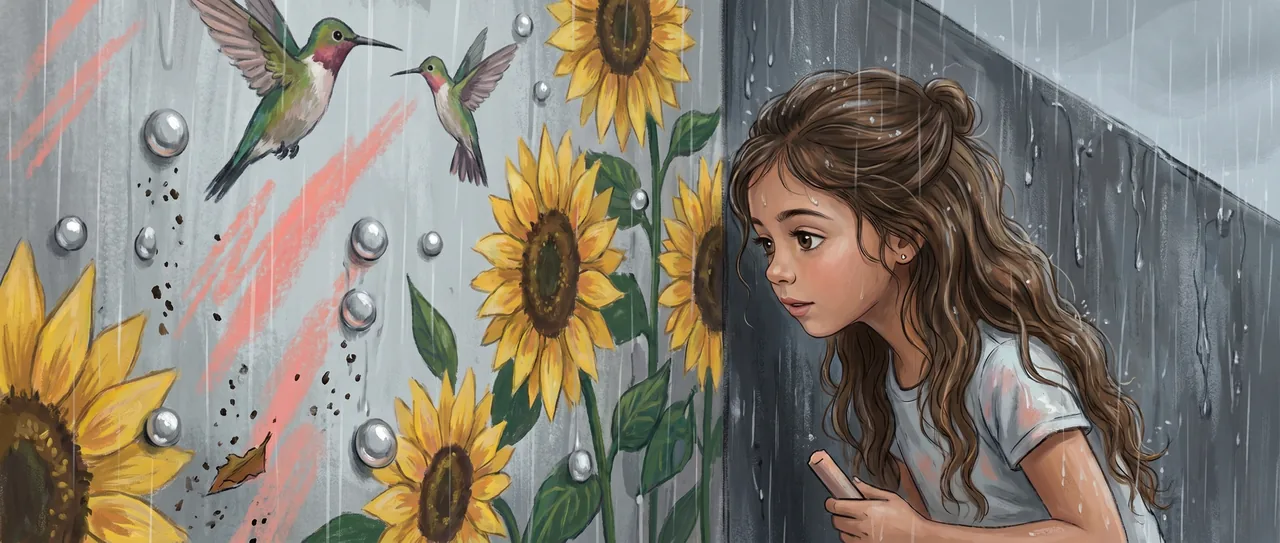
The Wall That Wouldn't Stay Dirty
Maya had been painting the butterfly for three days.
Not on the mural wall itself. She wasn't allowed. The community mural was for the professional artists, the ones the neighborhood association had hired to transform the long concrete retaining wall along Delancey Street into something worth looking at. Maya painted on the sidewalk beside it with chalk, adding her own butterfly to the garden scene growing across the concrete.
She liked being near the painters. She liked the smell of it and the way they talked to each other about color like it was a living thing. She liked that nobody told her to leave.
On Thursday, the rain came.
Maya stood under the awning of Kim's Laundry and watched her chalk butterfly dissolve into a pink and orange river that ran along the curb and disappeared into the storm drain. Gone in forty seconds. She had timed it.
But something was wrong with the mural wall.
The painters had finished the left third of it, the part with the sunflowers and the hummingbird, and a different crew had come yesterday to spray the finished section with a protective clear coat. A sealer, they called it. The rest of the wall was still bare concrete and fresh paint, uncoated.
The rain hit both sections the same way. Maya could see it. Same angle, same force, same gray sheets of water.
But on the coated section, the water wasn't sheeting. It was beading. Fat round drops that looked almost silver, trembling on the surface, then rolling down and off the wall fast, like the wall was shrugging them away. And as they rolled, they picked things up. She could see it. Dust, a smear of dirt, a fragment of leaf that had been stuck near the hummingbird's throat. The drops gathered it all and carried it to the ground.
The uncoated section just got wet. Water clung. Dirt stayed. The fresh paint darkened and looked sad.
Maya walked out into the rain.
She put her face close to the coated wall. The water drops were perfect spheres. Not flattened, not spreading. Spheres. Sitting on the surface like they didn't want to touch it. Like the wall and the water had agreed to keep their distance.
She touched the dry space between two beads. It didn't feel slippery. It felt almost rough. Faintly textured, like very fine sandpaper.
"That's wrong," she said out loud.
Smooth things should repel water. That was her assumption and she knew it was her assumption and she also knew it was wrong, because the evidence was sitting right in front of her face. The rough surface was the one the water couldn't grip.
She pressed her whole palm flat against the wall and pulled it away. Dry. Completely dry, even in pouring rain.
Maya went home and got her mother's kitchen magnifying glass and came back. The rain had slowed to a drizzle. She held the lens up to the coated section and looked.
Texture. Tiny bumps, too small to really see even with magnification, but she could tell they were there because of how the light scattered. The surface wasn't smooth at all. It was a landscape. And the water drops were sitting on top of that landscape like beach balls balanced on a bed of nails, touching almost nothing.
That was the trick. Not smoothness. The opposite of smoothness.
She knew about lotus leaves. She'd seen the videos in science class. Water rolling off them like mercury, carrying every speck of dirt. Mrs. Kashani had called it superhydrophobic, which just meant extremely water-fearing, which Maya had thought was a strange way to describe a leaf that grew in ponds.
But she hadn't understood it then. She'd thought the leaves were coated in something slick. Waxed, like a car hood.
Now, standing in front of this wall, she understood it differently. The lotus leaf wasn't just waxy. It was bumpy. And the bumps had smaller bumps. The water couldn't flatten itself against the surface because there wasn't enough surface to flatten against. The drops kept their round shape because round was what water wanted to be when nothing was forcing it to spread.
The dirt couldn't stick either, for the same reason. Not enough contact. So when a drop rolled, it stole the dirt, because the dirt was more attracted to the water than to the tiny points of the bumps. The thing that should have made the mural dirty was the thing that kept it perfect.
Maya sat down on the wet sidewalk. She didn't care about the wet. She stared at the wall, the stick of chalk still in her hand, not yet drawing.
Read the interactive version, listen to the narration, and earn a gold star →
A science-verified short story for curious kids · Curiosity Land