The Wall That Listened
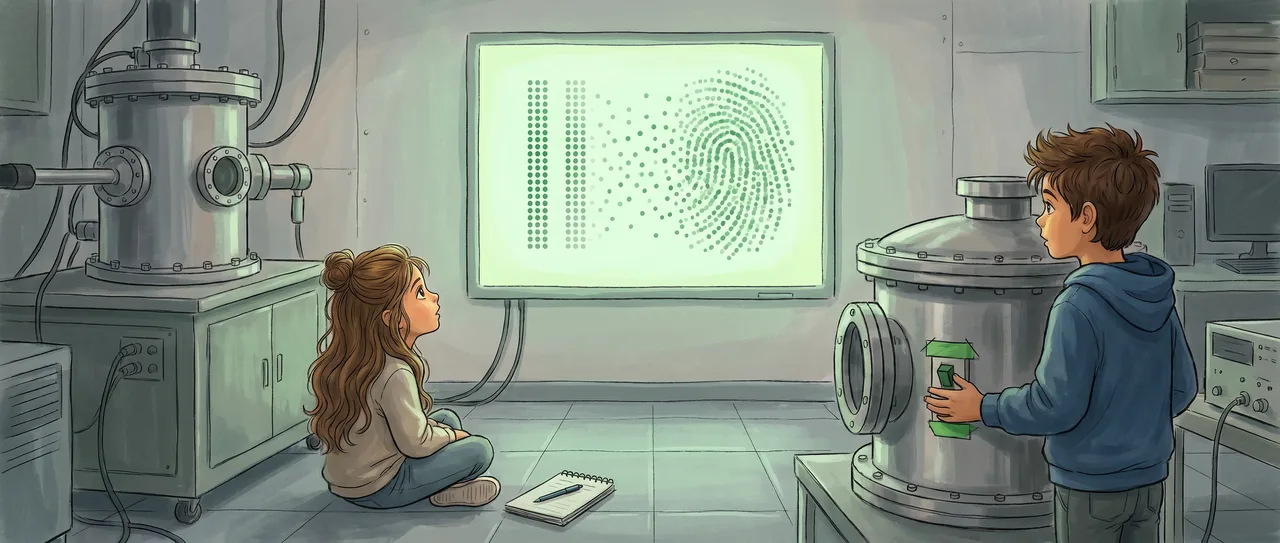
The pattern on the screen looked like a fingerprint made of light.
Maya stared at it. Three bright bands, two dimmer ones on either side, then dimmer still, fading out like an echo. The phosphorescent screen glowed pale green where the electrons had landed, one by one, over the last forty minutes.
"That's interference," Soren said. He had his notebook open. He'd drawn the pattern twice already, once when it was barely forming and once five minutes ago. Now he was drawing it a third time because the outer bands had sharpened. "Waves do that. They add up where they overlap and cancel where they don't."
"But they're electrons," Maya said.
"I know."
"Particles."
"I know."
Dr. Fuentes was on the phone in the hallway. She had been for twelve minutes. Something about a grant deadline. She'd left them alone with the vacuum chamber and a sheet of instructions that said DO NOT TOUCH THE APPARATUS in three places, underlined.
Maya didn't need to touch it. She needed to understand it. The machine fired electrons one at a time through two tiny slits in a barrier. One electron. Then another. Then another. Each one landed on the screen as a single dot, a tiny flash, one particle hitting one spot. But after thousands of them, the dots didn't pile up in two stripes behind the two slits the way they should have. They piled up in this pattern. This wave pattern. As if each single electron had gone through both slits at once and interfered with itself.
"How does one thing go through two doors?" Maya asked.
Soren didn't answer right away. He was reading the second page of Dr. Fuentes's instructions, the ones that said what to do next. His eyes moved down the page. Then they stopped.
"Maya."
"What."
"Step two says to turn on the detector at the slits. The one that records which slit each electron actually goes through."
Maya looked at the small device mounted beside the barrier inside the vacuum chamber. A tiny sensor, designed to flash when an electron passed through slit A or slit B. "So we can see which way they really go."
"So we can see," Soren repeated, but his voice was different. Careful.
He pressed the switch Dr. Fuentes had marked with green tape.
The detector activated. The screen kept accumulating dots, one at a time, each one still a single tiny flash. Maya watched the new pattern begin to form over the old one. For a minute she thought nothing had changed. Then she saw it.
"Soren."
"I see it."
The interference pattern was gone.
The dots were piling up in two simple stripes. Two bright bands, one behind each slit. Exactly what you'd expect if someone threw tiny balls through two doors. No waves. No fingerprint. Just particles acting like particles.
"We didn't change anything," Maya said slowly. "Same electrons. Same slits. Same screen."
"We added the detector."
"We looked."
They stood there. The screen kept filling. Two ordinary stripes.
Soren turned the detector off.
They waited. The dots kept coming, one by one. And slowly, like fog forming on a window, the interference pattern began to creep back. Bands. Bright and dim. Waves.
He turned the detector on. The bands dissolved into two plain stripes.
Off. Waves.
On. Particles.
He did it four more times. Maya counted. Each time, the same thing happened. When they could know which slit the electron went through, it behaved like a particle. When they couldn't know, it behaved like a wave.
The room was very quiet except for the hum of the vacuum pump.
"It's not the detector bumping them," Soren said. He was reading the notes now, the ones Dr. Fuentes had left for after the demonstration. "She writes here that they've done this with detectors that barely interact with the particle at all. Photons so gentle they couldn't push anything off course. The result is the same. It's not about disturbing the electron. It's about whether the information exists."
Maya sat down on the floor. Just sat. Right there on the cold tile.
"Whether the information exists," she repeated.
"Whether it's possible, even in principle, to know which slit it went through. If it's possible to know, it goes through one slit. If it's not possible to know, it goes through both."
"Both."
"Both."
"Soren, they've done this with molecules. Big ones." She'd read this somewhere. She was sure she'd read this. "Not just electrons. Actual molecules made of hundreds of atoms."
"Thousands," Soren said, finding the paragraph in Dr. Fuentes's notes. "Molecules of over two thousand atoms. They still show interference. They still go through both slits when nobody checks which one they use."
Two thousand atoms moving together, passing through two separate doors at the same time, interfering with themselves, arriving as a single dot. Unless you set up any way at all to record which door they used. Then they picked one.
Dr. Fuentes came back. She smelled like coffee and looked like deadlines. "Sorry, sorry. Did you run step one? The basic interference?"
"We ran all of it," Maya said from the floor.
"Oh." Dr. Fuentes looked at the screen, then at Maya on the floor, then at Soren, who had stopped writing and was just holding his pen above the page. "And?"
"Does anyone know why?" Soren asked.
Dr. Fuentes pulled up a stool and sat down heavily. "No," she said. "People have interpretations. Preferences. Mathematical frameworks that are consistent with the results. But why the act of measurement changes the outcome? No. Nobody knows why."
She said it the way you'd say the ocean is deep. Not dramatically. Just factually.
"Nobody," Maya said.
"Nobody on Earth."
Maya looked at Soren. He looked at her. This was not a problem that had been solved and was being taught to them. This was the open edge of what every human being alive did not yet know.
The vacuum pump hummed. The screen still glowed with its two stripes, the detector still on, the electrons still obediently choosing one slit each, as if they knew.
Soren reached over and switched the detector off.
They watched the stripes begin to blur. The ghost of the interference pattern returning, bands of light and dark assembling themselves out of individual dots, each one a single electron that somehow, impossibly, verifiably, passed through both slits because nothing in the universe had recorded which one it chose.
"Do you think," Maya said quietly, "that everything is doing that? All the time? Everything we're not looking at?"
The pattern kept building, dot by single dot, each one certain, all of them together impossible.
Read the interactive version, listen to the narration, and earn a gold star →
A science-verified short story for curious kids · Curiosity Land