The Ninety-Eight Percent
The fight started because of a pie chart.
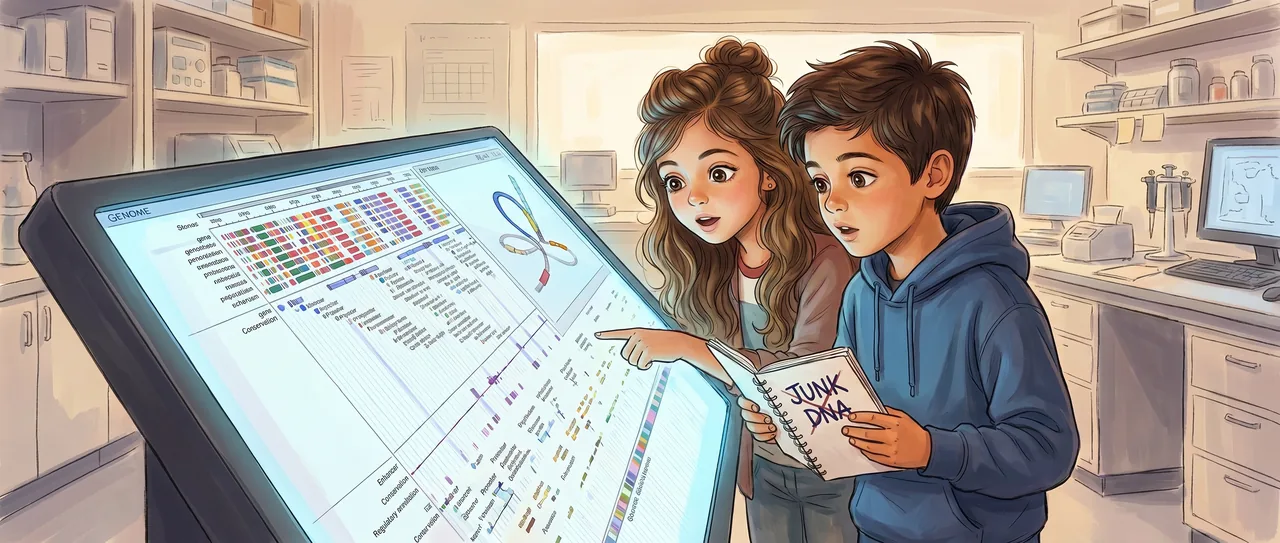
Soren had drawn it in his notebook during the bus ride to the university open lab. Two percent of the circle filled in with blue ink. The rest, the vast remaining slice, left white. He had written JUNK DNA in the white space because that was what the library book said, and Soren trusted books that cited their sources.
Maya looked at it and said, "That's wrong."
"It's not wrong. Two percent of the human genome codes for proteins. The rest doesn't. Three billion base pairs, and only about twenty thousand genes use that two percent to build proteins. I checked twice."
"The numbers aren't wrong. The word is wrong." Maya tapped the white space. "Junk."
"That's literally what scientists called it."
"Called. Past tense."
Soren closed the notebook. Not because he was angry, but because he wanted to be right and sensed he might not be, and he needed to think about that.
The genomics lab was a long room with touchscreens the size of dining tables, tilted at angles so you could lean over them like maps. A postdoc named Raina was supposed to be guiding visitors, but she was locked in a conversation with another researcher about a grant deadline and kept waving vaguely at the screens while saying, "Just explore, it's all interactive, the tutorial button is in the corner."
Maya was already at a screen. She had pulled up something called the UCSC Genome Browser, and it looked like a city seen from a satellite. Colored bars stacked in rows. Dense clusters of annotation in some regions. And then long, long stretches of almost nothing.
"See?" Soren leaned in. "Those colored blocks are genes. Protein-coding regions. And then all of this." He swept his hand across the vast pale gaps. "That's the ninety-eight percent."
"Zoom in on the empty part," Maya said.
Soren touched the screen and spread his fingers. The pale gap expanded. And as it expanded, things appeared. Not genes exactly, but markers. Tiny annotations. Labels he didn't recognize. ENCODE. Enhancer. Promoter. Regulatory element. Conservation tracks showing that this supposedly useless sequence had been preserved across species for millions of years.
"If it were junk," Maya said, "evolution would have thrown it out."
Soren stared at the screen. She was right. That was the thing about natural selection. Useless sequences accumulate mutations freely. They drift. They change. But these sequences were conserved. Nearly identical in humans and mice who last shared a common ancestor around seventy-five million years ago. You don't preserve something for seventy-five million years if it does nothing.
"So what does it do?" he asked.
Maya pulled up another view. This one showed gene expression data from different tissues. The same gene, present in every cell. But it was active in liver cells and silent in brain cells. Active in skin and silent in bone. Same DNA. Same sequence. Completely different behavior.
"Something is telling the gene when to turn on," Soren said slowly.
"And when to turn off. And how loud to be. And in which cells. And at what time during development." Maya scrolled through tissue after tissue. Heart. Kidney. Retina. The same gene, speaking or silent, in every single one. "The two percent is the orchestra. The ninety-eight percent is the conductor."
Soren opened his notebook again and crossed out JUNK DNA. He didn't write anything in its place yet.
Raina appeared behind them, finally free from her grant conversation, and glanced at the screen. "Oh, you found the regulatory landscape. Nice. Most visitors just look at the gene models."
Neither of them said anything for a moment.
"How much of the ninety-eight percent do we actually understand?" Soren asked.
Raina laughed. Not unkindly. The laugh of someone who thinks about this every day and still finds the answer absurd. "Honestly? We're still figuring that out. ENCODE mapped biochemical activity across the whole genome and found that maybe eighty percent shows some kind of function. But what kind of function, and how, and when, and why it matters. We have pieces. We have a lot of pieces. We do not have the picture on the box."
She wandered off to help a family struggling with the tutorial button.
Maya pulled up one more view. A region called a super-enhancer. A cluster of regulatory elements working together, sometimes reaching across thousands and thousands of base pairs to touch a gene that seemed impossibly far away. The DNA looped. It folded in three-dimensional space so that a regulatory element on one chromosome could physically contact a gene that, on the flat screen, looked like it was on the other side of the world.
"It's not even two-dimensional," Maya said quietly. "The genome folds. The parts that look far apart on the screen are actually touching inside the cell."
Soren felt something shift. He had walked in thinking of DNA as a string of code. Two percent useful, ninety-eight percent blank. Like a book that was mostly empty pages. But it wasn't a book. It was a living, folding, three-dimensional machine where the spaces between words were doing more than the words themselves. The silences were instructions. The emptiness was full.
"They called it junk because they didn't know what it did," Maya said. "Not because it didn't do anything."
Soren looked down at the white space in his notebook where he had crossed out the word junk. Still blank. Still waiting for a better word that hadn't been invented.
Maya was already zooming out. The genome browser pulled back and back and back, the regulatory landscape sprawling in every direction, vast and annotated and mostly unexplored. Three billion base pairs. Ninety-eight percent conducting.
Soren closed the notebook and watched the screen, the enormous white spaces between genes filling with structure nobody had decoded yet.
Read the interactive version, listen to the narration, and earn a gold star →
A science-verified short story for curious kids · Curiosity Land