The Floor of Everything
Maya's mother drove too fast on mountain roads.
This was not an opinion. It was a fact confirmed by the way the tires sang on every curve, by the white knuckles of Maya's grandmother in the passenger seat, and by the speedometer, which Maya could see from the back if she leaned forward at exactly the right angle.
But Maya was not leaning forward. She was pressed against the window, watching the road cuts.
Every time the highway sliced through a hill, the rock inside was layered. Dark band. Slightly less dark band. Dark band again. Over and over, like a cake made by someone who only had one color of frosting but kept spreading it in separate coats anyway.
"Amma, why is it striped?"
"Hmm?" Her mother was passing a truck.
"The rock. In the cuts. It's layered but it's all the same stuff."
"Basalt," her grandmother said quietly, not turning from the window. "All of it. The whole plateau."
Maya waited for more. Her grandmother was a retired geochemist who usually could not stop talking about rocks. But today she just stared at the landscape like she was reading a letter from someone she used to know.
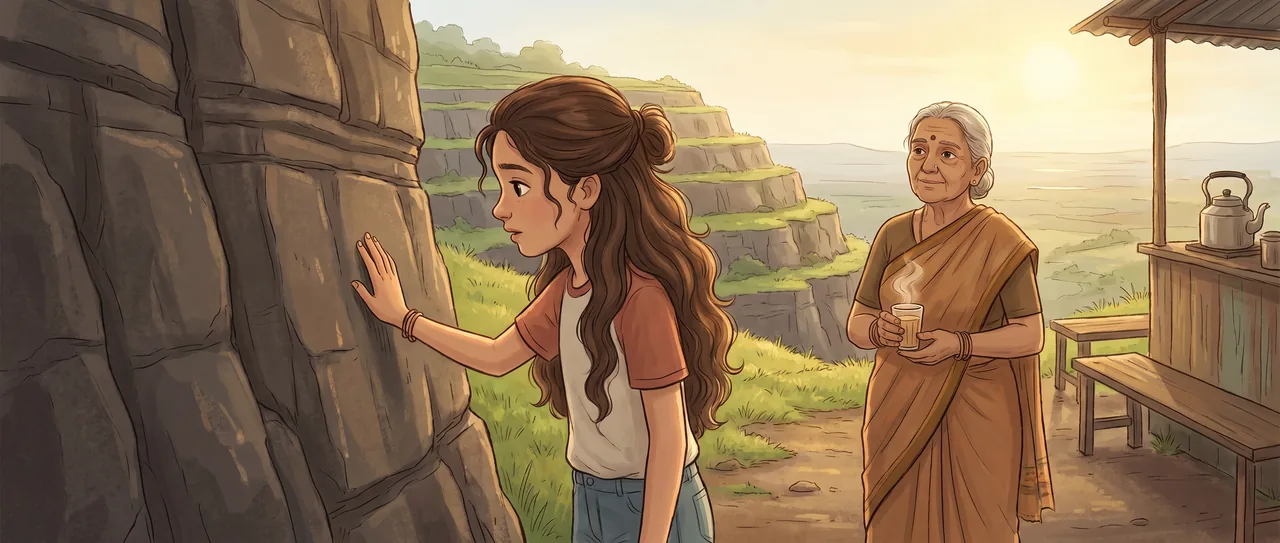
They stopped at a chai stall perched on the edge of what Maya's grandmother called a step. The Western Ghats did not slope. They descended in flat terraces, each one dropping to the next like a giant staircase.
Maya took her chai and walked to the edge. Below her, the next step stretched for kilometers. Flat. Green with monsoon grass. Then it dropped again.
"Each step is one flow," her grandmother said, appearing beside her. She had that quiet voice she used when she was being precise. "Lava came out of the ground. Not from a cone, not from a mountain. From cracks in the earth, some of them hundreds of kilometers long. The lava spread until it cooled. Then, years later, or centuries later, it happened again. A new layer on top."
"How many layers?"
"More than we've counted. The stack is over two kilometers thick in places."
Maya looked at the step beneath her feet. She jumped once, lightly. Solid. This one single layer of rock, stretching to the horizon in every direction, had been liquid once. All of it. At the same time.
That thought did something to her stomach.
"When?"
"It started before the asteroid," her grandmother said. "And it continued after. The eruptions lasted hundreds of thousands of years."
Maya set her chai down on a flat rock that used to be the inside of the earth.
"Wait," she said. "Before the asteroid? Everyone says the asteroid killed the dinosaurs."
"Everyone says a lot of things." Her grandmother sipped her chai. She was not being mysterious. She was being annoyed, the way she got when science was made too simple.
Maya looked out at the steps again. She started counting the visible layers in the nearest road cut. She got to eleven before the shadows made it hard to tell them apart.
Each one was a flow. Each flow released gas. She knew that much from the volcano unit at school. Carbon dioxide. Sulfur dioxide.
"The CO2," Maya said slowly. "From something this big. Over this long."
Her grandmother turned and looked at her. Not the way adults look at children who are performing. The way one person looks at another who has just walked through the same door.
"Yes," she said.
"It would have warmed everything."
"Several degrees. Over hundreds of thousands of years. The oceans warmed. The chemistry of seawater shifted. Species were already stressed before that rock ever fell from the sky."
Maya sat down on the edge of the step. The stone was warm from the afternoon sun, but she was thinking about a different kind of warmth. Warmth that came from below. Warmth that came out in rivers of liquid rock from wounds in the ground that stretched longer than any river she had ever seen on a map.
She thought about what it meant to be a living thing on a planet that was doing this. Not for a day. Not for a year. For longer than her species had existed.
"So the dinosaurs were already in trouble," she said.
"Some of them. Some ecosystems. The picture is complicated and we are still arguing about it. That is the honest answer."
"But people just talk about the asteroid."
"The asteroid is a single event. A single moment. People love single moments." Her grandmother finished her chai. "The Deccan eruptions are harder to love. They are slow. They overlap with other things. They do not make a clean story. But they were here. Two kilometers of proof that they were here, and we are standing on it."
Maya pressed her palm flat against the basalt. Sixty six million years ago, give or take, the ground beneath western India had opened and poured itself out across an area half the size of the country. Layer after layer, century after century, while the atmosphere filled and the ocean warmed and the whole living system of the planet bent under a pressure that had no single morning, no single headline, no moment you could point to and say: this is when it started.
And then, somewhere in the middle of all that, a rock ten kilometers wide hit the Gulf of Mexico.
Both things were true. Both things were enormous. And the world had decided to remember only the loud one.
Maya stood up. She walked to the road cut and put her hand on the lowest layer she could reach, then moved it up, layer by layer. Her fingers bumped over each boundary. Each bump was a silence between eruptions. A pause that might have lasted decades, where things grew and lived and adapted on top of a floor that would become the ceiling of the next catastrophe.
"Paati," she said. "How do they figure out how much CO2 came from all of this? It was sixty six million years ago. The gas is gone."
Her grandmother smiled the way she smiled when someone asked the right question, which was different from her regular smile. It was sharper. It had teeth.
"That," she said, "is a problem I spent eleven years working on. Come. I will show you what the gas left behind in the rock, if your mother will stop at the outcrop near Mahabaleshwar."
She was already walking to the car. Maya followed, but at the edge of the step she paused and looked out one more time.
Read the interactive version, listen to the narration, and earn a gold star →
A science-verified short story for curious kids · Curiosity Land