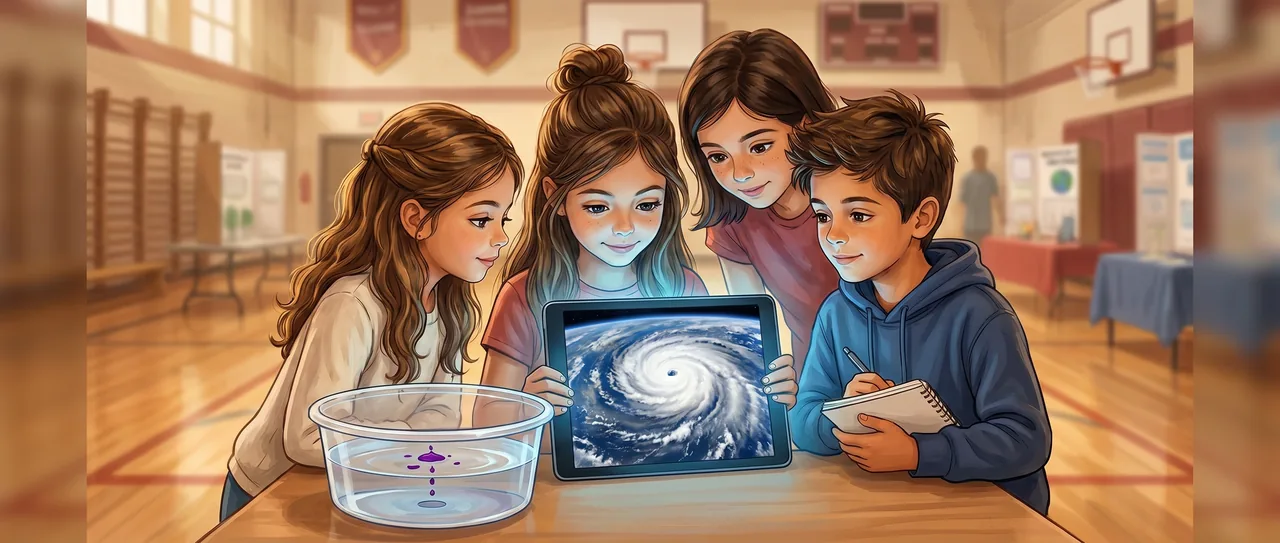
Which Way the World Turns
The argument started at nine in the morning and had not stopped by lunch.
Maya and Soren's demonstration table sat directly across from Team Montevideo's, which meant they had been staring at each other's drain experiments for three hours. The Uruguayan team, two girls named Lucia and Valentina, had a clear basin with a hole in the bottom. So did Maya and Soren. Both teams had food coloring. Both teams had stopwatches. Both teams had identical setups, which was the entire problem.
"Ours goes clockwise," Soren said, for the fourth time, watching the purple dye spiral down their drain.
"Ours goes counterclockwise," Lucia called across the aisle. She said it cheerfully, like someone winning.
"Because you're from the Southern Hemisphere," said Valentina. "The Coriolis effect. Drains spin opposite below the equator."
Soren wrote something in his notebook. Maya noticed he pressed hard with the pencil, which meant he was bothered.
"What," she said.
"I filled it three times before they got here. It went clockwise twice and counterclockwise once."
Maya looked at the basin. The water was gone now, just a thin film of purple dye on the plastic. "You didn't tell me that."
"I thought I set it up wrong. But I was careful each time. Same fill speed. Same wait. And it still went different directions."
Maya's list of things that didn't make sense yet gained an entry. "So ours doesn't always go clockwise."
"No. It doesn't."
She looked across the aisle at Team Montevideo's basin. "Do theirs always go counterclockwise?"
Soren closed his notebook. "That's the right question."
They crossed the aisle together. Mr. Hendricks, who was supposed to be supervising their section, was four tables away talking enthusiastically about someone's potato battery and not paying attention to anything else.
"Can we watch you run it again?" Maya asked.
Lucia shrugged. "Sure." She filled the basin from a pitcher, added three drops of blue dye, and pulled the plug.
Counterclockwise. Valentina pointed at it like evidence.
Soren was watching the surface of the water, not the drain. "You poured from the left side," he said.
"So?"
"Can you pour from the right side?"
Lucia looked at Valentina. Valentina looked at Soren. Then Lucia refilled the basin, this time from the right. Three drops of dye. Plug pulled.
The water spiraled clockwise.
Valentina's face did something complicated. "That's. No. Do it again."
They did it again. And again. Lucia poured from the left: counterclockwise. From the right: clockwise. Straight down the middle, very carefully: it went counterclockwise the first time and clockwise the second, and the third time the dye just sort of slouched sadly toward the drain with barely any spin at all.
"This is wrong," Valentina said. She did not sound cheerful anymore.
Maya sat on the gymnasium floor, which was not something the science fair rules encouraged, and looked up at both basins from below. "It's not wrong. It's just not the Coriolis effect."
"It has to be," Valentina said. "Hurricanes spin counterclockwise in the north and clockwise in the south. That's the Coriolis effect. It works on water."
"It works on big water," Soren said. He had his notebook out again but he wasn't writing yet, just holding the pencil and staring at the basin like it owed him something. "Hurricanes are hundreds of kilometers across. They last for days. The Coriolis effect needs time and distance to show up. This basin is maybe forty centimeters."
Maya looked at him. "How do you know that?"
"I don't know it. But the Coriolis effect comes from the Earth rotating, and the Earth rotates once a day. That's slow. Really, really slow. For something that slow to push water in a curve, the water has to be moving a long distance. In our basin, the water barely moves at all before it's already down the drain. The tiny push from the Earth's rotation can't compete with the push from how Lucia poured it."
"Or the shape of the basin," Maya added, standing up. She had noticed something from below. "Your drain hole isn't perfectly centered. It's maybe two millimeters to the left."
Lucia leaned down and looked. Her eyes widened.
Valentina sat down next to where Maya had been sitting. "So our whole demonstration is wrong."
"No," Maya said. "The Coriolis effect is real. Hurricanes really do spin in opposite directions in different hemispheres. That part is true and huge and actually because the Earth is turning under them while they form. It's just that the bathtub thing, the drain thing, that's too small. The effect is there, technically, but it's so tiny that everything else matters more. A millimeter of offset. Which direction you fill it. Whether someone walked past and made the air move."
"Our demonstration is about something real," Soren said, "but we set it up to show something it can't show."
Valentina looked up from the floor. "Both of us."
"Both of us."
There was a pause. The gymnasium hummed with voices and the clatter of other people's projects. Maya could hear Mr. Hendricks across the room, now excited about magnets.
"So what do we actually demonstrate?" Lucia asked.
Maya smiled. "We demonstrate that. We show them the Coriolis effect is real and we show them the drain thing is a myth. We pour from different directions. We show it doesn't matter which hemisphere you're in. And then we show them satellite footage of actual hurricanes, northern and southern, and they can see the real thing for themselves. The thing that's so big it needs a whole ocean to see it."
"The thing that's so big," Soren said slowly, "that the spinning of the entire planet matters."
Valentina stood up. She brushed off her pants. "I like being wrong about this," she said, in a tone that suggested she was slightly surprised at herself.
"That's because the true version is better," Maya said.
Soren was writing now. He stopped and looked at what he'd written, then turned the notebook so all three of them could read it: a number. The rotation speed of the Earth at the equator. One thousand six hundred seventy kilometers per hour.
Lucia pulled up satellite imagery on her tablet. A hurricane seen from space, counterclockwise, wide as a country, its arms made of clouds being dragged sideways by a planet that would not stop turning beneath them.
All four of them leaned in, and the gymnasium fell away.
Read the interactive version, listen to the narration, and earn a gold star →
A science-verified short story for curious kids · Curiosity Land