The Year Without a Summer
The stalagmite was already cut in half when they arrived.
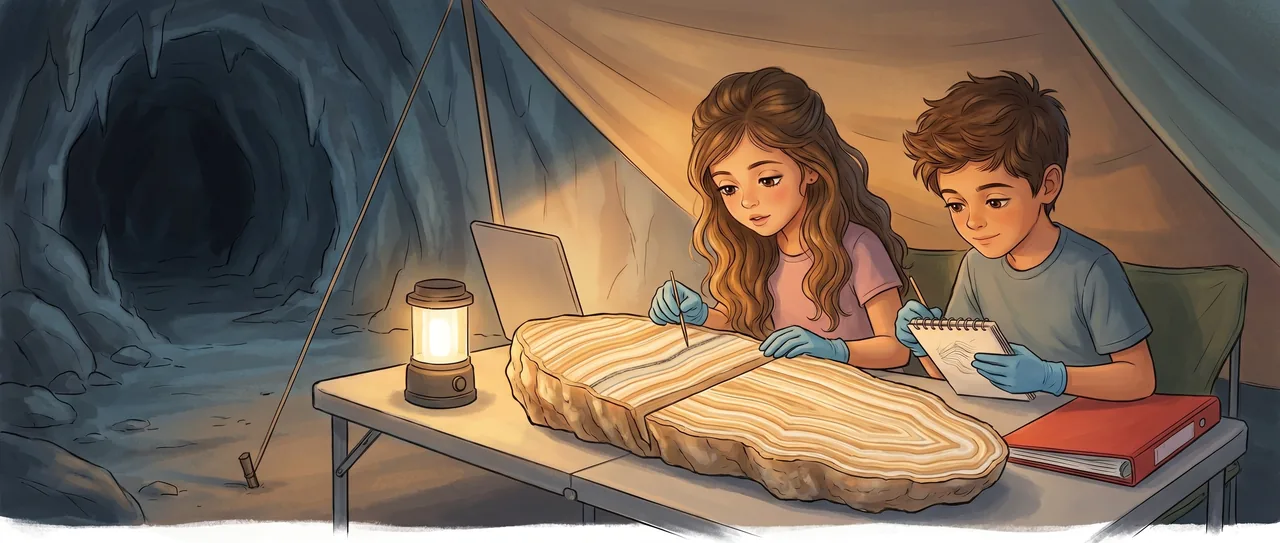
Dr. Ruiz had sawed it lengthwise with a rock saw the day before, and now the two halves lay on a folding table at the mouth of the cave like an opened book. She barely looked up from her laptop when Maya and Soren ducked under the tarp.
"Gloves are in the bin. Don't touch the cut face with bare hands. Oil from your fingers will contaminate the isotope samples." She went back to typing. "I need the layer count from the top sixty centimeters before Thursday or I lose my funding window. The manual is in the red binder."
Then she put in earbuds.
Maya pulled on nitrile gloves and leaned over the cut face. The inside of the stalagmite looked nothing like she expected. She had imagined rough stone. Instead it was gorgeous. Hundreds of fine bands, some pale cream, some amber, some almost translucent, curved in delicate arcs like the rings of a tree but rounder, following the dome shape of the stalagmite's tip.
"Each one of these is a year?" Soren asked. He was already flipping through the red binder.
Dr. Ruiz didn't hear him through her earbuds.
Soren read aloud from the binder, quietly enough that it was mostly for himself. "Calcium carbonate precipitates from dripping water. Each wet season deposits a visible layer. Count layers like tree rings. Thicker layers indicate wetter years."
Maya was already counting. She had her face three inches from the surface, moving a toothpick along the bands. "Some of these are so thin they almost disappear."
"Dry years," Soren said.
"Obviously dry years. But look at this." She pointed to a spot about forty centimeters down from the top. "There's a cluster. Six, maybe seven really thin bands right in a row. And then one that's weirdly dark."
Soren came around to her side. He could see it. A sequence of pale, almost ghostly lines, compressed together, followed by a single band that was noticeably darker than anything around it.
"The dark ones," he said, flipping pages. "The binder says darker coloration can indicate higher organic content in the drip water. More stuff washing into the cave. So that dark band means something big flushed through."
"After years of almost nothing," Maya said.
Soren opened his notebook and started sketching the pattern. He drew the compressed thin lines, then the dark one, then the return to normal thickness below. "What's the growth rate? If we know how far down this is, we can figure out when."
The binder gave an average rate of zero point one millimeters per year for this cave. They measured. The cluster was roughly four hundred and ten millimeters from the top.
"Four thousand one hundred years ago," Soren said. "Give or take."
"Give or take what, though," Maya said. She wasn't really asking him. She was staring at the bands above and below the cluster, comparing. The stalagmite recorded wetter periods with the same mechanical faithfulness as dry ones. It didn't care. It just grew, one drip at a time, and whatever was in the water got locked inside.
She moved her toothpick to a different spot, much closer to the top. Twenty centimeters down. "There's another weird one here. Not thin. Thick. Really thick. But it's got a funny color, almost grey."
Soren measured. "About two thousand millimeters down from... wait. Two hundred millimeters. Two thousand years ago."
"That's not what I'm asking. What makes it grey?"
The binder didn't say.
Maya pulled out one earbud from Dr. Ruiz's ear. The geochemist startled.
"What makes a layer grey?"
Dr. Ruiz blinked at the spot Maya was pointing to. For the first time, she actually looked at the stalagmite instead of her laptop. She leaned in.
"Volcanic aerosols," she said slowly. "Sulfur dioxide dissolves in rainwater, changes the chemistry of the drip water, shifts the crystalline structure. We see it after major eruptions." She stared at the band a moment longer. "I actually hadn't flagged that one yet."
"So the rain two thousand years ago carried volcano stuff into this cave," Soren said. "From how far away?"
"Could be anywhere. Stratospheric aerosols circle the globe. An eruption in Iceland could show up in a cave in Missouri six months later." Dr. Ruiz was typing again, but differently now. Not grant paperwork. She was pulling up a database. "If your date estimate is right, that could correlate with a known eruption. Or it could be one we haven't identified yet."
She trailed off into her screen.
Maya and Soren looked at each other.
"This thing is a tape recorder," Maya said.
"It's better than a tape recorder. It doesn't choose what to record. It just records everything."
Maya ran her gloved finger just above the surface, not touching, tracing the bands from top to bottom. Four thousand years of rain. Of drought. Of volcanic winters and wet springs and whatever else fell from the sky and seeped through limestone and dripped, one drop at a time, onto this slowly rising column in the dark.
"Nobody was here," she said. "Nobody was watching. Nobody set it up. It just did this."
Soren understood what she meant. The cave had been writing its own history in the dark for millennia. Every year, a new line. Every catastrophe, a change in color or thickness. No observer required.
"The binder says some of these go back two hundred thousand years," he said. "In other caves. Longer than our whole species has been writing anything down."
Maya looked at the grey band again. Two thousand years ago, a volcano erupted somewhere on Earth. The ash and gas rose into the stratosphere, circled the planet, dissolved into rain, filtered through Missouri limestone, and left a thin grey mark on a stalagmite that wouldn't be cut open for another two millennia.
And it was still there. Still legible. Still waiting for someone to count down to it and wonder.
From deep inside the cave came the sound that had been there all along, under their conversation, under Dr. Ruiz's typing, under everything. A slow, measured drip striking wet stone.
Soren tilted his head toward the darkness.
"That's this year," he said.
They listened to the next drop fall.
Read the interactive version, listen to the narration, and earn a gold star →
A science-verified short story for curious kids · Curiosity Land