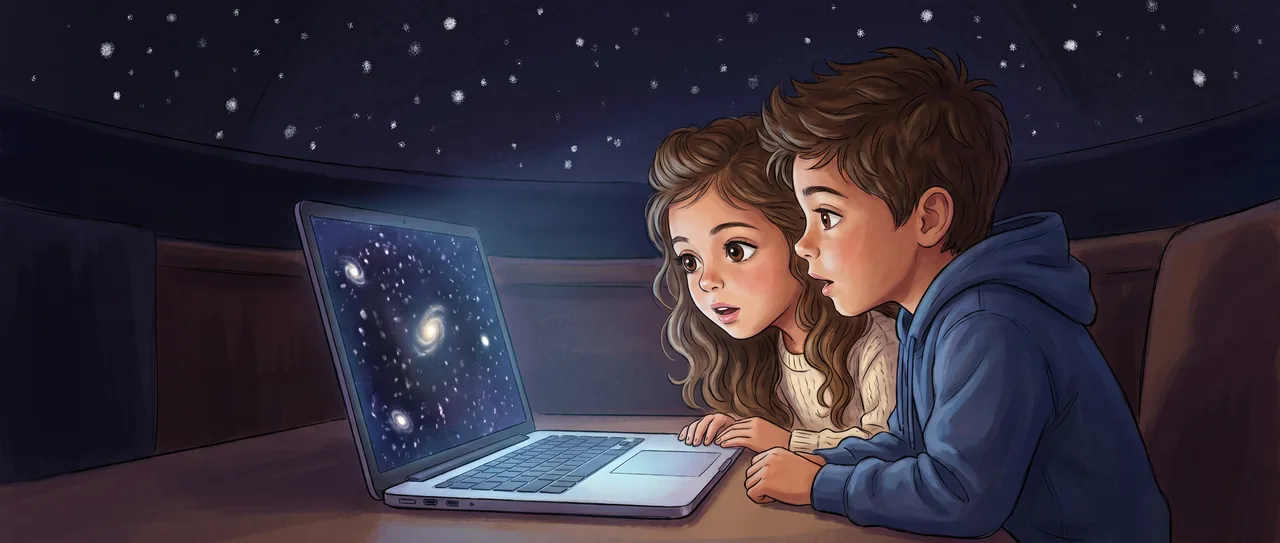
The Ones You Almost Missed
The planetarium projector was broken, which was the best thing that had happened to Soren all week.
Not broken broken. Shifted. The power surge on Tuesday had knocked the calibration off, and now the star field was wrong in ways that most people wouldn't notice but that made Dr. Adebayo furious. She had let Maya and Soren help because they were the only two people who'd shown up for the Saturday volunteer session, and because she needed someone to read numbers off the screen while she crawled behind the projector housing with a wrench.
"Quadrant seven," Dr. Adebayo called from behind the machine, her voice muffled. "Give me the count."
Maya read the number on the calibration laptop. "Fourteen hundred and twelve."
"Should be fourteen hundred and nine. Close enough for government work but not close enough for me. Tell me if it changes."
Something clanked. The dome overhead shifted, stars sliding a fraction of a degree. Soren watched them move and felt, as he always did in here, like the floor had quietly disappeared beneath him.
"Fourteen ten," Maya said.
"Wrong direction. Hang on."
While Dr. Adebayo swore softly at the projector's internal gearing, Soren opened the other program she'd left running on the laptop. It was the image she used for the deep field segment of her Tuesday night public show: the Hubble Deep Field, a tiny patch of sky no bigger than a grain of sand held at arm's length, crammed with galaxies. He'd seen it before. Everyone had seen it before.
But the program had two layers. He clicked between them.
The first layer was the famous image. Spirals and smears of light, maybe a thousand galaxies visible, each one containing billions of stars. The universe's most humbling photograph.
The second layer was the same patch of sky, reprocessed. Mathematically enhanced. It looked almost identical, except where the background had been dark, it was now faintly, impossibly granular. Like someone had taken the darkness and zoomed in far enough to find it was made of sand.
"Maya."
"Fourteen eleven. Still wrong."
"No, come look at this."
She came and looked. He clicked back and forth between the two layers.
"What's different?" she asked.
"That's what I'm trying to figure out. The second one looks grainier."
"It looks noisier. Like a bad photo."
"That's what I thought too. But look." He zoomed in on one corner, a region that in the original image was essentially black. Empty space between the visible galaxies. In the second layer, it wasn't black. It was peppered with tiny, faint smudges. Dozens of them. Hundreds.
Maya leaned closer. "Those aren't noise artifacts. They're too irregular. Noise would be uniform."
Soren had noticed the same thing without being able to name it. The smudges weren't random static. Each one had a slightly different shape, a slightly different brightness. Some were rounder. Some were elongated.
"Dr. Adebayo," he said. "What's the second layer in your deep field file?"
"The Conselice reanalysis. Two thousand sixteen." Another clank. "Why?"
"What did they find?"
"That we'd been wrong. About the number. Read me quadrant seven again."
"Fourteen eleven," Maya said without looking, because she was zooming in on a different corner now.
"Wrong by how much?" Soren asked.
Dr. Adebayo's wrench stopped. "They found we'd been undercounting by a factor of about twenty. Old estimates said a hundred billion galaxies in the observable universe. Maybe two hundred billion. The new analysis said two trillion. Most of them small, faint, far away. Too dim for direct imaging. We could only find them statistically, by analyzing what the background light was actually made of."
Soren sat with that number for a moment.
Maya was already ahead of him. "These smudges. Each one is a galaxy."
"Each resolved one, yes. And the math says there are far more that don't resolve at all. They're there. They affect the total light. But you can't pick them out individually, even with Hubble. They're too small and too far."
"So the darkness between the galaxies," Soren said slowly, "wasn't empty."
"It was never empty. We just couldn't see what was in it."
Dr. Adebayo went back to her wrench. Maya and Soren sat in front of the laptop, the dome overhead full of the projector's imperfect stars, and stared at the image.
Soren zoomed all the way out. The full deep field. A thumbnail of sky, the size of nothing. In the original layer, it held thousands of galaxies. In the reanalysis, the spaces between them dissolved into texture, into a granularity that meant galaxies upon galaxies upon galaxies, too small and faint and far away to see as themselves, but there, adding their light to the total.
"Twenty times," Maya said. "They weren't off by a little. They were off by twenty times."
"For decades."
"All those astronomers looking at the deep field for years, and ninety-five percent of the galaxies in the universe were the ones nobody could see."
Soren thought about that. About how many people had looked at the Hubble Deep Field and felt the right kind of overwhelmed by the thousands of galaxies visible in it. He had. Everyone had. And the whole time, the picture was twenty times more overwhelming than anyone realized, and the proof was right there in the darkness, in what looked like nothing.
The thing that looked like noise was the thing that mattered most.
"Quadrant seven," Dr. Adebayo called.
"Fourteen oh nine," Maya said, finally glancing at the number.
"Perfect. Now quadrant eight."
Soren clicked to the second layer one more time. All those faint smudges. All those almost-missed galaxies. Not the bright spirals that made the posters. The dim, small, ancient ones that everyone had mistaken for background noise, for the graininess of the camera, for nothing. Twenty times more numerous than the ones you could easily see.
He thought about the kind of person who would look at an image everyone else had already celebrated and think, wait. That darkness is too bright. Something is in it that we haven't counted.
"Soren," Maya said quietly. "Two trillion."
She said it the way you'd say it if someone handed you a box you thought was empty and you opened it and it was so full the contents spilled across the floor and under the furniture and you realized you'd need a bigger room, and then a bigger room after that.
Above them, the projector clicked. The dome filled with recalibrated stars, sharp and precise, Dr. Adebayo's fourteen hundred and nine points of light exactly where they should be.
Maya reached over and turned the projector off.
In the sudden, total darkness of the dome, they both looked up, and the dark looked different now.
Read the interactive version, listen to the narration, and earn a gold star →
A science-verified short story for curious kids · Curiosity Land