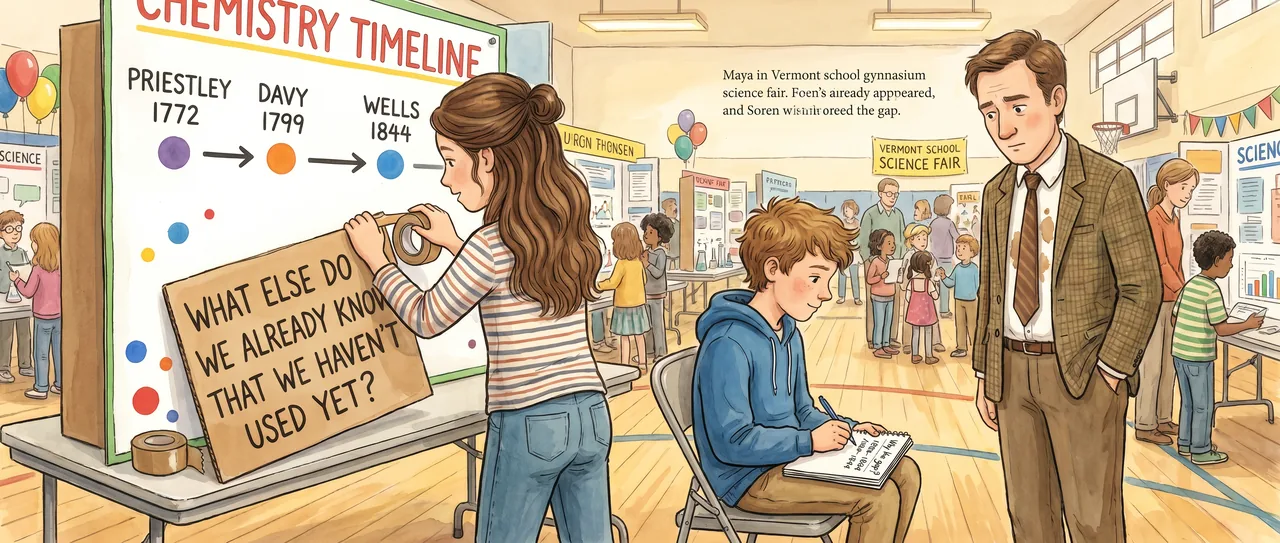
The Forty-Year Gap
The judge had already moved on to the next table when Maya said, "Wait."
He turned back. He was a tall man with a coffee stain on his lanyard and the expression of someone who had been smiling for four hours straight. "Yes?"
"You said our timeline was inaccurate."
"The dates don't add up," he said, tapping the poster board. "You have nitrous oxide discovered in 1772. Then you have it used as an anesthetic in 1844. That's a seventy-two-year gap."
"It's correct," Soren said.
"Seventy-two years between discovering something and using it? That's not how science works, kids. Someone discovers something useful, and within a few years it gets applied. You probably mean 1840 for the discovery, not 1772. Joseph Priestley wasn't even doing gas work that early." He paused. "Well. Look it up and fix it for regionals, okay? The rest of the project is solid."
He walked away.
Maya stared at the poster. Soren stared at Maya.
"He's wrong," Maya said.
"He is wrong," Soren said. "I checked it four times. Priestley synthesized it in 1772. Humphry Davy wrote about its anesthetic properties in 1800. Horace Wells didn't use it in surgery until 1844."
"That's the part that's strange, though," Maya said. "Not the seventy-two years. The forty-four."
"What do you mean?"
"Davy knew. In 1800, Humphry Davy actually wrote that nitrous oxide could probably be used in surgical operations. He published it. He told people."
Soren flipped open his notebook to the page where he had copied out the Davy quote. He read it aloud, quietly, under the noise of the science fair. "As nitrous oxide appears capable of destroying physical pain, it may probably be used with advantage during surgical operations."
"1800," Maya said. "He said that in 1800. And then nobody did it for forty-four years."
Soren put the notebook down. "That doesn't make sense."
"People were having their legs amputated while they were awake. They were biting down on leather straps. And someone had already written down the answer."
"So what were they doing with it instead?"
Maya pulled out her phone and scrolled to the research she had bookmarked weeks ago. "Parties."
"What?"
"Laughing gas parties. The British aristocracy held them. You'd inhale the gas from a silk bag and stumble around and laugh. They were fashionable. Davy himself hosted them. Poets came. Samuel Taylor Coleridge came."
Soren sat down on the metal folding chair behind their table. He looked at the ceiling of the gymnasium, and Maya knew that look. He was not upset. He was calculating.
"So a man discovered that a gas could stop pain," Soren said slowly. "He wrote it down in a published book. And then for forty years, the gas was used at parties. While people screamed through surgery."
"Forty-four years."
"Why?"
Maya sat down next to him. "That's what I keep asking."
A kid from the next table leaned over. "Did you guys get disqualified?"
"No," Maya said. "We got something better."
The kid looked confused and went back to his volcano.
Soren was writing. Not for the project. For himself. He listed the dates in a column. 1772, discovery. 1800, Davy publishes the idea. 1844, Wells finally uses it. Below the dates he wrote: Why the gap?
"It wasn't a technology problem," he said. "The gas already existed. It wasn't hard to make. You heat ammonium nitrate."
"It wasn't a knowledge problem," Maya said. "Davy literally published the answer."
"So what kind of problem was it?"
Maya had been turning this over for two weeks, since she first found the Davy quote and felt something tilt inside her, the way a shelf tilts when you put one too many books on it. She had not been able to name the feeling until right now.
"It was an imagination problem," she said. "Everyone who saw the gas saw a toy. Something fun. Something silly. Davy saw what it could actually do, but even he didn't push it. He went back to other chemistry. And everyone around him just kept throwing parties."
"For forty-four years."
"Because the idea was right there in a book, and nobody picked it up."
Soren stopped writing. He looked at Maya. "How many other things are like that right now?"
The gymnasium was loud. Three tables away, someone's vinegar-and-baking-soda rocket went off early and a parent yelped. The coffee-stain judge was marking something on his clipboard.
"That's the real question," Maya said. "Not why it took so long. But what's sitting in front of us right now that we're using wrong. Or not using at all."
"Something someone has already published."
"Something someone has already written down."
Soren looked at their poster board. Their neat timeline with its colorful dots and labeled arrows. The judge had called it inaccurate because the truth was too strange. A gap that wide between knowing and doing seemed like a mistake.
But it was real. Forty-four years of laughing while the answer sat in a book.
"We're not changing the poster," Soren said.
"No," Maya agreed. "But we're adding something."
She pulled a blank sheet of paper from their supply box and wrote across it in thick marker: WHAT ELSE DO WE ALREADY KNOW THAT WE HAVEN'T USED YET?
She taped it below the timeline.
The judge came back around four o'clock, saw the new sign, and stood in front of it for a long time. He did not say anything about the dates. He did not say anything at all.
When the fair ended, Soren carefully removed the poster from the board. Maya left the question taped to the table.
The janitor found it that evening, read it once, read it again, and left it where it was.
Read the interactive version, listen to the narration, and earn a gold star →
A science-verified short story for curious kids · Curiosity Land