The Catching Game
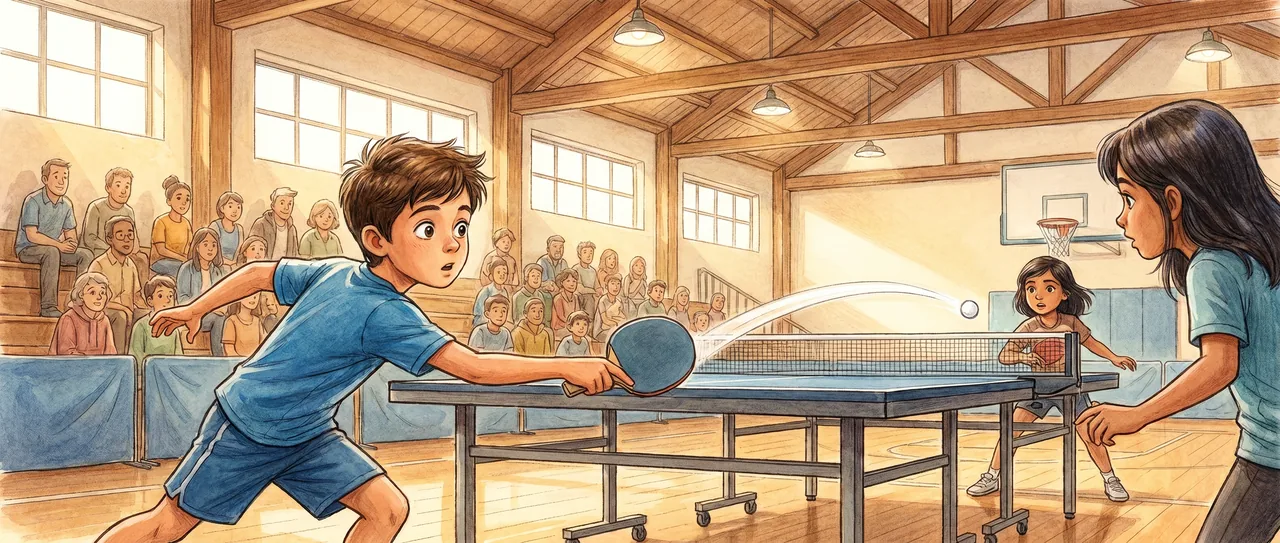
Soren lost eleven points in a row.
Not gradually. Not in some slow decline where he could feel the problem building. Eleven straight points, bang bang bang, and each time the ball hit the table on his side and bounced past his paddle like he was standing in a different room.
His opponent, a girl named Diya from the next town over, was not even trying hard. She was just placing the ball where he wasn't.
"You're thinking too much," said Mr. Farooq from the sideline. Mr. Farooq ran the Saturday tournament. He said this to everyone. He said it to people who were winning. It was his one piece of advice, and he delivered it while eating sunflower seeds and checking his phone.
Soren switched his paddle to his left hand, then back. He bounced on his toes. He tried to not think, which, he was pretty sure, was itself a thought.
Diya served. His arm moved. The ball came back over the net.
He blinked. He hadn't decided to swing. His arm had just gone.
Diya returned it to his backhand. His body rotated and his paddle was there, angled, and the ball clipped the edge of the table on her side. Point.
"See?" said Mr. Farooq, not looking up.
But Soren had not done anything. That was the problem. Or the not-problem. He stood there holding his paddle and tried to reconstruct what had just happened. The ball had come toward him at maybe, what, thirty miles per hour? The whole rally had taken less than two seconds. There was no time in there for him to have decided anything.
So who decided?
Diya bounced the ball twice and served again. This time Soren watched himself play. He was aware of his feet adjusting before the ball even crossed the net, his weight shifting to the left, his paddle coming up at an angle he had not calculated. The return was good. Diya hit it back, and again his arm moved, and again the ball went where it needed to go.
Four-shot rally. Maybe one and a half seconds total. He had been inside it but not steering it.
He won that point too.
"Okay, now we're playing," Diya said.
Soren picked up the ball and held it. A ping pong ball weighed almost nothing. It moved fast. Between the moment Diya's paddle made contact and the moment his paddle had to make contact, there was maybe four tenths of a second. He had read once that conscious decisions took at least half a second to form. So the math was wrong. There literally was not enough time for his conscious mind to decide what to do.
But something was deciding.
He served. This time he paid attention not to the ball but to himself. There was a feeling, like a current running underneath his thoughts. His thoughts were up here, slow and wordy, narrating things after they happened. Hey, the ball went left. Hey, my arm moved. But under that narration, something was already three steps ahead, already reading Diya's shoulder angle, already adjusting his grip.
He lost the next point because he was paying attention to the underneath instead of letting it work.
"You're thinking again," said Mr. Farooq.
Soren almost laughed, because Mr. Farooq was accidentally right. Conscious thinking was getting in the way of the other thinking. The fast thinking. The kind that could process a spinning white ball, the sound of the bounce, the angle of the paddle, the position of Diya's feet, all in a fraction of a second, all without asking permission.
He served again. Let the underneath play.
Three points in a row.
During the break between games, Soren sat on the bench and opened his notebook. Not to write about table tennis. To write a number. He had read it somewhere and not thought much about it, but now it sat in his head like a stone in a shoe.
Seventy thousand.
That was roughly how many thoughts a human brain generated in a day. Not the ones you heard. Not the slow, clumsy sentences that scrolled across the front of your mind like subtitles. Seventy thousand total, most of them happening in the dark. Processing. Deciding. Adjusting. The conscious part, the part that felt like you, was a thin bright line on the surface of something enormous.
He looked at his hand. Right now, without him doing anything deliberate, that hand was maintaining grip pressure on a pencil, compensating for tiny muscle tremors, sensing the texture of the paper, keeping his fingers from pressing too hard. All of that was happening in the dark, below his awareness, and it was working perfectly.
The you that you think you are, he wrote, is not the whole you. It is not even the biggest part.
Diya sat down on the other end of the bench, drinking water. "You got better in the middle there. What changed?"
"I stopped trying to steer," Soren said.
"Steer what?"
He hesitated. "My arm knows how to hit the ball. My eyes know where the ball is going. The thing I think of as me, the part that says words in my head, it's too slow. All it can do is get in the way or get out of the way."
Diya looked at her own hand, opening and closing it. "That's kind of creepy."
"I don't think it's creepy," Soren said. "I think it means I'm bigger than I thought."
She looked at him sideways.
He tried again.
"So we're all walking around being geniuses and we don't know it," Diya said.
"Something like that."
Mr. Farooq called game two. Soren stood, picked up his paddle. His fingers found the grip without instruction, settling into position like a key into a lock.
Diya served. The ball came fast, curving slightly.
Soren's body was already moving.
Read the interactive version, listen to the narration, and earn a gold star →
A science-verified short story for curious kids · Curiosity Land