Everything Else
The robot had been stuck for eleven minutes.
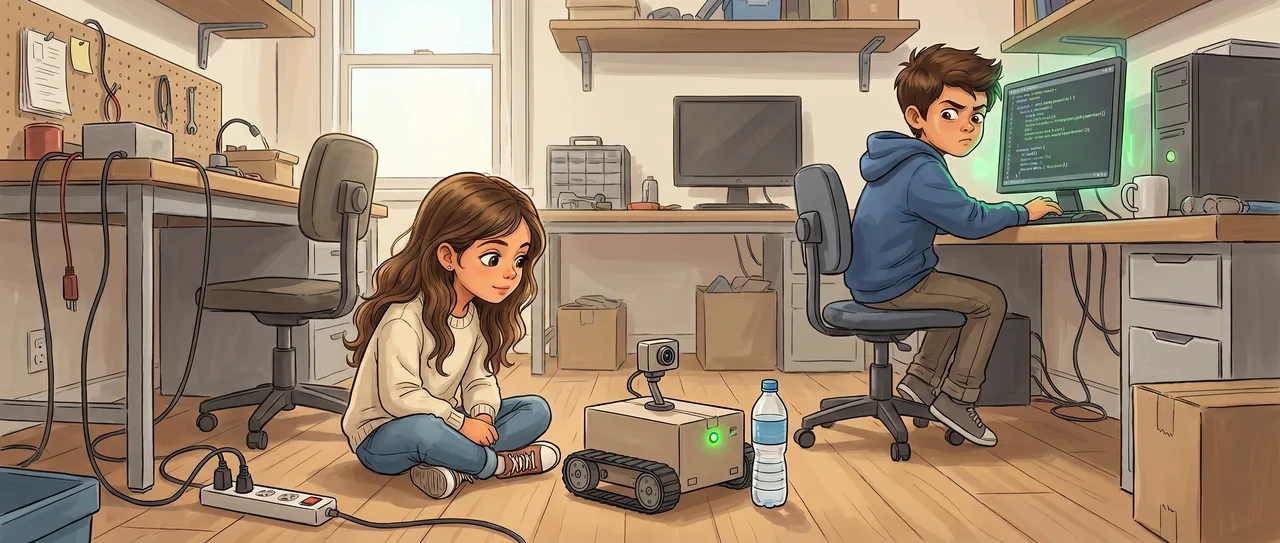
It was about the size of a shoebox, with soft rubber treads and a camera on a little stalk, and it sat in the middle of the lab floor doing absolutely nothing. Its status light blinked green, which meant it was thinking.
Dr. Adeyemi had stepped out to take a phone call nine minutes ago. She had said, "Just watch it. Write down what it does." Then she had laughed a little and added, "If it does anything."
Maya sat cross-legged on the floor three feet from the robot. Soren sat at the workstation, where the robot's decision log scrolled in real time.
"It's recalculating," Soren said.
"Still?"
"Every single time. Watch." He pointed at the screen. "I moved that cup two minutes ago. Just slid it three inches to the left. And now it's re-evaluating everything in the room."
Maya looked at the cup on the table, then at the robot, then back at Soren. "Everything everything?"
"The chair. The door. The power strip. My shoes. Your shoes. The table legs. Everything." He scrolled up. The log was enormous. "It saw me move the cup, and now it's trying to figure out what else changed."
"But nothing else changed."
"Right. But it doesn't know that."
Maya stared at the little robot. Its camera turned slowly, scanning the room. Checking the chair. Checking the door. Checking the power strip.
"That's ridiculous," she said.
Soren was reading the log carefully now. "Okay. So here's what I think is happening. It has a model of the room, right? A list of where everything is and what state everything is in. And when something changes, like the cup moving, it knows the cup moved. But it doesn't have a way to know that only the cup moved."
"So it checks everything."
"It checks everything. Every single object. Every single property. Did the door close? Is the chair still a chair? Are my shoes still on the floor?" He paused. "Maya, it literally re-verified that the floor was still there."
Maya laughed. Then she stopped laughing. She looked at the decision log scrolling on the screen and something shifted behind her eyes.
"Wait," she said. "Wait. We do that too."
"No we don't."
"We do, though. When you moved the cup, I didn't check whether the floor was still there. But I could have. The information was available. I just didn't bother."
Soren opened his mouth and then closed it.
"So the question isn't why the robot checks everything," Maya said slowly. "The question is why we don't."
Soren pulled his notebook out. Not because anyone told him to. Because the inside of his head had just become too small.
"Okay," he said. "Okay. So. When you moved the cup. Actually, when I moved the cup. I knew the door didn't move. How did I know that?"
"Because doors don't move when you move cups."
"But how do I know that? Like, formally. If I had to write it as a rule."
Maya was quiet for a second. "You'd write: moving a cup does not affect the position of the door."
"Right. But there are maybe a hundred objects in this room. So I'd need a rule for every pair. Moving the cup doesn't move the chair. Moving the cup doesn't move my shoes. Moving the cup doesn't change the color of the wall."
"That's thousands of rules."
"And that's just for moving the cup. What about opening the door? What about turning on the light?"
Maya pressed her palms flat against the floor, as if she needed to feel something solid. "It's infinite," she said. "The number of things that don't change is always way bigger than the number of things that do. And we just know. We just skip all of it."
"But the robot can't skip what it can't justify skipping."
They both looked at the little robot. It had finished its scan. Its treads engaged. It rolled forward four inches. Then it stopped.
Soren checked the log. "I breathed," he said. "My chest moved. It detected the change and now it's checking everything again."
The robot's camera panned across the room. The chair. The door. The power strip. The floor.
"This is the problem," Maya said. "This is the actual problem. Not making it smarter. Making it know what to ignore."
Soren was writing. "For us, the world is mostly stable and a few things change. For the robot, every change makes the whole world uncertain."
"It must be terrifying," Maya said. Then she caught herself. "I mean. If it could feel anything. Imagine if every time someone moved a cup, you had to verify that gravity still worked."
Soren put his pen down. "We walk around all day with this massive assumption that almost everything stays the same, and it's so obvious to us that we never even notice we're making it. And nobody knows how to give that to a machine."
"Nobody?"
"It's been decades, Maya. Dr. Adeyemi told me last week. Philosophers, computer scientists, AI researchers. They call it the frame problem. How do you formally specify what doesn't change? Everyone's been working on it since the nineteen sixties."
Maya looked at the robot again. It had finished its latest scan and was rolling forward, one cautious inch at a time.
"You know what's weird?" she said. "The thing that makes us smart isn't what we figure out. It's what we never bother to figure out. All the stuff we just leave alone."
Soren looked up from his notebook. "That's the most unsettling thing anyone has ever said to me."
"You're welcome."
Dr. Adeyemi came back in, phone still in hand. "Any progress?"
"It moved about a foot," Soren said.
"A foot! That's actually good." She looked pleased. She didn't ask what they'd been talking about. She was already pulling up a new parameter file on her laptop.
Maya reached out and set her water bottle on the floor in the robot's path. Not to be mean. She just wanted to see.
The robot stopped. The camera tilted. The status light blinked green.
And then it began, again, to check everything in the room, one object at a time, while Maya and Soren sat perfectly still in a world that they knew, without knowing how they knew, had barely changed at all.
Read the interactive version, listen to the narration, and earn a gold star →
A science-verified short story for curious kids · Curiosity Land