The Vending Machine War
The vending machine only worked for seven minutes.
Something about the timer on the cafeteria's electrical panel. Between fourth and fifth period, the old machine in the corner hummed to life, accepted coins, and dispensed exactly what you wanted. The rest of the day it sat dark and warm, a metal cabinet full of inaccessible granola bars.
Two tables had claims on those seven minutes. Maya's table, closest to the east door. And the table by the windows, run by a kid named Deshi who moved like he was always late for something more important.
The problem was physics. The hallway leading to the cafeteria had one door. If both tables rushed it at the bell, everyone jammed together, elbows and backpacks, and by the time anyone reached the machine, three of the seven minutes were gone. Maybe four people total got to buy something.
But if only one table rushed while the other waited, the rushing table could get six people through. The waiting table got one, maybe two, in the remaining time.
Soren had been tracking this in his notebook for nine days.
"Look," he said, sliding it across to Maya on day ten. Columns of numbers, tallied neatly. Days when both tables rushed. Days when one held back. Days when both held back, which had happened exactly once, on a Thursday, and somehow nine people had gotten vending machine food.
"That Thursday," Maya said. She tapped it.
"Both tables walked. Nobody jammed the door. Nine people ate."
"So why don't we just always do that?"
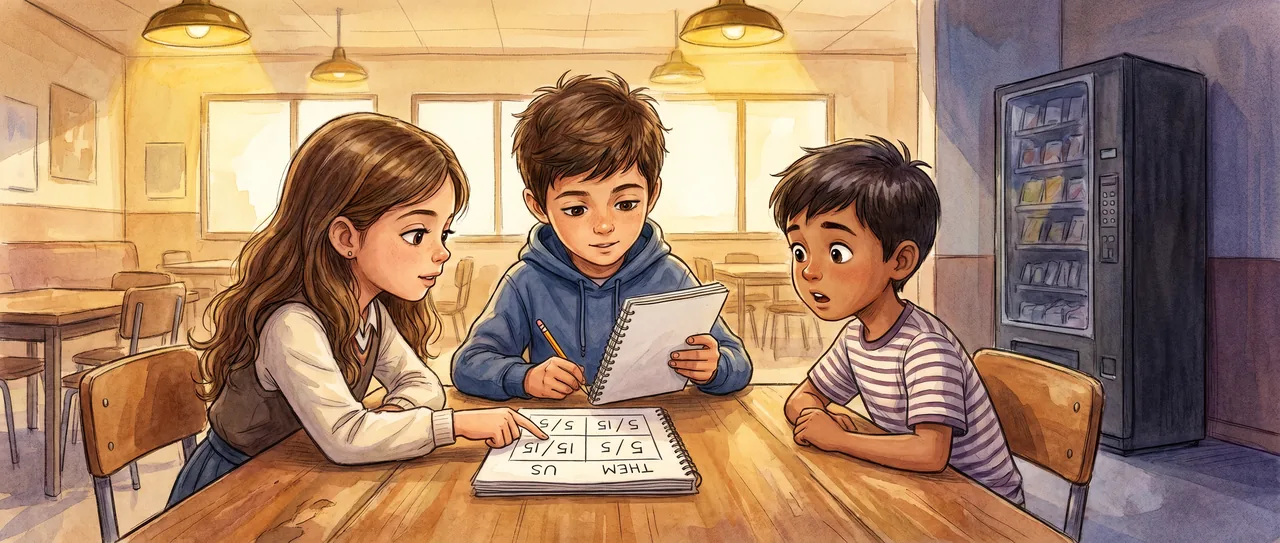
Soren turned to a new page. He'd drawn a square divided into four boxes. Along the top he'd written US, and along the side, THEM. Each box held two numbers.
"If we both rush, we each get about two people through. If we walk and they rush, they get six and we get maybe one. If we rush and they walk, we get six and they get one. If we both walk, we each get four or five."
Maya stared at it. "We should both walk. Obviously."
"Obviously. Except look at it from their side. Whatever we do, they get more people through if they rush. If we walk, they get six instead of five by rushing. If we rush, they get two instead of one by rushing."
"Same for us," Maya said slowly.
"Same for us. Rushing is always better for you no matter what the other side does. So everyone rushes. And everyone gets two instead of five."
Maya pulled the notebook closer. She didn't say anything for almost a minute. Soren waited. He'd learned that when Maya went quiet like this, something was rearranging itself behind her eyes.
"This is broken," she said.
"It's not broken. It's a real pattern. There's a name for it, probably."
"No, I mean it's broken because we don't do this once. We do this every single day."
Soren looked at his own chart. Nine days of data. The same game, repeating.
"That changes things," he said.
"That changes everything," Maya said. "If we rush today, what do they do tomorrow?"
Soren thought about it honestly. "Rush. They'd be angry."
"And if we walk?"
"Depends. If they rush and get away with it, they rush again. Why wouldn't they?"
Maya drummed her fingers on the table. "So we walk first. If they walk too, we keep walking. If they rush, we rush the next day."
"Just copy them," Soren said. "One day behind."
"Just copy them."
"That's it? That's your whole plan?"
"Start nice. Then be a mirror."
Soren wrote it down, not because he'd forget, but because it seemed like the kind of thing that should be written down. It was too simple. He didn't trust it.
Day eleven. Maya's table walked. Deshi's table rushed. Six of Deshi's people got food. Maya's table got one. Anika, who sat with Maya, was furious.
"We just let them win," Anika said.
"Today," Maya said.
Day twelve. Maya's table rushed. They had to. That was the rule, mirror what the other side did last. Both tables jammed the hallway. Two people from each side got through. Deshi looked annoyed.
Day thirteen. Maya's table rushed again, because Deshi's had rushed on day twelve. Same result. Loud and pointless.
Day fourteen. Deshi's table walked.
Soren almost missed it. He was counting heads in the doorway and suddenly there was no jam. Maya's table was rushing alone. Six of their people got through. One of Deshi's.
Day fifteen. Maya's table walked. Because Deshi had walked yesterday.
Deshi's table walked too.
Nine people got vending machine food. The hallway was quiet. It felt like a Thursday.
Day sixteen. Both walked. Day seventeen. Both walked.
Soren filled in his chart. The numbers were lopsided for the first few days, messy, unfair. Then they leveled out. Then they rose. Both sides were getting more food than they'd ever gotten in the rushing days.
On day nineteen, Deshi sat down across from Maya and Soren without asking.
"You're copying me," he said. Not angry. Curious.
"One day behind," Maya said.
"Why does that work?"
Soren opened his notebook to the four-box grid. Deshi looked at it for a long time. He was a quick reader. Soren could tell because his eyes moved to the right places.
"If you always cooperate, I can take advantage of you every day," Deshi said. "If you always rush, we're stuck fighting. But because you copy me, the only way I get good results tomorrow is if I cooperate today."
"You're playing against your own last move," Maya said.
"That's weird."
"That's the point."
Deshi sat back. He looked at the vending machine, dark and quiet in its corner, waiting for tomorrow's seven minutes.
"Nobody told us to cooperate," he said. "There's no rule that says be nice. It just, it came out of the math."
Soren felt something shift in the room, or maybe in himself. That this wasn't about vending machines. That two players locked in a game with no referee and no rules and every reason to be selfish could find their way to cooperation, not because they were good but because the game repeated, and the repetition changed everything.
"It came out of the math," Soren agreed.
Deshi pulled over a chair and sat down properly, and the three of them stared at the four boxes like a map to somewhere none of them had been.
Read the interactive version, listen to the narration, and earn a gold star →
A science-verified short story for curious kids · Curiosity Land