The Garden That Grew Backward
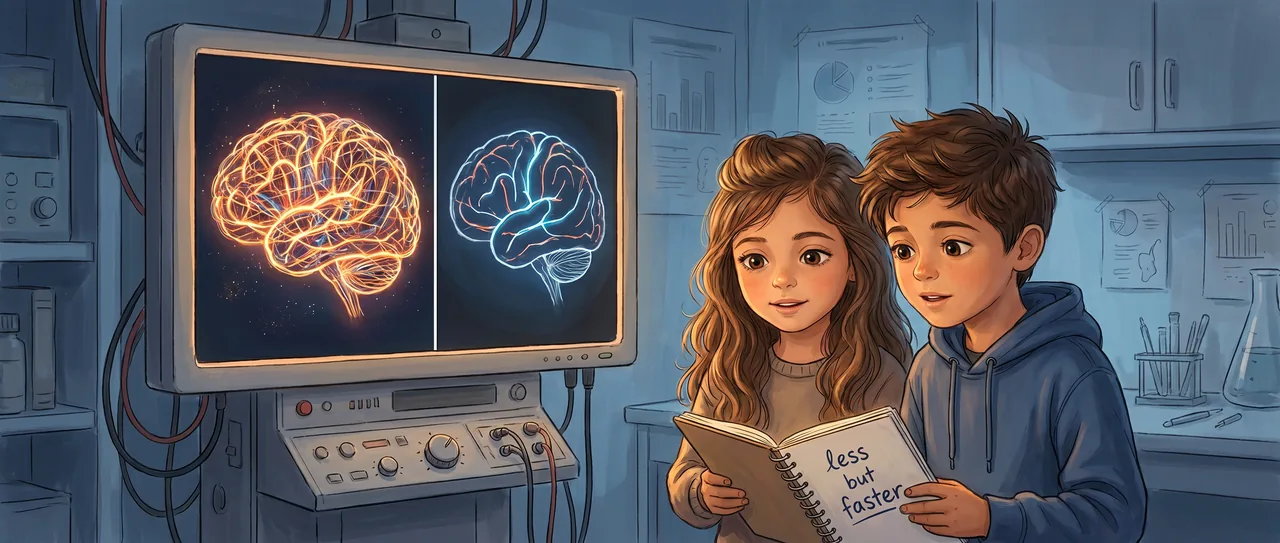
The image on the screen looked like a city seen from space at night. Bright threads everywhere, tangled and overlapping, a web so dense it seemed to glow.
"That," said Dr. Achebe, barely glancing up from the laptop she was troubleshooting at the next station, "is a two-year-old's brain."
Maya leaned closer. The image was beautiful. It was also, she thought, a mess.
Soren was already looking at the second image pinned beside it. This brain belonged to a seventeen-year-old. Fewer connections. Much fewer. But the ones remaining were bright and clean, like highways instead of tangled yarn.
"Wait," Soren said. He looked at the first image, then the second. "The younger brain has more."
"Way more," Maya said.
"So why does the seventeen-year-old think better?"
Dr. Achebe was now fully occupied with a cable that refused to connect, muttering at it in a way that suggested the cable was losing the argument. She didn't seem to hear.
Maya stared at the two images side by side. More connections. Worse thinking. Fewer connections. Better thinking. That was wrong. That was backward.
Unless losing things was the point.
Soren pulled out his notebook and sketched both images quickly. Under the toddler brain he wrote: everything everywhere. Under the teenager brain he wrote: less but faster.
"It's like," he said slowly, committing to the idea before he was sure of it, "a path through a forest. If you walk the same one every day, it gets wider. But if there are a thousand paths and you never use most of them, they disappear."
"You don't build your brain by adding," Maya said. "You build it by subtracting."
They both went quiet.
The community lab had eight stations, each with a different brain activity. Most of the other kids had moved on to the station where you could see your own hand's electrical signals on an oscilloscope. That one had a line. This station, with its two printed images and one distracted scientist, had Maya and Soren.
"Dr. Achebe," Maya said. "How many connections does the two-year-old have?"
"Hmm?" Dr. Achebe looked up, pushed her glasses straight. "Oh. Roughly twice as many synapses as you have right now. About a quadrillion at peak. You've been losing them since you were about two."
"A quadrillion," Soren repeated.
"Give or take. Your brain's been pruning ever since. Keeps the circuits you use. Dissolves the ones you don't. It won't really finish until you're around twenty." She turned back to her cable. "Possibly twenty-five. We argue about it."
Maya's running list of things that didn't make sense gained a new entry. She looked at Soren and saw him adding something to his notebook.
He'd written: we are LOSING connections RIGHT NOW.
Then, underneath: which ones?
"That's the thing, isn't it," Maya said, reading over his shoulder. Not a question. More like something settling into place.
Because if your brain kept the paths you walked and pruned the ones you didn't, then everything she spent her time doing was literally building her. And everything she never tried was a road dissolving behind her, one she'd never even seen.
"Soren. What if there's a connection you'd need for something you've never encountered yet? Something you can't even imagine. But it gets pruned because you never had the chance to use it."
Soren's pencil stopped. "Then you'd never know it was gone."
"You wouldn't even know what you'd lost. You can't miss a thought you've never had."
The lab hummed around them. Kids laughed at the oscilloscope station. Someone's little brother knocked over a model of a neuron. The world was loud and ordinary and completely untouched by what Maya had just said.
Soren closed his notebook, then opened it again. He crossed out which ones and wrote: what am I becoming.
Not scared. Just honest.
"It means everything matters," he said. "Every weird thing you pay attention to. Every question you follow. It's not just learning. It's deciding what kind of brain you end up with."
Maya thought about every hour she'd spent watching how water moved in gutters. Every evening she'd lost to wondering why the moon looked bigger near the horizon. Every time someone had told her she was wasting time on things that didn't matter.
Those paths were still lit.
She felt something shift, not in her understanding but underneath it. The things she did that nobody else seemed interested in, the patterns she followed, the questions that kept her up. They weren't distractions. They were architecture. She was building the brain that would carry her through the rest of her life, and she was building it out of every single thing she couldn't stop paying attention to.
So was Soren. His notebooks, his careful testing, his need to understand the mechanism before trusting the answer. Those were paths he'd walked so often they'd become highways.
"Dr. Achebe," Soren said. "Does the pruning respond to everything? Not just school stuff. Like, if someone spends a lot of time noticing how things don't quite work right, does that count?"
Dr. Achebe finally won her battle with the cable. The screen beside her flickered to life. She looked at Soren with the expression of someone actually seeing a kid for the first time that afternoon.
"It counts," she said. "It all counts. The brain doesn't distinguish between schoolwork and the things you can't stop thinking about. Use is use. Attention is attention." She paused. "In fact, some of the most robust circuits tend to be the ones driven by genuine interest. The brain is very good at knowing what you actually care about."
She turned to her newly alive screen, already moving on.
Read the interactive version, listen to the narration, and earn a gold star →
A science-verified short story for curious kids · Curiosity Land