The Color That Has No Name
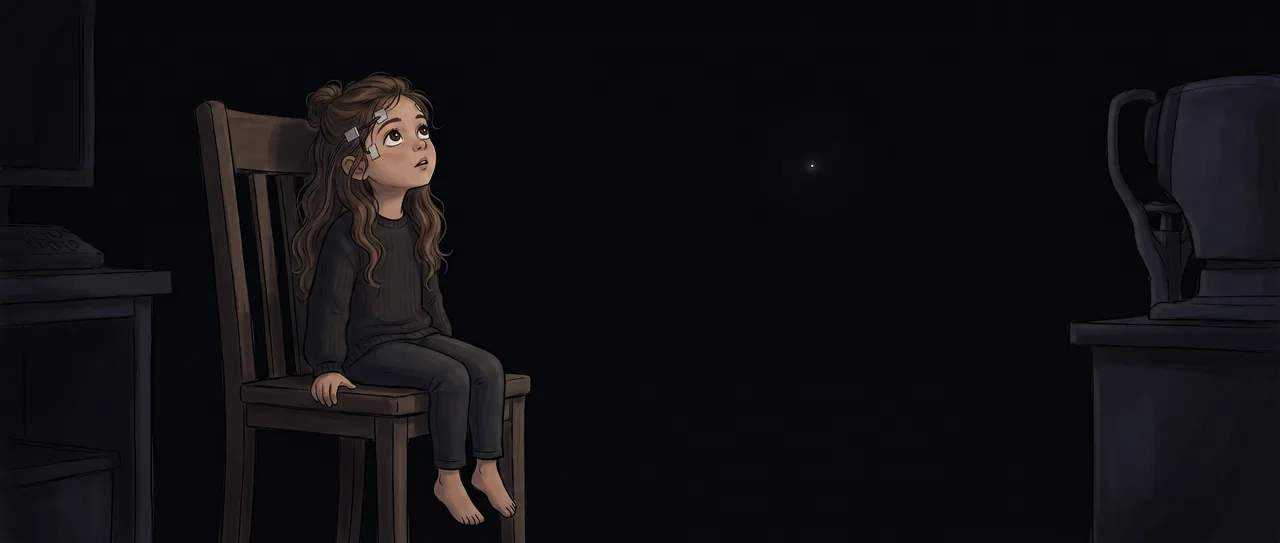
The lab smelled like new carpet and old coffee. Maya sat in a chair that was too tall for her, feet dangling, while Dr. Achebe taped a small sensor to her left temple.
"You understand the experiment?" Dr. Achebe asked, not looking up from the sensor.
"You turn off all the lights. You shoot one photon at a time toward my eye. I say when I see something."
"Close enough." Dr. Achebe finished taping and rolled her chair back to a monitor. "Most adults hate this part. The waiting in the dark."
"I don't mind the dark," Maya said.
"Good. I need to finish calibrating, so it will be about twenty minutes before we start. Just sit tight." Dr. Achebe pulled on headphones, squinted at waveforms on her screen, and became a person in a different room.
Maya sat tight. She was good at that, when there was something to pay attention to.
The lab was part of the university's weekend open house, where kids could sign up for real experiments. Most of the other kids had chosen the robot arm station or the ice cream made with liquid nitrogen. Maya had chosen this: sitting in a dark room, trying to see the smallest possible piece of light.
Dr. Achebe reached over without looking and flipped a switch. The lights went out.
Not dim. Not shadowy. Out. The darkness was so complete that Maya could not see her own hand when she held it in front of her face. She held it there anyway, wiggling her fingers, feeling them move through air she could not see.
After a while, her eyes began doing something strange. Not adjusting, exactly. More like becoming. Like the difference between holding a cup and feeling your hand around the cup. Her eyes had always been open, but now they were open.
"Okay," Dr. Achebe said from somewhere to her left. "Starting sequence one. Tell me when you see a flash. Could be anything. A tiny blip. Even if you're not sure."
Maya stared into the dark.
Nothing. Nothing. Nothing.
Then: something. Not a flash. Not a spark. Something that was barely different from nothing, but was not nothing.
"There," Maya said.
"Good. Again."
Nothing. Nothing. A flicker that she almost talked herself out of.
"There."
They went on like this for a long time. Maya stopped counting. She stopped thinking about the chair or the sensor or the carpet smell. There was just the dark, and these tiny pieces of light that existed right at the boundary between real and imagined.
"How many photons is that?" Maya asked during a pause.
"When the signal reaches your retina, we estimate roughly one photon is being absorbed by a single rod cell," Dr. Achebe said. She sounded different now, more present, like Maya's results had pulled her headphones off. "One quantum of light. The smallest unit of light that exists. And you're seeing it."
Maya sat with that. One photon. The smallest piece of light in the universe, and her eye, just her plain ordinary eye, could catch it.
"Why can we do that?" Maya asked.
"Honestly? We're still working on it. The signal-to-noise ratio should be impossible. Your retina should not be able to distinguish a single photon from its own thermal noise. But it does. Consistently. We've replicated it hundreds of times." Dr. Achebe paused. "You're performing above average, by the way. Your detection rate is about seventy percent."
Maya didn't say anything. She was thinking about the word impossible.
Dr. Achebe turned the lights on, low, and Maya blinked. The lab reassembled itself around her.
"Ready for part two?"
Part two was colors. Dr. Achebe set up a screen that displayed two color patches side by side. Maya's job was to say whether they were the same or different.
At first it was easy. Blue next to green. Red next to orange. But the patches crept closer and closer together. Salmon next to a slightly pinker salmon. Teal next to a teal that leaned one degree toward green.
"Different," Maya said.
"Different," she said again.
Dr. Achebe kept narrowing the gap. The two patches on the screen looked, to anyone walking past, like the same color. Maya could feel the difference between them the way you can feel the difference between a flat note and a true one.
"Different," Maya said, and then stopped. She was looking at a color she had never seen before. Not the left patch, not the right patch. The place where her vision held both of them at once and understood the distance between them. That distance was a color, and she did not have a word for it.
"What would you call that one?" Dr. Achebe asked, pointing to the left patch.
Maya looked at it. "I don't know."
"Nobody does. The human eye can distinguish somewhere around ten million colors. We have words for maybe a few thousand. Maybe less." Dr. Achebe leaned back. "Most of what you can see, you cannot say."
Most of what you can see, you cannot say.
Maya looked at the patch again. It was not purple. It was not mauve. It was not lavender or plum or violet or any of the words that lived near it. It was itself, and she could see it perfectly, and the only container she had for it was the seeing itself.
Most of them didn't even notice.
"Can I see the dark room again?" Maya asked.
Dr. Achebe looked at her for a moment. Then she turned off the screen, walked to the switch, and turned off the lights.
The darkness returned. Maya sat in it and waited. Her eyes opened again, that deep opening, and she understood that she had been carrying this instrument her whole life. Not a camera. Not a machine. Something more sensitive than either. Something that could catch a single photon in absolute darkness and split the world into ten million colors that no language had bothered to name.
Somewhere in the black, a photon arrived.
Maya saw it.
Read the interactive version, listen to the narration, and earn a gold star →
A science-verified short story for curious kids · Curiosity Land