The Breathing Planet
The gas sensor broke on Tuesday.
Not dramatically. Not with sparks or a crunch. It just started giving numbers that were wrong. Soren knew they were wrong because he had been logging sulfur dioxide readings every thirty minutes since Monday morning, and the new numbers didn't fit the pattern he'd drawn in his notebook. The line went flat when it should have been climbing.
He told Dr. Akamu, who was running the youth station on the upslope shoulder of Kīlauea. She barely glanced at the sensor. She was deep in her own data feed from three vents further east, muttering about pressure gradients.
"Recalibrate it," she said. "Instructions are in the yellow binder. I need to drive to the east station before noon."
Then she left.
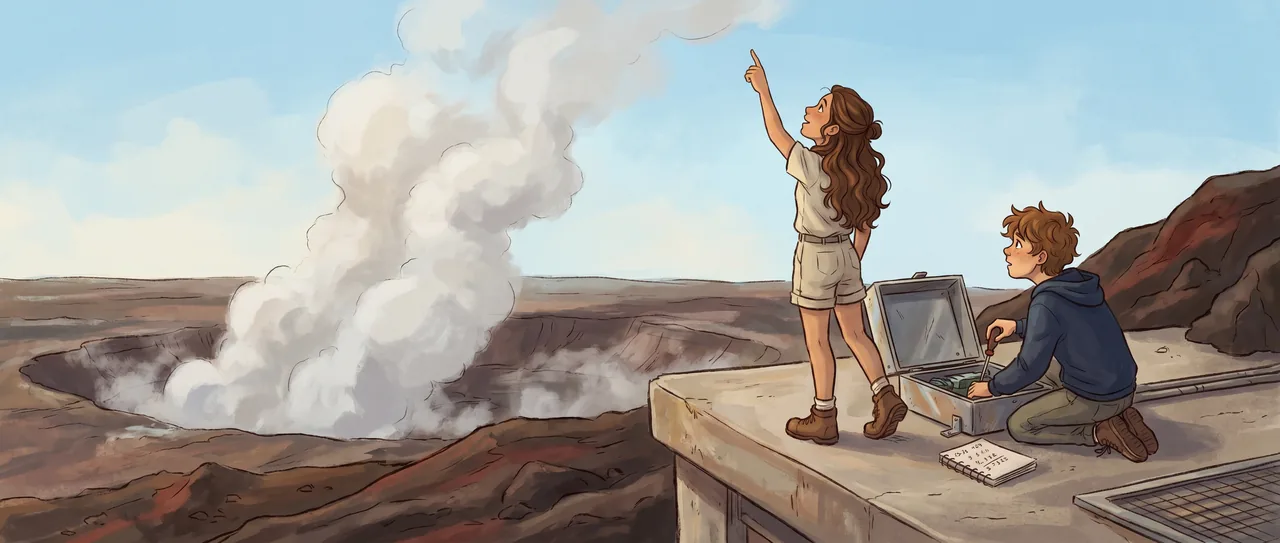
Soren stared at the yellow binder. It was two hundred pages of procedures he had never seen before. Maya was sitting on the concrete lip of the monitoring platform, watching the plume from Halema'uma'u drift south across a sky so blue it looked painted.
"The sensor's broken," Soren said.
"I heard."
"She wants me to recalibrate it from a binder I've never read."
"So read it."
Soren opened the binder. He started at page one. Maya kept watching the plume.
After twenty minutes, Soren had found the recalibration section. After forty minutes, he had the sensor housing open and was following the steps, checking each one against his notes. Maya had not moved, but she had stopped watching the plume. She was watching something else now.
"Soren."
"Busy."
"How much gas comes out of a volcano?"
He looked up. She was pointing at the plume, but her face had the expression he recognized. She wasn't asking about that plume. She was asking about something behind the plume.
"A lot," he said. "Kīlauea releases something like fifteen thousand to thirty thousand tons of SO2 a year. Plus water vapor, carbon dioxide, other stuff."
"But not just Kīlauea. All the volcanoes everywhere. How much total gas are they putting into the air?"
"I don't know the exact number. A lot. Why?"
Maya pulled her knees up to her chin. "Yesterday Dr. Akamu said something I keep thinking about. She said the atmosphere isn't sealed. That we lose atmosphere to space."
"Hydrogen and helium, mostly. The light stuff. Molecules moving fast enough at the top of the atmosphere to escape Earth's gravity." Soren paused, a screwdriver in one hand. "Fifty thousand tons a year, something like that."
"Fifty thousand tons. Every year. Just gone."
"Gone," Soren confirmed.
"So why do we still have an atmosphere?"
Soren set the screwdriver down.
He had never thought about it that way. He had known the fact. Atmospheric escape. Jeans escape, it was called. He had read about it. But he had known it the way you know a word in a language you don't speak. It had sat in his head doing nothing.
Why do we still have an atmosphere.
"It's been four and a half billion years," Maya said. "Fifty thousand tons a year for four and a half billion years. That's. That's a lot of tons."
Soren did the math in his head and then stopped because the number was absurd and he was probably missing something. He grabbed his notebook. He wrote it out. Two hundred and twenty-five trillion tons. He stared at it.
The entire atmosphere weighs about five point five quadrillion tons. So the loss was not nothing. Over geological time, it was deeply not nothing.
"Something is replacing it," Soren said slowly.
"That's what I think too."
They both looked at the plume.
It was rising thick and white from the caldera. Mostly water vapor and CO2, Soren knew, but carrying with it a cocktail of gases drawn from deep in the Earth's mantle. Gases that had been locked inside the planet since it formed. Gases that had never been part of the atmosphere before.
"Volcanoes put gas in," Maya said. "Space takes gas out. And there's the other thing. Meteorites."
Soren flipped back in his notebook. He had written this down from one of Dr. Akamu's talks. "About forty thousand tons of material fall to Earth from space every year. Mostly dust, micrometeorites. Tiny stuff burning up in the upper atmosphere."
"So the Earth gains forty thousand tons from space. And loses fifty thousand tons to space."
"And volcanoes put back roughly what's lost. Maybe more. It's an estimate."
Maya stood up. She walked to the edge of the platform where you could see the caldera shimmer with heat. "It's breathing," she said.
"What?"
"The planet. It breathes out through volcanoes. It breathes in from space. It exhales to space. And it almost balances. It almost exactly balances."
Soren felt something shift inside his chest. Not understanding. Not excitement. Something quieter than both. He looked at the plume and for the first time it didn't look like pollution or geology or data. It looked like an exhale.
The planet was not a rock with air stuck to it. The atmosphere was not a finished thing. It was a process. An ongoing, four-and-a-half-billion-year-long process of gaining and losing and gaining, and right now, today, this afternoon, while he sat here with a broken sensor and a yellow binder, fifty thousand tons of hydrogen was drifting off the top of the sky into space, and forty thousand tons of dust was drifting down from space into the sky, and under his feet, deep under the rock and the magma and the mantle, gases were working their way up toward the surface to replace what was lost.
All at once. All the time. An atmosphere in motion.
"What if it didn't balance?" Maya said quietly.
"Mars," Soren said. The word just came out.
"Mars," Maya repeated.
Because Mars had volcanoes once. Olympus Mons, the tallest in the solar system. But they went quiet. And Mars was smaller, with weaker gravity, so it lost its atmosphere faster. And nothing replaced it. And now Mars had almost no air at all.
Soren picked up the screwdriver. He had three more recalibration steps. He wanted the sensor working. He wanted the numbers to be right.
Maya watched him work, and while she watched, she tilted her head back to look straight up, past the plume, past the blue, toward the place where the sky thinned to nothing, where the last atoms of hydrogen spun fast enough to leave and never come back.
Below them, the mountain exhaled.
Read the interactive version, listen to the narration, and earn a gold star →
A science-verified short story for curious kids · Curiosity Land