The Billion in a Spoon
The tomatoes in Bed Seven were a scandal.
Every other bed in the Corktown Community Garden had gone yellow and thin by August. Lettuce bolted. Peppers cracked. The pole beans in Bed Twelve never even climbed. But Bed Seven kept pushing out tomatoes so red and heavy they bent the cages sideways, and nobody could explain it because Mrs. Okoro, who planted Bed Seven, had done absolutely nothing different from anyone else.
"Same seeds," Maya said, crouching between Beds Six and Seven. "Same sun. Same water schedule."
"Same fertilizer," Soren added, flipping back three pages in his notebook where he had copied down Mrs. Okoro's planting log. "She even used less than most people."
Maya pressed her thumb into the soil of Bed Six. It came up pale, almost powdery. She reached over the wooden border and pressed her thumb into Bed Seven. The soil stuck. It was darker. It smelled different.
"Soren. Smell this."
He leaned over. "That smells like the woods behind my grandma's house."
"Exactly. Bed Six smells like nothing."
Soren wrote that down. Then he wrote: WHY DOES DIRT SMELL?
Mrs. Okoro was across the garden arguing with Mr. Babcock about the hose schedule and did not seem interested in being interviewed again. She had already told them three times that she had no secret. She had filled her bed with soil from the same delivery truck as everyone else.
"Except she didn't," Maya said.
Soren looked up.
"Go back to your notes. What did she say about the first year?"
Soren flipped pages. "She said the soil from the truck was no good, so she went and got some from her cousin's place in Hamtramck. A yard that hadn't been disturbed in forty years."
"And then she never replaced it. Everyone else gets new bagged soil every spring. She just keeps adding her kitchen scraps and leaves."
They stared at Bed Seven. A fat tomato hung near the edge, split at the top from its own ripeness.
"So the question isn't what she's adding," Soren said slowly. "It's what everyone else is missing."
Maya was already moving. She went to the garden shed and came back with two plastic cups and a spoon from someone's abandoned lunch bag. She scooped a level teaspoon from Bed Six into one cup. Then a level teaspoon from Bed Seven into the other.
She held them up side by side.
"They look different," Soren said. "But I don't know what I'm looking at."
"Neither do I. But someone at Wayne State might."
Dr. Choudhury was not expecting two eleven-year-olds at her lab door on a Wednesday. She was in the middle of writing a grant proposal and had a pen behind each ear and a cold cup of coffee she kept almost drinking and then putting down.
"I have fifteen minutes," she said. "Probably."
She took the cups. She looked at the soil the way Maya's mom looked at a grocery receipt that didn't add up.
"Where is this from?"
They told her. She asked about the garden's history, the soil sources, what the other gardeners used. Soren read from his notes. Dr. Choudhury stopped pretending she only had fifteen minutes.
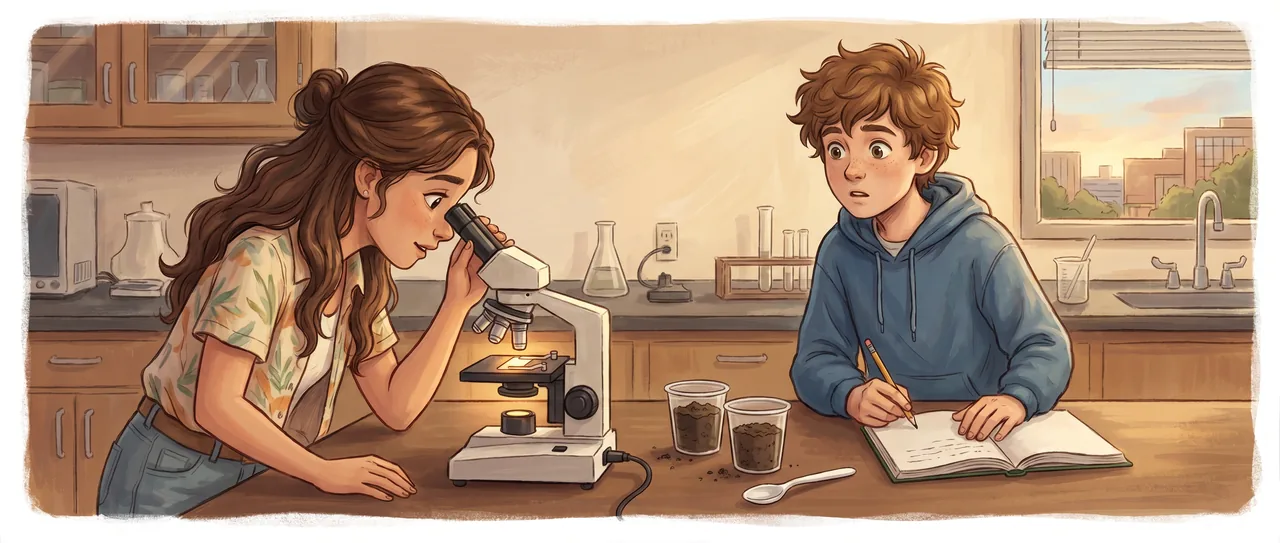
She prepared slides. Under the microscope, Bed Six looked like a desert. Grains of mineral, some fibrous material, empty space.
Bed Seven was alive.
There is no other word. The field of view crawled with motion. Threads of fungal hyphae laced between soil particles like a root system for the root system. Bacteria clustered in colonies around fragments of decomposing leaf. Something transparent and bloblike oozed across a grain of sand.
"A teaspoon of healthy soil," Dr. Choudhury said, adjusting the focus, "can hold up to a billion bacteria. Ten thousand different species. More diversity than a coral reef. More organisms than there are people on Earth."
Soren put his pencil down. He looked at the teaspoon still sitting on the lab bench.
"In that," he said.
Dr. Choudhury nodded. "Fungi that transport phosphorus to roots. Bacteria that fix nitrogen from the air. Protozoa that eat the bacteria and release nutrients the plant can absorb. It's a complete economy. The plant feeds sugar to the fungi through its roots, and the fungi bring it minerals it can't reach. Cooperation at a scale we can barely map."
"And Bed Six?" Maya asked.
"Bagged commercial soil is mostly sterile. Some products add a few microbial strains back in, but it's like replacing a symphony orchestra with a single violin. And heavy fertilizer use, tilling every season, all of that kills the network. Across modern agriculture, we've reduced soil microbial diversity by roughly forty percent. In some places, much more."
Maya was staring into the eyepiece. She adjusted the knob the way she had seen Dr. Choudhury do it, bringing the threads into sharper focus.
"The hyphae," she said. "They're connecting different soil particles together."
"That's how healthy soil holds water," Dr. Choudhury said. "The fungal threads bind the particles into aggregates. Little clumps with air pockets between them. Water stays in the pockets instead of draining straight through."
"So it's not just feeding the plant," Soren said. He was writing again, fast. "It's building the structure that holds the water that feeds the plant that feeds the fungi that build the structure."
"Yes."
"And when you break the network, you lose all of it at once."
"Yes."
They were quiet for a moment. The microscope hummed.
"Can you put it back?" Maya asked. "If it's gone, can you rebuild it?"
Dr. Choudhury sat back. "That," she said, "is the billion-dollar question. Literally. We know how to stop killing it. Stop tilling. Stop the chemical overload. Add organic matter. But rebuilding ten thousand species of bacteria, the fungal networks, the protozoa, the micro-arthropods, in the right proportions, in the right relationships? We're trying. We barely have names for most of them."
She looked at the two cups on her bench.
"Your Bed Seven might actually be more useful to me than you realize. Undisturbed urban soil with forty years of intact biology. That's not common."
On the bus ride home, Soren held both cups carefully in his lap. Maya sat sideways in her seat with her knees against the window.
"Mrs. Okoro didn't do anything special," Maya said. "She just didn't kill what was already there."
"Ten thousand species," Soren said. "In a spoon."
The bus hit a pothole and he cupped his hands tighter around the soil from Bed Seven, the way you would hold something that was not yours to drop.
Outside the window, the vacant lots of Michigan Avenue scrolled by, each one thick with ragweed and goldenrod, untouched and unnamed and quietly, vastly, full.
Read the interactive version, listen to the narration, and earn a gold star →
A science-verified short story for curious kids · Curiosity Land