Every Room at Once
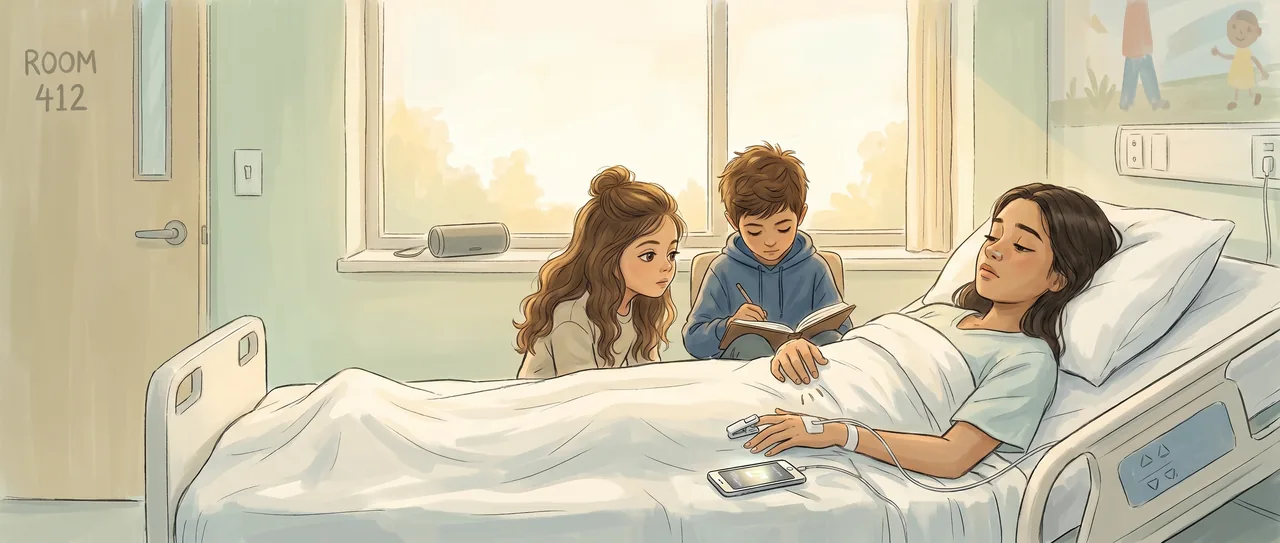
Maya's cousin Devi had been lying in Room 412 for nineteen days. She breathed on her own. Her eyes opened and closed. But she did not track movement, did not respond to voices, did not squeeze anyone's hand when they asked.
Maya visited every Saturday. She talked to Devi about school, about the terrible cafeteria pizza, about the cat that had started sleeping on their porch. She talked because her aunt said talking was important, that the brain could hear even when it seemed like it couldn't. But Devi's face stayed the same, smooth and far away, like a window with the curtains drawn.
Soren came with her this time because Maya had asked him to, and she almost never asked anyone for anything.
They stood in the doorway. The room smelled like hand sanitizer and warming plastic. A physical therapist had just finished moving Devi's arms and legs through their range of motion. She nodded at them on her way out but did not slow down.
"She used to play drums," Maya said.
Soren looked at Devi. He looked at the monitors, the oxygen clip on her finger, the thin blanket pulled up to her collarbone. He looked at the small speaker on the windowsill, which was playing soft ambient noise, something like wind through digital trees.
"That music is terrible," he said.
"It's not music. It's just sound."
"What did she actually listen to?"
Maya pulled out her phone and scrolled. She found a playlist labeled DEVI DRIVING, songs Devi had blasted in the car with the windows down. Loud things. Complicated things. Songs with horn sections and drums that sounded like arguments.
She held the phone up. "This."
"Play it."
Maya hesitated. The ward was quiet. Other patients rested in other rooms. But Soren was already disconnecting the ambient speaker, making space on the sill.
She pressed play. A song broke open into the room, brass and bass and a drumline that climbed over itself.
Nothing happened. Devi breathed. The monitors beeped their same rhythm.
But Maya was watching Devi's left hand. She watched it because she always watched hands. Devi was left-handed, played a left-handed kit, opened every jar and turned every doorknob with her left hand.
For sixteen bars of music, nothing.
Then Devi's left index finger moved. Not a twitch. A tap. It landed on the mattress and came back up, and it was not on the beat but it was near the beat, the way you tap along to something you almost remember.
Maya grabbed Soren's arm.
"I see it," he said. He was already watching. He had his notebook open, which seemed absurd in this room, but he wrote the time and the song name and the word tapping.
"It could be a muscle spasm," Maya said, because she needed someone to say no.
"Muscle spasms don't have rhythm."
The song changed. Slower. Piano and voice. Devi's finger stopped.
Maya skipped forward to another loud one, dense with drums, and seven seconds in the finger started again. This time, two fingers. This time, closer to the beat.
"Change it again," Soren said. "Something with no drums."
Maya found a slow acoustic track. They waited. Nothing moved.
"Now back to drums."
She switched. Within four bars, the tapping returned.
Soren was writing fast. "She's not just hearing it. She played drums. Her brain has motor patterns for this. It's like, the music is going in through her ears but it's coming out through her hands."
"It's coming out through her," Maya said.
A nurse appeared in the doorway. "What's going on in here? You need to keep the volume down."
"Look at her hand," Maya said.
The nurse looked. Devi's fingers were tapping in clusters now, not just index but middle finger too, a ghost of a paradiddle, the basic drum rudiment she'd practiced ten thousand times in her bedroom while the family begged her to stop.
The nurse's expression changed. She left the room quickly, and Maya heard her voice in the hallway, clipped and urgent.
Soren said, "I've been reading about this. About why music does things other stuff can't."
"Tell me."
"It's not one part of the brain. It's all of them. At the same time. When you hear music, your auditory cortex processes the sound, but your motor cortex activates too because your brain predicts rhythm with movement. Your visual cortex lights up because pitch maps to spatial processing. Your emotional centers respond to the harmony. Your memory systems engage because music is stored all over the place, connected to everything."
"So it's not going through one door."
"It's going through every door at once. If one hallway is blocked, the music takes a different one. Talking is mostly just two regions. Music is like, the whole building."
Maya looked at Devi's hand, still tapping, and she thought about all the doors inside her cousin opening at the same time, rooms that had been dark for nineteen days getting light through windows nobody thought to check.
A doctor came in, a young woman with her glasses pushed up on her forehead and a coffee stain on her coat. She watched Devi's hand for thirty seconds without speaking.
"Has she done this before?" she asked.
"Not that I've seen," Maya said. "Not that anyone's told us."
"What are you playing?"
"Her music. The real stuff. Not that ambient garbage."
The doctor almost smiled. "Keep playing it." She pulled out her own phone and started recording Devi's hand. "I want to show this to the rehab team on Monday. Can you make a list of which songs get a response?"
"Already doing it," Soren said, and held up his notebook.
The doctor left. Maya turned the volume up a little more. She found the song Devi had played at her last school concert, the one where she had a solo and stood up behind her kit and the whole auditorium felt her pulse.
Devi's hand moved faster. Ring finger now too. Three fingers in a pattern that repeated.
Maya leaned close to her cousin's ear. Not to say anything. Just to be near. She could feel the music vibrating in the phone she held between them, could feel it traveling through the mattress and the pillow and the bone.
"It's not about being smart enough or loud enough," Soren said quietly from his chair by the window. "It's about finding the thing that lights up every room at once. Devi's brain isn't gone. It just needed a way in that wasn't a single hallway."
The song built toward the drum solo. Devi's hand opened flat against the sheet, all four fingers moving now, not random, not a spasm, a pattern that lived in her muscles from a thousand afternoons of practice.
Maya put the phone on the mattress beside her cousin's hand, pressed play on the next track, and sat on the floor with her back against the bed, close enough to feel every beat come through.
Read the interactive version, listen to the narration, and earn a gold star →
A science-verified short story for curious kids · Curiosity Land