Both
The first time Maya ran the experiment, she broke it.
Not the equipment. The equipment was fine. Dr. Yoon had shown her how to set everything up before leaving to find coffee, waving vaguely at the monitor. "Don't touch the emitter housing. Everything else is yours. I'll be back in twenty."
Maya had fired a single electron at two slits. Then another. Then another. One at a time, like throwing one tiny ball after another at a wall with two doorways.
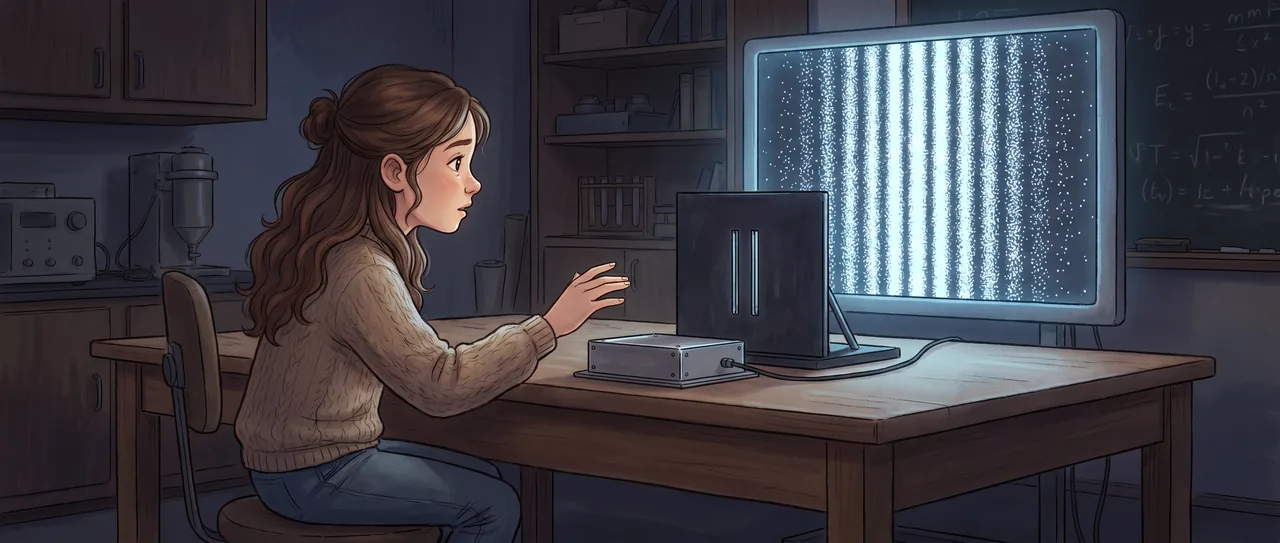
On the detector screen behind the slits, each electron landed as a single dot. One dot. Then another. Random-looking at first. But after two hundred electrons, the dots started forming a pattern. Bright bands and dark bands. Stripes.
She knew what this was. She had read about it. Interference. The kind of pattern you get when two waves overlap, like ripples crossing in a pond. Bright where the peaks meet peaks. Dark where peaks meet troughs.
But these weren't waves. They were electrons. Fired one at a time.
She stared at the screen.
One electron. Alone. No other electron to interact with. And somehow it was interfering with itself, as though it had gone through both slits at once and met itself on the other side.
That was the part she had read about. That was the part that was supposed to be strange. And it was strange, but in the way a magic trick is strange. Surprising, then you accept it and move on.
Maya did not move on.
She sat there looking at the stripes forming, one dot at a time, and something started to bother her. Not the result. The question behind the result.
If the electron goes through both slits, she thought, then which slit does it actually go through?
The apparatus had a detector module. A small addition you could place at one of the slits to register which slit the electron passed through. Dr. Yoon had shown her how to attach it, then detach it, then said, "Try it both ways."
Maya attached the detector to the left slit.
She fired electrons. One at a time. The detector clicked each time an electron chose the left slit. Or didn't click, meaning it went right.
Left. Right. Left. Left. Right.
She watched the screen.
No stripes.
The pattern was different now. Two bright clumps, one behind each slit. Like paint thrown through two doorways. Exactly what you would expect from tiny balls going through one door or the other.
The interference was gone.
Maya detached the detector. Fired more electrons. The stripes came back.
Attached it. Stripes gone.
Detached it. Stripes.
She did this four more times. Her hands were steady, but her breathing was not.
It wasn't that she didn't understand the result. She did, in the way you understand the words of a sentence in a language you barely speak. Each word makes sense. The sentence doesn't.
The electron goes through both slits when no one checks. The electron goes through one slit when someone checks. The checking changes the outcome.
Not the electron. The checking.
Maya put both hands flat on the table and stared at the monitor.
She was not thinking about physics. She was thinking about a day last March, when she had told her mother she already knew the answer to a math problem and her mother had said, "Then show me your work," and the moment Maya tried to show the steps, the answer fell apart. She had been right. She was sure she had been right. But trying to show why she was right had destroyed the thing she was right about.
That was not the same thing. She knew that was not the same thing.
But it was shaped the same way.
She heard Dr. Yoon's footsteps in the hall and spoke without turning around.
"It's not about electrons, is it."
Dr. Yoon paused. Maya could hear the coffee cup stop moving.
"I mean," Maya said, "it is about electrons. But the weird part isn't the electron. The weird part is that looking at something changes what it does."
"What do you think looking means, in this experiment?" Dr. Yoon asked.
Maya had already thought about this. The detector at the slit wasn't a camera. It wasn't an eye. It was a device that interacted with the electron to determine its position. It had to touch the electron, in some sense. Exchange a photon. Disturb it.
"It means interacting with it," Maya said. "You can't get information without interacting. And the interaction changes the result."
"Good," Dr. Yoon said.
"But that's not the weird part either," Maya said.
Dr. Yoon sat down. She did not say anything.
Maya pointed at the screen where the interference stripes were forming again, the detector removed, electrons arriving one by one.
"Each electron lands in one spot. Like a particle. A dot. But the pattern they make together is a wave pattern. So each electron is somehow a wave when it travels and a particle when it arrives. And it only becomes a particle at a definite place when something interacts with it."
She stopped pointing. Her hand hung in the air.
"So before anything interacts with it, what is it?"
Dr. Yoon sipped her coffee. "That is the question," she said. "That is, in fact, the question."
"Not a wave," Maya said. "Not a particle. Something that could be either, depending on what you do."
"Some physicists would agree with you," Dr. Yoon said. "Some wouldn't. It's been almost a hundred years and we still argue about what it means."
Maya looked at the stripes on the screen. Each dot was a real electron that had really traveled from the emitter to the detector. Each one had really passed through the slits. And no one in a hundred years could agree on what really happened in between.
Not because they weren't smart enough. Because the universe might not have a "what happened" in between. Not until something asks.
The lab was quiet except for the soft tick of electrons arriving, one by one, at the screen.
Maya thought about every time she had known something she couldn't explain, and every time explaining it had broken it, and every time someone had told her that the thing she noticed wasn't real because she couldn't show her work. She thought about all the things that might be true between one moment and the next, in the space where no one was looking.
She reached for the detector module, then stopped.
She left it on the table. On the screen, the stripes kept building, one impossible dot at a time.
Read the interactive version, listen to the narration, and earn a gold star →
A science-verified short story for curious kids · Curiosity Land