What the Spikes Want
The graduate student had left the magnet on.
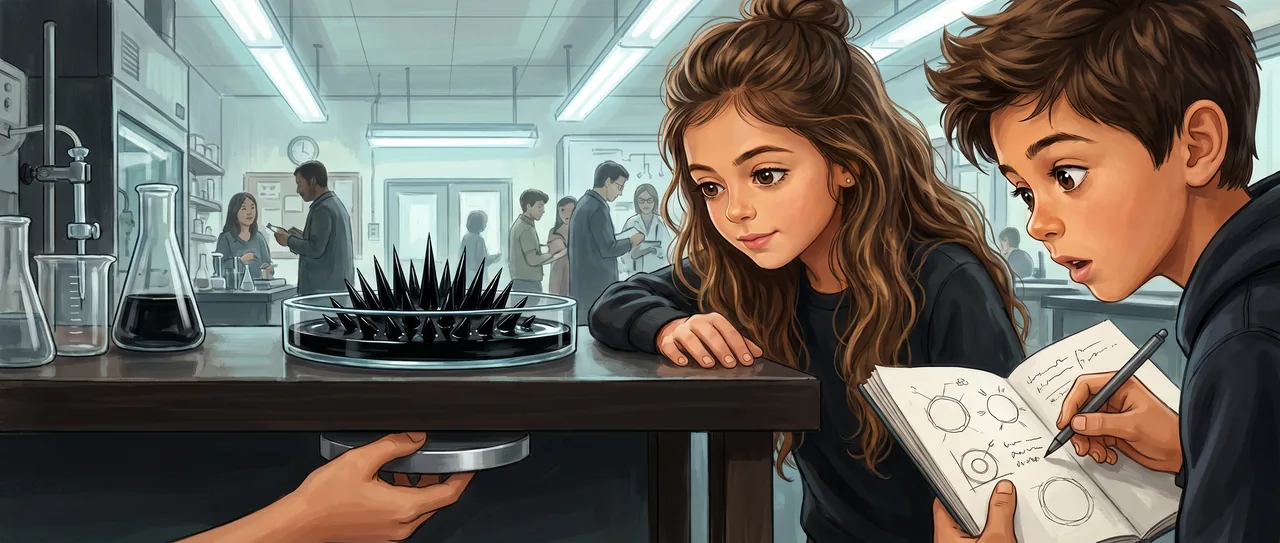
Maya saw it first, obviously. Not the magnet itself, which was just a fat silver disc beneath a glass dish, but the liquid in the dish. It was black, blacker than anything she had seen that wasn't a screen, and it was not flat. It had grown a crown.
Six perfect cones stood up from the surface, evenly spaced, each one sharp enough to look painful. The liquid between them curved in smooth valleys, like the surface of a tiny dark planet with tiny dark mountains.
"Soren."
He was three tables back, reading a laminated card about superconductors. He looked up.
"Soren, come here."
He came. He stopped. He said nothing for about four seconds, which for Soren was a long time to not say anything.
"That's a liquid," he said.
"That's a liquid," Maya agreed.
The cones did not move. They did not wobble or drip. They stood there, precise and still, like the liquid had opinions about geometry.
The laminated card next to this station read FERROFLUID DEMONSTRATION and then a long paragraph that started with "Ferrofluid is a colloidal suspension of" and Maya stopped reading because the spikes were right there.
"It's full of tiny magnetic particles," Soren said. He had actually read the card. "Nanoscale. Suspended in oil. The magnet pulls them up."
"But why spikes," Maya said. Not a question, exactly. More like the first half of a thought.
"Right," Soren said. "Why not just a dome? If the magnet is pulling the liquid up, it should just make a hill."
Maya leaned closer. The tips of the cones reflected the overhead fluorescents as tiny white stars. "They're evenly spaced. Look. It's not random."
"Equal distance from each other," Soren confirmed, tilting his head, measuring with his eyes.
The graduate student came back then. She was carrying a coffee and looked like she had forgotten they would be here. Her name tag said PRIYA and below that, in smaller letters, SOFT MATTER LAB.
"Oh good, it's still going," Priya said, mostly to the ferrofluid. She set her coffee down on a stack of papers. "So this is a ferrofluid demonstration. If you have questions, I can."
"Why spikes," Maya said.
"Why not a dome," Soren said.
Priya blinked. "Okay. Wow. Usually people ask if they can touch it." She pulled up a stool and sat down but immediately got back up to check something on a laptop across the room. "Give me one second. Actually. Hm. Okay, think about it this way. Two things are happening to that liquid at the same time. What pulls it up?"
"The magnet," Soren said.
"And what pulls it down?"
"Gravity," Maya said.
"Right. Gravity and surface tension. So the liquid is trying to go two directions at once." Priya was typing something on the laptop while talking. "The magnetic field wants all the fluid to rush to where the field is strongest. Gravity wants it flat. They're fighting. The spikes are what the fight looks like when nobody wins."
She carried the laptop back to her station, frowning at the screen. "Sorry. I have data running. The spikes are the shape that costs the least energy. The system finds the arrangement where both forces are as satisfied as they can be at the same time."
Then Priya's laptop beeped and she said "No no no" quietly and walked away with it.
Maya and Soren stood with the spikes.
"Both forces satisfied at the same time," Soren repeated. He opened his notebook and drew six circles in a rough hexagonal pattern. "So each spike is as far from the other spikes as it can get, because."
"Because if two spikes were close together, there'd be too much weight in one spot," Maya said. "Gravity would pull that part down."
"And if they spread out too far, the magnetic field would be weaker at the edges, so those spikes couldn't hold up."
Maya pressed her palms on the edge of the table and stared at the cones. "So the spacing isn't designed. It's just what happens when you let two forces fight until they stop fighting."
"Until they find the cheapest shape," Soren said.
Maya reached under the table. She could feel the disc magnet attached to the underside of the glass dish with some kind of clamp. She slid it, just a centimeter.
The spikes moved. Not like liquid sloshing. Like they rearranged. One of the six cones split into two shorter ones, and the others shifted to make room, and for one second the surface was chaotic, a dark churning landscape, and then it was still again. Seven cones now. Evenly spaced. Perfect.
"It found a new answer," Soren said.
"In like one second," Maya said.
She moved the magnet again. The spikes reorganized again. Eight cones, shorter, wider spaced. Still perfect. Still evenly distributed. The liquid had solved the problem instantly, without thinking, without trying, just by being what it was.
Soren was writing fast. Then he stopped.
"Maya. It's doing math."
"It's not doing math. It's doing the thing that math describes."
They looked at each other. This was the kind of distinction that other people found annoying and they found essential.
"Every drop," Soren said slowly, "is just responding to the forces right around it. None of them know about the pattern. But the pattern happens anyway."
"Because the pattern is what it looks like when every single point finds its cheapest option at the same time."
Maya moved the magnet one more time, further off-center, and watched the cones dissolve and reform. Twelve spikes now, small and delicate, arranged in rows that looked almost crystalline. A geometry that nobody chose. A geometry that the universe defaulted to when two forces pulled in opposite directions and the liquid just tried to be still.
Priya came back. "Still playing with it? Good. Most kids get bored."
"Most kids don't move the magnet," Maya said.
Priya looked under the table. "You moved the magnet?"
Soren was already sliding it to a new position. Fourteen spikes rose in a staggered grid, each one catching the light like a needle, each one exactly where it had to be.
Read the interactive version, listen to the narration, and earn a gold star →
A science-verified short story for curious kids · Curiosity Land