What the Pipe Remembers
The tour guide had been talking for forty minutes about the economic history of the mine, and Maya had stopped listening thirty-nine minutes ago.
She was looking at the wall.
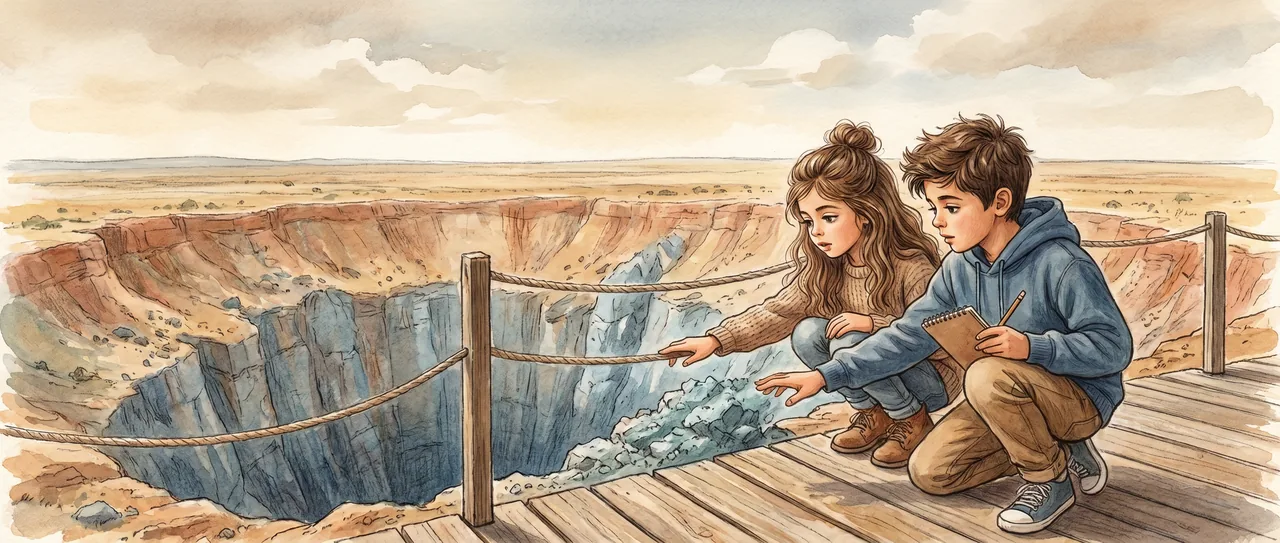
The Big Hole stretched below them, a vast open pit carved into the earth by human hands over a hundred years ago. But the tour guide kept pointing down, and Maya kept looking sideways, at the exposed rock face where the viewing platform met the ground. The rock there was different. Not layered like the surrounding stone. It was darker, bluer, crumbled in a way that looked almost soft.
"Soren," she said.
He was three people away in the group, writing something in his notebook. She said his name again and he looked up, then followed her eyes to the wall.
"That's weird," he said.
"It's not the same rock."
"No," he agreed. He moved closer. "It looks like it was pushed through the other stuff. Like a plug."
The tour guide, Mr. Dlamini, noticed them drifting. "Please stay with the group. We'll be moving to the museum in five minutes."
"What's this rock?" Maya asked, pointing.
Mr. Dlamini barely glanced. "Kimberlite. That's the ore they mined. The diamonds are found inside it. Now, as I was saying about Cecil Rhodes and the consolidation of the mining claims in eighteen eighty-eight."
He turned back to the group. Maya mouthed the word kimberlite at Soren. Soren wrote it down.
In the museum, the group clustered around a case of uncut diamonds while Mr. Dlamini explained carats. Maya and Soren stood in front of a diagram on the back wall that nobody else was looking at.
The diagram showed Earth in cross-section. Crust. Mantle. Core. And in the upper mantle, at a depth marked one hundred and fifty kilometers, a small label read: Diamond Stability Zone.
"One hundred and fifty kilometers," Soren said. "That's basically in space but pointing the wrong way."
"And the diamonds formed there."
"Under the weight of everything above them." He was quiet for a moment. "That's a lot of weight."
Maya traced the diagram upward from the stability zone. A thin red line rose from the depth, narrow and violent-looking, punching through the layers of the mantle and crust like a needle. The label read: Kimberlite pipe. Eruption velocity: supersonic.
"Supersonic," Maya said.
"That can't be right."
"It says supersonic."
Soren leaned closer to the diagram. The information panel beside it confirmed: the magma carrying diamonds to the surface traveled faster than the speed of sound. Faster than a bullet. The entire journey from one hundred and fifty kilometers deep to the surface might have taken hours. Maybe less.
"The rock outside," Maya said. "The blue stuff. That's what's left of the explosion."
"The pipe."
"The pipe." She pressed her finger against the glass over the diagram. "That crumbly blue rock is the throat of something that came from a hundred and fifty kilometers down, moving faster than sound."
Soren stared at her finger on the glass. Then he turned and walked back outside to the viewing platform. Maya followed.
The blue-grey kimberlite sat in the wall exactly where they had left it. Ordinary-looking. Crumbled at the edges. Soren crouched beside it. He did not touch it because there was a rope barrier, but he got his face close.
"It looks like compressed mud," he said.
"It carried diamonds."
"It carried everything. This whole pipe, this whole hole they dug, it's just the exit wound. The thing already happened. Millions of years ago something down there decided to come up, and it came up so fast it broke the speed of sound through solid rock, and when it got here it just, what, stopped?"
"Cooled," Maya said. "The pressure released. The magma cooled and became this."
She crouched next to him. The Big Hole yawned below them, almost a kilometer wide, carved by dynamite and pickaxes. All that work, all that digging. And the explosion that made the pipe in the first place had done something incomparably larger in incomparably less time.
"People dug this hole for diamonds," Maya said slowly. "But the hole was already here. The real hole. The pipe. It goes all the way down."
Soren opened his notebook. He had drawn a small circle and now he drew a line descending from it, straight down, and wrote 150 km beside it. Then he looked at the drawing and the scale of it seemed to hit him because he stopped writing and just held the pen against the page.
"The diamonds aren't the interesting part," he said.
"No."
"The interesting part is that the inside of the Earth reached up."
Mr. Dlamini appeared at the platform entrance. "There you two are. The bus is loading. Did you enjoy the museum?"
"Mr. Dlamini," Soren said. "How many kimberlite pipes are there?"
"In the Kimberley area? Several. Globally? Thousands, I think. Most of them are very old. Tens of millions of years, hundreds of millions."
"Could new ones happen?"
Mr. Dlamini paused. His tour-guide expression shifted into something more uncertain, more honest. "Geologically, there's no reason they couldn't. The conditions still exist deep in the mantle. But the last known kimberlite eruptions were tens of millions of years ago. We don't really know why they stopped. Or if they have."
He shrugged and walked toward the bus.
Maya and Soren stayed on the platform another moment. Below them, the enormous pit testified to how badly people wanted what came up through the pipe. Around them, the ordinary landscape of the Northern Cape stretched flat and dry to the horizon.
"Somewhere under this," Maya said. She didn't finish. She didn't need to.
Soren looked at the ground beneath his shoes. Dirt and gravel and concrete. And below that, rock. And below the rock, more rock, hotter rock, pressurized rock, and somewhere around a hundred and fifty kilometers down,
and maybe, somewhere beneath some ordinary patch of ground that nobody was paying attention to, the mantle was gathering itself again.
The bus honked.
Maya stood up. She took one more look at the crumbled blue kimberlite in the wall, this quiet remnant of something that had once moved faster than sound, and then she put her hand flat against it, just for a second, feeling how still it was now.
Soren put his hand beside hers.
Read the interactive version, listen to the narration, and earn a gold star →
A science-verified short story for curious kids · Curiosity Land