The Second Vote
Soren's project was broken, and the science fair was in fourteen hours.
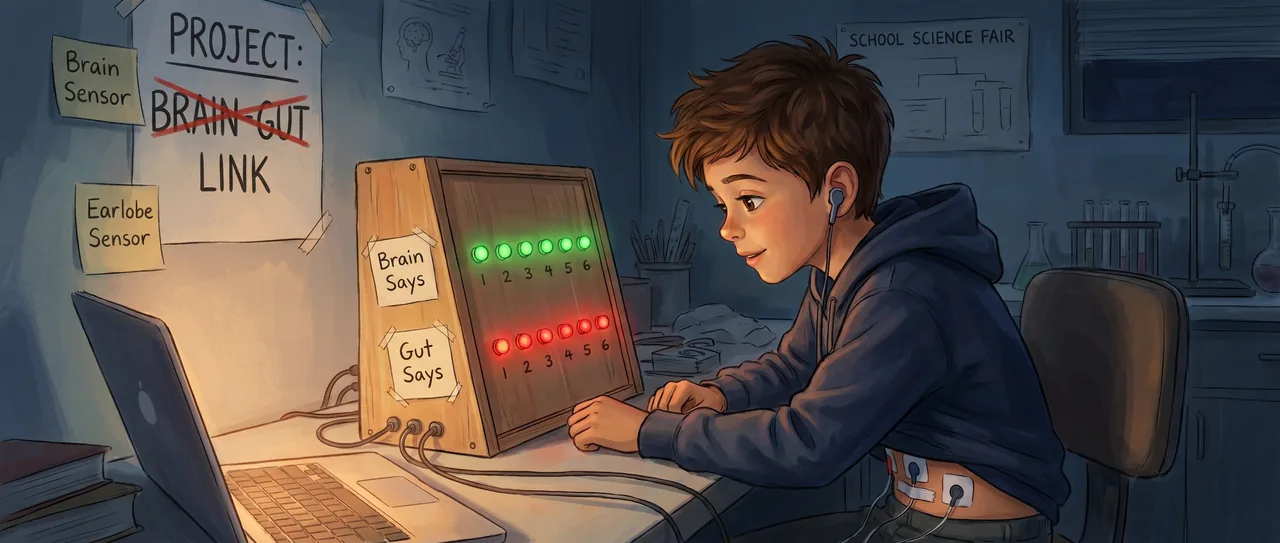
The device was simple enough. A heart rate sensor clipped to his earlobe, wired to an Arduino, which lit up a strip of LEDs. Green when his heart rate dropped. Red when it climbed. The idea was to demonstrate biofeedback, how thinking calm thoughts could slow your pulse, how you could watch yourself calming down in real time.
Except the LEDs kept doing something he hadn't programmed.
He sat alone in the empty science room. Ms. Kazemi had left him the key because she trusted him not to burn the building down, which was the closest thing to a compliment she had ever given anyone. She'd looked at his project last week, said it was solid, said maybe add a poster about the autonomic nervous system. Then she'd gone back to arguing with someone on the phone about chemical supply budgets.
Soren clipped the sensor on. Breathed slowly. Watched the LEDs crawl from red toward green. Good. That was working.
Then he thought about his presentation tomorrow. Standing in front of the judges. Explaining the autonomic nervous system to people who already knew more about it than he did.
The LEDs jumped red. Obviously.
But here was the part that wasn't obvious. He noticed it because he'd been sitting here for two hours and he'd started paying very close attention to the timing.
The feeling came first.
Not the thought. The feeling. A kind of dropping sensation in his stomach, a tightening, and then half a second later his heart rate spiked and the LEDs went red and the anxious thoughts arrived. Not the other way around.
He wrote it down. He'd noticed it four times now. Each time he triggered a stress response, the sequence was the same. Gut first. Then heart. Then the thoughts that felt like they were causing everything.
That couldn't be right. His whole project was built on the idea that your brain decided how you felt and your body followed. Biofeedback was supposed to demonstrate the brain's control over the body. Think calm, become calm. That was the pitch.
Soren unclipped the sensor. Clipped it back on. Tried again.
He thought about the math test he'd failed last month. Nothing. Then, without warning, his stomach did a slow roll, and a half-beat later the LEDs blazed and he was thinking about the disappointed look on his dad's face.
Gut. Then heart. Then brain.
He opened his laptop. He was looking for the vagus nerve because he half-remembered something from the textbook chapter Ms. Kazemi had assigned, something about a nerve connecting the brain and the stomach. What he found made him sit very still for a long time.
The vagus nerve was the longest cranial nerve in the body. It ran from the brainstem all the way down to the gut. And it carried signals in both directions. That part he expected.
The part he did not expect: roughly eighty percent of the nerve fibers in the vagus nerve carried information upward. From gut to brain. Not brain to gut.
Eighty percent.
He read it again. He checked three sources. Eighty percent of the traffic on the longest nerve in his body was going the wrong direction. Or rather, it was going the direction nobody talked about.
His gut was not sitting around waiting for instructions from his brain. His gut was sending a river of information upward, constantly, and his brain was listening. The gut had opinions. The gut voted.
Soren looked at his biofeedback display. The neat little story it told: your brain controls your body. Think calm, be calm.
That story wasn't wrong, exactly. But it was incomplete in a way that changed everything. It was like saying a conversation was one person talking, when actually the other person was doing eighty percent of the talking and you just hadn't been paying attention to them.
He sat there and felt his stomach do a small complicated thing he didn't have a word for.
The science fair was in fourteen hours. His project was built on a half-truth. He could present it the way he'd planned and it would work fine and the judges would nod and he'd probably get a ribbon.
Or.
Soren pulled his notebook from his bag. He started writing. Not a new project. A second part. A question that his own project accidentally asked.
He redesigned the display. Now the LEDs did two things. They still showed heart rate. But he added a second row, wired to a simple galvanic skin response sensor he'd built from two electrodes and a resistor. When he taped the electrodes to his abdomen, they picked up tiny changes in skin conductance there. Not a perfect gut sensor. But a rough one. Close enough to show the timing.
He triggered the stress response again. Thought about the judges. Watched.
The bottom row of LEDs flickered first. A full beat before the top row. Every time.
He labeled the rows on a piece of tape. The top row: Brain Says. The bottom row: Gut Says.
His poster was wrong now. He crossed out the title, which had been "Biofeedback: Your Brain in Control." He wrote the new one in thick marker.
The next morning Ms. Kazemi walked past his table early, coffee in hand, barely glancing down. Then she stopped. Backed up. Read the poster.
"This isn't what you showed me last week," she said.
"No," Soren said. "Last week I thought the brain was in charge."
"The brain is in charge."
"Eighty percent of vagus nerve fibers carry signals from gut to brain. Not the other direction."
Ms. Kazemi's coffee stopped halfway to her mouth.
"Where did you find that?"
"Three sources. I can show you."
She set her coffee down and leaned over the display. "Show me the timing."
Soren clipped on the sensors and thought about something that scared him. The bottom LEDs flickered. A half-second gap. Then the top.
Ms. Kazemi watched it happen three times without saying anything. Then she said, "Your title's going to make the judges uncomfortable."
"Good," Soren said.
She picked up her coffee and walked away.
The first pair of judges arrived at nine. They read his poster, looked at the two rows of LEDs, and asked him to explain.
Soren clipped on the sensors and breathed in, and before he said a single word, the bottom row flickered to life.
Read the interactive version, listen to the narration, and earn a gold star →
A science-verified short story for curious kids · Curiosity Land