The Party Problem
Soren's mother had a theory about parties. If you invited enough people, she said, the event planned itself. Soren had a different theory about his mother's parties: they planned themselves the way avalanches planned themselves, and someone always ended up buried.
Today it was him. He stood in the community center with a clipboard, forty-two name tags spread across a folding table, and a problem.
"Sort them into tables of six," his mother had said, already on the phone, already half out the door. "But keep the people who know each other together. And keep the people who don't like each other apart. The chart's on my laptop."
The chart was on her laptop. Soren opened it and stared.
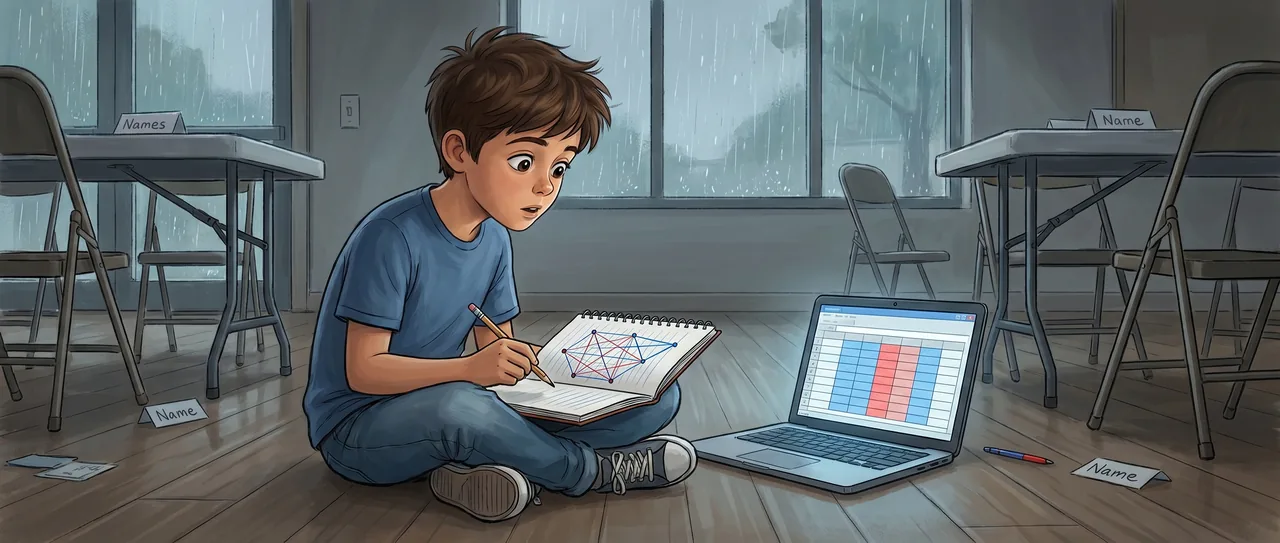
It was a spreadsheet. Forty-two names down the left column, forty-two names across the top row. Each cell was colored either blue or red. Blue meant the two people were friends. Red meant they were, in his mother's careful phrasing, "best kept separate."
Forty-two people. Every pair either friends or not friends. Soren started counting the relationships and stopped at eight hundred. There were eight hundred and sixty-one cells filled in.
His mother wanted tables where friends sat with friends and strangers sat with strangers. Simple groups. No mixed tables where someone's enemy ended up passing them the salt.
Soren picked six names at random and checked their cells. Two pairs were blue. One pair was red. The rest were blue. Almost, but the red pair would be a disaster. He tried again. This time three red pairs. Worse.
He pulled out his notebook and started drawing dots for people and lines between them, coloring each line blue or red from the spreadsheet. After ten minutes he had a tangle that looked like a bowl of spaghetti someone had fought.
But something in the tangle caught him.
He picked three names. Deirdre, Kwame, Alistair. All three lines between them were blue. All friends.
That was fine. That was a table seed. He could build around it.
He picked another three. Rosa, Tomoko, Bill. All red. All people who needed distance from each other.
Also fine. He could seat them far apart.
But then he started looking more carefully, and the thing that had caught him pulled tighter. He picked six people at random. Checked every pair. Found a triangle of three who were all blue or a triangle of three who were all red. Every time.
He tried again. Six different people. Same thing.
Again. Same thing.
Soren sat down on the floor with his notebook flat on his knees and tried to build a group of six where this didn't happen. He drew six dots in a hexagon and tried to color the lines, fifteen lines total, with blue and red so that no triangle was all one color.
He got close. Then he didn't.
He tried for twenty minutes. Every time he fixed one triangle, he created another. It was like pressing down on a bubble in wallpaper.
This felt like it wasn't about his mother's party anymore.
Soren wrote at the top of a new page: Is it impossible? With six dots and two colors, can you always avoid a single-color triangle?
He worked it through. Five dots first. He could do five. He drew a pentagon and colored it carefully: every edge of the pentagon blue, every diagonal red. No monochromatic triangle. He checked three times. It worked.
But with six dots, he couldn't make it work. Every time the sixth dot arrived, it had five lines going out from it. Each line was blue or red. At least three of those five lines had to be the same color. Say three were blue. Then he looked at the three people on the other end of those blue lines. If any pair of them were also blue friends, there was a blue triangle. If none of them were blue friends, then all three pairs were red, and those three formed a red triangle.
Either way, a triangle appeared.
Soren put his pencil down.
It wasn't about his seating chart. It was about six. Any six people in the world. Any six dots connected by lines in two colors. It didn't matter who they were or how they felt about each other. Among any six, there would always be three who were all connected the same way. Three mutual friends, or three mutual strangers. Always.
You couldn't stop it. You couldn't arrange your way out of it. The pattern wasn't something you built. It was something that existed the moment there were enough connections. The order was already there, hiding inside any large enough web of relationships, whether anyone wanted it or not.
He looked at the forty-two names on the spreadsheet. Forty-two was wildly more than six. The guaranteed patterns in this room would be everywhere, overlapping, dense, inescapable. His mother's seating chart wasn't hard because the relationships were complicated. It was hard because the mathematics underneath were already structured, already full of hidden clusters, before a single person walked through the door.
The community center was quiet except for the rain. Soren looked at his pentagon, the one arrangement of five that avoided the pattern, and thought about how fragile it was. One more person, one more connection, and the whole thing collapsed into order.
Five was the edge. The last moment you could hold chaos together. Six was where the universe said no.
His phone buzzed. His mother: "How's the seating?"
Soren looked at his notebook. He looked at the spreadsheet. He started building tables differently now. Instead of trying to avoid the triangles, he went looking for them. He found three mutual friends, seated them together, then found three more, then built the tables outward from the clusters that were already guaranteed to exist.
It took twelve minutes.
He texted back: "Done."
Then he sat there on the community center floor with the name tags in neat piles on seven tables, the rain tapping the high windows, and opened his notebook to the pentagon again. Five dots. The threshold. The last number where you could still choose.
He added a sixth dot and drew its five lines.
Three of them were the same color, and he hadn't even decided which.
Read the interactive version, listen to the narration, and earn a gold star →
A science-verified short story for curious kids · Curiosity Land