The Coin That Knew
The coin was wrong.
Not wrong the way coins usually go wrong, landing on an edge or rolling under a table. Wrong in a way that made Soren put his pencil down and stare at his notebook like the numbers had rearranged themselves when he wasn't looking.
"It's doing it again," Maya said from across the room.
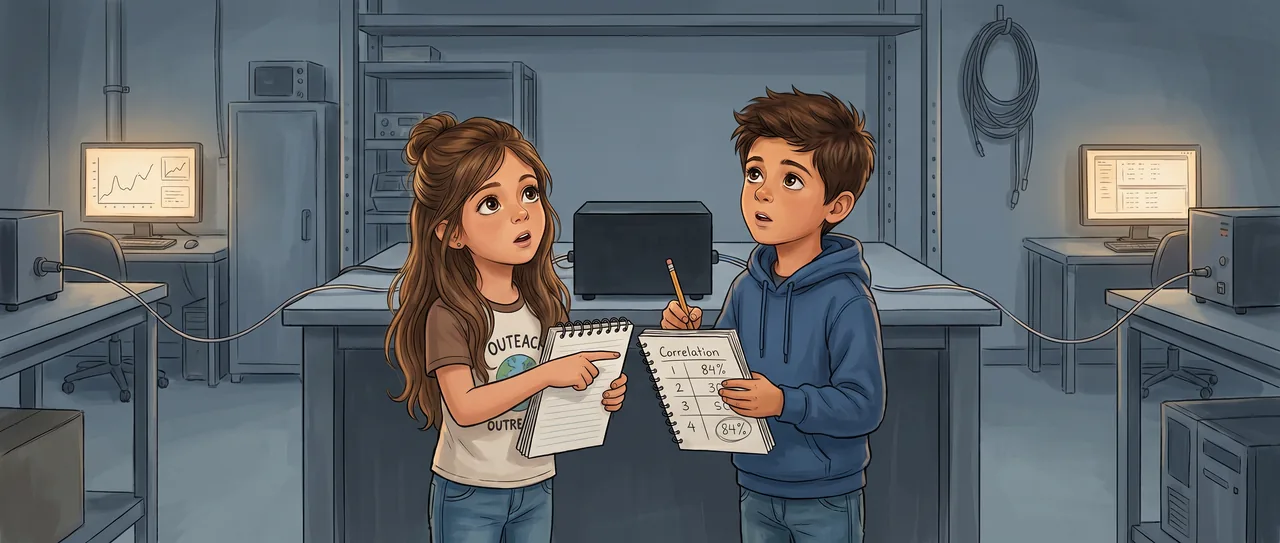
They were separated by twelve meters of laboratory, sitting at two different stations with two different screens, pressing two different buttons. Between them, inside a humming black box that a graduate student named Priya had spent forty minutes explaining, pairs of photons were being created, split apart, and sent in opposite directions through fiber optic cables. One photon went to Maya's detector. One went to Soren's.
The program was simple. Choose an angle. Press the button. Record what your detector reads, zero or one. Do it again. Do it two hundred times.
Priya had explained, with a lot of hand waving, that each photon's result should be random. Like flipping a coin. And if Maya and Soren happened to choose the same angle, their coins would always match. Always. Even though nothing connected the two photons anymore. Even though no signal could pass between the detectors fast enough.
"So did someone prove him right?" Maya asked.
"Someone proved him wrong." Priya smiled in a way that wasn't quite comfortable. "A physicist named John Bell figured out that if hidden instructions existed, there would be a limit. A mathematical ceiling on how often the results could correlate when you measure at different angles. And then people ran the experiment. The correlations broke the ceiling."
Soren had written that down. Broke the ceiling. He underlined it twice.
Now they were running it themselves. Two hundred trials. Maya picked her angle from three options. Soren picked his. Neither knew what the other chose. After every batch of fifty, they walked to the middle of the room and compared notebooks.
The first fifty were fine. When they had picked the same angle, their results matched. When they picked different angles, the results were messier, correlated but not perfectly.
After the second batch, Soren started calculating.
"Maya. Come look at this."
She crossed the room. He had drawn a table. Same angles, different angles, match percentages.
"If the photons had hidden instructions," he said, "these different angle matches can't go above seventy five percent. That's Bell's limit. That's the ceiling."
"And?"
"We're at eighty three."
Maya looked at the numbers. Then she looked at the black box. Then back at the numbers.
"Run more," she said.
They ran more. Fifty more trials. The correlation held at eighty four percent. Soren checked his arithmetic three times. He checked it a fourth time, because this was the kind of thing you checked a fourth time.
"It's not hidden instructions," he said quietly.
"It can't be," Maya said. "The numbers are too high."
They stood there in the middle of the lab, two notebooks open between them, and for a moment neither said anything. The humming black box made its small steady sound.
"So what is it?" Soren asked. Not to Maya. Not to anyone. Just outward, into the room.
Priya was at her desk, half turned away, working on something of her own. She glanced over. "You broke the ceiling?"
"Eighty four percent," Maya said.
"Good. That's close to the theoretical maximum. Eighty five point four."
"But what does it mean?" Soren asked. "If they don't carry instructions, how do they match?"
Priya spun her chair halfway toward them, then stopped. She had the expression of someone choosing her words like crossing stones in a river. "I want to be honest with you. Nobody knows. We know it's not hidden instructions, because you just showed yourself that. We know it's not a signal, because the correlations happen faster than light could carry a message between the detectors. We know the math describes it perfectly. But what it means, what's actually happening between those two photons, there is no consensus. Physicists have been arguing about it for almost a hundred years."
"Einstein argued about it," Soren said.
"Einstein argued about it for the last thirty years of his life. He called it spooky action at a distance. He was sure the theory was incomplete. He was sure there had to be hidden instructions. And then Bell proved there couldn't be, and then experimenters proved Bell was right." Priya paused. "Einstein was one of the greatest minds in human history, and on this specific question, the universe disagreed with him."
Maya had gone quiet in the way she went quiet when something was rearranging itself inside her head.
"They're not sending messages," she said slowly. "They're not carrying instructions. But they're not independent. They're one thing."
Priya tilted her head.
"I mean," Maya said, "we keep asking how photon A tells photon B what to do. But maybe that's the wrong question. Maybe they never stopped being one thing. Even across the room. Even across a galaxy. Measuring one isn't sending a message to the other. It's like, you're only looking at one end of something that doesn't have ends."
Soren stared at her. Then he looked down at his notebook, at the eighty four percent, at the ceiling that wasn't there.
"That's one interpretation," Priya said carefully. "Some physicists think something like that. Others think something very different. The math doesn't choose between them."
"But the math works," Soren said.
"The math works perfectly."
Soren looked at Maya. Maya looked at Soren. There was a long, full silence, the kind that isn't empty at all.
"I want to run it again," Soren said. "But this time, I want to be farther away."
"How far?" Priya asked.
"How far does the cable reach?"
Priya almost laughed, then didn't, because he was serious. "There's a spool in the supply room. You could run it down the hall to the next lab. Maybe forty meters."
"The number won't change," Maya said. Not a question.
"No," Soren said. "But I want to feel it."
Maya nodded, because she understood. Some things you had to feel at a distance. Some things you had to prove with your hands that the universe was stranger than you were, and then sit with that, and then keep going.
They spent twenty minutes unspooling fiber optic cable down the corridor, around a corner, into a room where Soren could not see Maya and Maya could not see Soren. Priya watched them work and said nothing and handed them tape when they needed it.
Soren pressed his button. Forty meters away, through a wall and around a corner, Maya pressed hers.
He wrote down: one.
Read the interactive version, listen to the narration, and earn a gold star →
A science-verified short story for curious kids · Curiosity Land