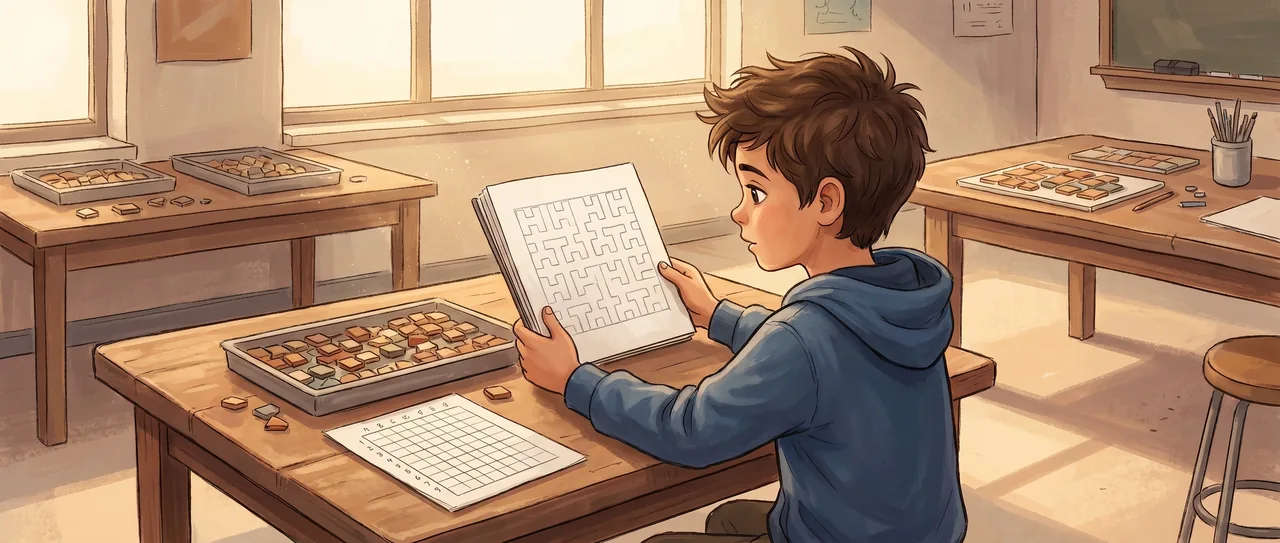
Every Point in the Square
The problem was the grout.
Soren had volunteered to help Mrs. Aziz plan the mosaic for the community center wall. She had given him a simple job: figure out the most efficient path to lay grout between four hundred and nine small tiles arranged in a square grid. One continuous line of grout, no lifting the tube, covering every gap between every tile.
He had been at it for forty minutes. His notebook was filling with attempts that always dead-ended in some corner, leaving gaps unvisited.
"You're still on that?" Mrs. Aziz called from across the room. She was sorting tiles by color, squinting through reading glasses perched on the tip of her nose. "Just do it in rows, Soren. Back and forth. Zig-zag. It doesn't have to be elegant."
"Rows miss the vertical gaps," Soren said.
She waved a hand. "Close enough."
It was not close enough. The vertical gaps between tiles needed grout too, not just the horizontal ones. A simple zig-zag across rows would trace a path that covered horizontal channels but skipped over the short vertical ones at each turn. He needed a path that filled every gap. Every single one.
He drew the grid again, smaller this time. A three-by-three version. Nine tiles. He numbered the gaps. Then he tried to trace one continuous path through all of them.
Dead end. Dead end. Dead end.
Soren put his pencil down and stared at the grid. He wasn't thinking about grout anymore. He was thinking about the grid itself, about what it meant to fill a space completely with a single line.
He picked up the pencil and drew something different. Not the grout channels. Just a square. And inside it, he tried to draw a single continuous curve that would touch every point. Not just every gap. Every point.
That was impossible. Obviously impossible. A line was one-dimensional. A square was two-dimensional. You couldn't cover a higher dimension with a lower one.
Except he had read something once, months ago, in a library book about infinity. A single sentence that had lodged itself in his list of things to come back to: "Peano constructed a continuous curve that passes through every point of a unit square."
He had not come back to it. Until now.
Soren opened his phone and searched. It took him three minutes to find the construction, and when he found it, he sat very still for a long time.
The trick was iteration. You start simple. Divide the square into nine smaller squares, and draw a curve that visits each one. It looks like a bent path, clumsy, with big gaps. But then you do it again. Each of those nine squares gets divided into nine more, and the curve bends itself to visit all eighty-one. Then again: seven hundred and twenty-nine. Again: six thousand five hundred and sixty-one.
Each time, the curve gets longer. Each time, it fills more of the square. And in the limit, after infinitely many steps, the curve visits every single point in the square. Every point. A one-dimensional line that completely fills two dimensions.
Soren drew the first iteration in his notebook. Then the second. His hand was steady. He was not thinking fast. He was thinking carefully, because this was the kind of thing that broke if you rushed it.
The second iteration looked like a jittery, folded-up version of the first. Same shape at every scale. He held the notebook at arm's length and something shifted in his chest. The curve was still just a line. One dimension. You could unspool it and lay it flat and it would be a segment, nothing more. But it bent itself so thoroughly, so completely, that it touched everywhere.
A line that was also a square.
Not approximately. Not metaphorically. Mathematically, rigorously, provably: a continuous function from the unit interval onto the unit square. Peano published it in eighteen ninety. It had been true for over a hundred and thirty years and Soren had not known.
"Mrs. Aziz," he said.
"Hmm?"
"Did you know a line can fill a square?"
She looked up from her tiles. "That doesn't make sense, Soren."
"I know," he said. "It doesn't. But it does."
She walked over and looked at his notebook. The second iteration of the Peano curve stared up at her, a tangled but precise path that was already beginning to leave very little white space.
"That's a nice pattern," she said. "Is it for the mosaic?"
"No. Maybe. I don't know. It's a curve that fills every point in a square. One line. No gaps."
Mrs. Aziz studied it. "There are clearly gaps, Soren. I can see white space."
"This is only the second step. If you keep going, the gaps disappear. Mathematically, they actually disappear. After infinite steps, the line touches every point."
"Infinite steps," she repeated, the way adults repeated things that sounded unreasonable.
"Yeah."
She handed the notebook back. "Well, we don't have infinite steps. We have Saturday. Can you solve the grout problem with a finite number of steps?"
Soren looked at the Peano curve. Then he looked at his grout grid. And something clicked.
He could not fill every point. But he could approximate. The second iteration of the curve, adapted to his grid, would give him a single continuous path that visited every small square in the grid. Not every point. Every region. For grout, that was more than enough.
He redrew the grid. Twenty-one by twenty-one tiles, adjusted to fit the wall dimensions Mrs. Aziz had given him. Then he traced the Peano path through it, three iterations deep, bending and folding the line so it snaked through every region of the grid without lifting.
It took twenty minutes. When he finished, the path covered every gap.
"Got it," he said.
Mrs. Aziz took the paper, looked at it, looked at him, and said, "This is genuinely unhinged." Then she pinned it to the planning board.
Soren sat alone in the art room after she went to make a phone call. He looked at his notebook. The second iteration of the Peano curve on one page. The grout path on another. The grout path was practical, finite, useful. The Peano curve was none of those things. It was a proof that dimension was not what he thought it was. That a line, if it folded itself with enough patience, could be a square.
He thought about all the other things he assumed couldn't cross into each other. The categories that seemed solid. One dimension here, two dimensions there, a wall between them.
The wall was not there.
Soren turned to a blank page and began the third iteration, his pencil bending and bending and bending into the white space that was almost, almost gone.
Read the interactive version, listen to the narration, and earn a gold star →
A science-verified short story for curious kids · Curiosity Land