The Weight of Three Billion Wings
The taxidermied bird was smaller than Soren expected.
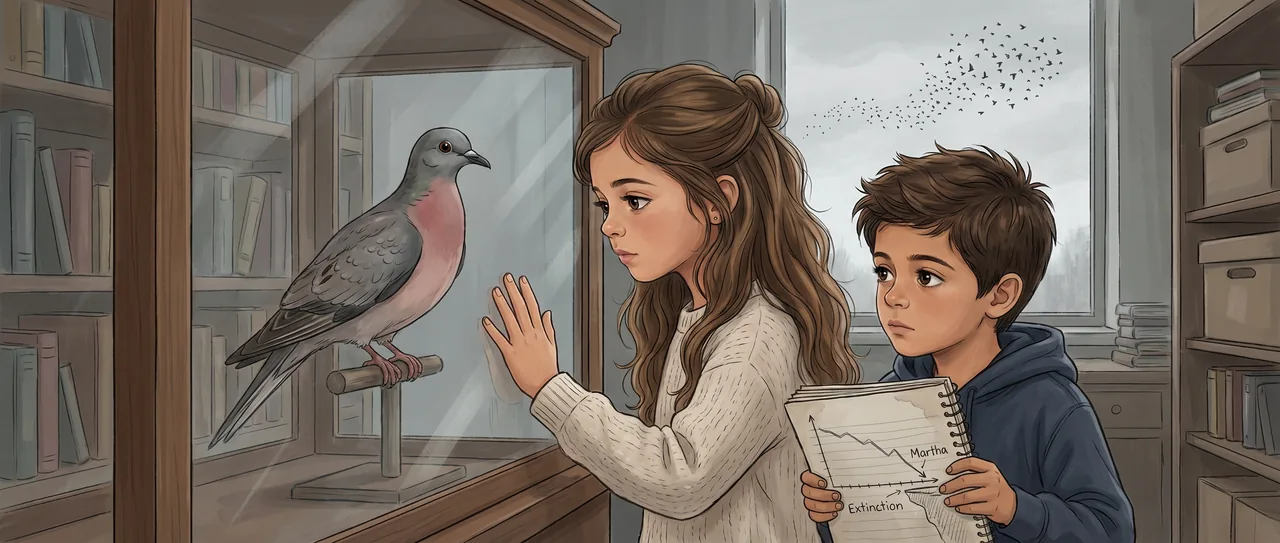
He stood in front of the glass case in the Cincinnati Zoo's archive room, staring at the soft gray body, the rose-colored breast, the eye that was just dark glass now. A little placard read PASSENGER PIGEON, ECTOPISTES MIGRATORIUS. The bird looked like a mourning dove that someone had stretched slightly, made more elegant. More ordinary than he'd imagined.
"That's not Martha," Maya said from across the room. She was looking at a framed photograph on the wall, not the bird. "Martha was the last one. This is just a specimen from before."
"I know," Soren said. He did know. Martha had died right here, in this zoo, on September first, nineteen fourteen. He'd read it six times in different sources and the date never changed and the feeling never got smaller.
Maya walked over and stood beside him. She looked at the bird for a long time without saying anything, which was unusual for her.
"It doesn't make sense," she finally said.
"What part?"
"The math. Three billion to five billion in a single flock. A single flock, Soren. They said it took fourteen hours for one flock to pass overhead. Three days for another. And then fifty years later, zero." She pressed her finger against the glass, right next to the bird's frozen wing. "How do you lose something that big?"
Soren opened his notebook. He'd copied down the numbers at the library that morning, and they still looked wrong on the page. "One estimate said they were twenty-five to forty percent of all birds in North America. Not twenty-five percent of pigeons. Twenty-five percent of all birds."
Maya shook her head slowly. "One out of every four birds you'd see. Imagine walking outside and one in four birds is the same species. They were everywhere."
"And that's the part that bothers you?"
"No. What bothers me is that everybody saw it happening. They weren't invisible. You couldn't miss them. The sky went dark. People wrote about it, painted it. There are newspaper accounts of the flocks being so thick they broke tree branches when they landed. Branches just snapping under the weight."
The archive room was quiet. Dr. Kalra, the zoo's collections manager, had let them in twenty minutes ago and then gotten a phone call she said would take a while. She'd waved her hand at the room and said, "Don't open the drawers, don't touch the specimens, and try not to breathe on anything from before nineteen hundred." Then she'd disappeared into the hallway, already talking about shipping containers.
Soren looked at the bird again. He tried to multiply it. Tried to imagine not one but a billion of this exact bird, filling the sky in a column three hundred miles long and a mile wide, their wings beating so close together you could hear the sound from miles away like a river in the air.
He couldn't do it. His brain just kept showing him one bird.
"They were colonial nesters," he said. "They needed enormous flocks to breed successfully. The huge numbers weren't just how many there were. The huge numbers were how they survived. Without the giant flock, they couldn't, I don't know, they couldn't be themselves."
Maya turned to look at him. "Say that again."
"The flock wasn't just a lot of birds in the same place. The flock was the thing. One passenger pigeon wasn't really a passenger pigeon. A billion passenger pigeons were a passenger pigeon."
"So when the hunters thinned the flocks enough, they didn't just reduce the population. They broke the thing that made the population work."
"Right. Below a certain number, they couldn't nest successfully. The flocks got too small to function as flocks. And then it just," Soren drew a line in his notebook that curved gently downward and then dropped off a cliff, "collapsed."
Maya was pacing now, three steps one way, three steps back, which meant something was building. "That's the part that doesn't fit with how I think about extinction. I always thought extinction was about the last one. Martha in a cage. The final bird dying and then the species is gone. But that's not what happened. The species was already gone before Martha died. It was gone the moment the flocks got too small. Martha was just the epilogue."
Soren felt something cold and precise settle in his chest. She was right. The extinction didn't happen in nineteen fourteen. It happened somewhere in the eighteen eighties or nineties, in a moment nobody marked, when the last flock dropped below whatever number it needed to be to still be a flock. Everything after that was just the long quiet of something already finished.
"People tried to breed them in captivity," Soren said. "It didn't work. You can't captive-breed a species that needs a million neighbors to feel safe enough to nest."
"Because the thing you're trying to save isn't the bird. It's the billion."
They stood there, both of them looking at the single bird behind glass.
Dr. Kalra appeared in the doorway, phone still in hand. "Finding what you need? I've got about four more minutes of hold music before shipping gets back to me."
"Dr. Kalra," Maya said. "Is there anything alive right now that works like this? Where the population size itself is what keeps the species going?"
Dr. Kalra paused. "Oh, quite a few. Herring, some coral species, locusts arguably. There are species that need density, need abundance, to trigger breeding behaviors, to overwhelm predators, to maintain genetic diversity. The term is Allee effect, if you want to look it up. Below a critical threshold, survival actually gets harder the fewer individuals remain. A death spiral."
She vanished back into the hallway. Soren wrote down Allee effect, and then underneath it, the question neither of them had said out loud yet.
"So which ones right now are getting close to that line," Maya said. Not a question. A statement of the thing she was going to find out.
"And you can't tell by counting the last few," Soren said. "You have to know what the number needs to be. You have to know what the flock needs to be."
Maya pressed her hand flat against the glass case, next to the bird that had once been part of a sky-darkening river of wings.
"We count what's disappearing," she said. "But we don't always know what the number means."
Outside the archive room window, a flock of starlings swept past in a murmuration, maybe two hundred birds folding and unfolding against the gray Ohio sky, moving like a single creature that did not know its own shape.
Read the interactive version, listen to the narration, and earn a gold star →
A science-verified short story for curious kids · Curiosity Land