The Kittens Who Could Not See Stripes
The poster outside the lab said COME SEE HOW SEEING WORKS, which Soren thought was either clever or trying too hard. Maya was already through the door.
Inside, a dozen stations were set up with monitors and optical illusions and brain models you could take apart. Most of the other kids from the Saturday science program had clustered around a station where you could watch your own pupil dilate on camera. Maya walked past all of it toward the back wall, where a woman in a wrinkled lab coat was sitting alone beside a display that nobody was visiting.
Soren followed. He always followed when Maya walked like that, like something was pulling her.
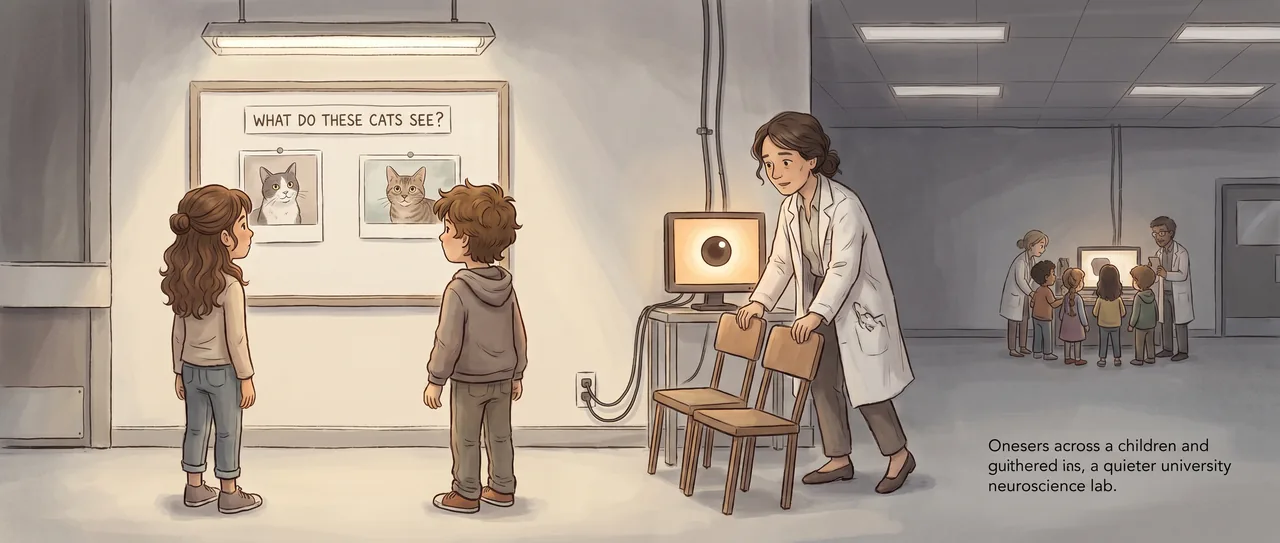
The display was simple. Two photographs of cats, side by side. Underneath, a single question: WHAT DO THESE CATS SEE?
"They see the same thing," Soren said. "They're both looking at the same room."
"Are they, though?" Maya said. Not to him. To the photographs.
The woman in the lab coat looked up. She had been reading something on her phone and seemed mildly surprised that anyone was standing there. "Oh. Hello. I'm Dr. Petrov. This station is. Well." She gestured vaguely. "It's not very flashy."
"What's different about the cats?" Maya asked.
"Nothing you can see from a photograph. That's sort of the problem with this display. My graduate student was supposed to build an interactive but she's defending her thesis on Monday and I told her not to worry about it." Dr. Petrov rubbed her eyes. "The cat on the left was raised normally. The cat on the right was raised, from birth, in an environment that contained only vertical lines. Vertical stripes on the walls. Vertical bars on the enclosure. Nothing horizontal. This was weeks old, decades ago. Classic experiment."
Soren waited. Maya was doing the thing where she went still.
"What happened?" Soren asked.
"The cat on the right can't see horizontal lines. Not won't. Can't. You could put a horizontal bar right in front of it at whisker height and it would walk into it. Every time. Its brain never learned to process horizontal because horizontal was never there when its visual cortex was wiring itself up."
Soren felt the words land strangely, like they were heavier than they should have been.
"But its eyes work," Maya said.
"Its eyes work perfectly. Light enters. Signals travel the optic nerve. Everything is fine until the signal reaches the part of the brain that's supposed to interpret orientation. The neurons that should have learned to respond to horizontal lines, during those first weeks of life, they wired themselves to respond to vertical instead. Because vertical was all there was."
"So you show it horizontal lines later," Soren said. "You put it in a normal room. It relearns."
Dr. Petrov shook her head. "That's what everyone thinks. That's what I thought when I first read the Hubel and Wiesel papers in college. But no. The window closes. Those neurons committed. You can put that cat in the most horizontal room in the world for the rest of its life and it will never see horizontal. The window was open, and then it shut."
Maya turned to Soren. Her face had a look he recognized. Not the look she got when something was cool. The look she got when something was important and she hadn't figured out why yet.
"How long is the window?" she asked.
"In cats, a few weeks after birth. In humans, the critical period for basic visual processing is roughly the first few years. Different abilities have different windows. Some close earlier. Some later. But they close."
Dr. Petrov's phone buzzed. She glanced at it, typed something fast, looked back up. "Sorry. My grad student. Listen, the interactive would have been better, but." She trailed off and went back to her phone.
Maya and Soren stood there looking at the two cats.
"Soren," Maya said quietly. "The cat's eyes are sending the right information."
"I know."
"The world has horizontal lines in it. The light is hitting the retina correctly. The data is all there. And the brain just. Doesn't."
"Because it never got the chance to learn during the one time it could have learned."
They were both quiet for a moment.
"It's walking around in a world that's partly invisible," Soren said. "And it doesn't know. It can't know what it's not seeing."
Maya was staring at the photograph of the normal cat. "Soren. What if it works the other way too?"
"What do you mean?"
"What if there are things in the world, real things, that human brains don't see because we never got exposed to them during our critical period? Not because our eyes can't detect them. Because our brains never learned to process them during the window."
"Like what?"
"That's the thing. We wouldn't know. We'd be the cat walking into horizontal bars. We'd have no idea they were there."
Soren opened his mouth and closed it. He looked at the two photographs again. Two cats in the same room. One of them living in a world with missing pieces it could never discover were missing.
"We can't know what we can't perceive," he said slowly. "We can only know what we can."
"Unless," Maya said.
"Unless what?"
"Unless we build instruments. That's what instruments are, Soren. Telescopes. Spectrometers. Radio arrays. They're like, they're prosthetic critical periods. They let us see the things our brains never got wired to notice."
Soren stared at her. Then he stared at the poster on the wall. WHAT DO THESE CATS SEE?
The question had been sitting there all afternoon and nobody else had stopped at this station. The pupil camera was more fun. The brain models were more fun.
But this was the one that mattered.
"Dr. Petrov," Soren said.
She looked up from her phone again.
"Your display is the best one here."
She blinked at them, then almost smiled. "Yeah," she said. "I know. Nobody ever stops, though."
"We stopped," Maya said.
Dr. Petrov looked at them for a long moment, the way people look at you when they're deciding you're real. Then she pulled two chairs over.
"Sit down," she said. "Let me tell you about what happens when you cover one eye of a newborn for just three days."
Maya sat. Soren sat. Somewhere across the room a kid shrieked with delight at the size of his own pupil on a screen.
But here, at the quiet station with the two cats, the world was getting larger.
Read the interactive version, listen to the narration, and earn a gold star →
A science-verified short story for curious kids · Curiosity Land