The Hungry Forest
Maya's mother had been wrong about the soil for three days, and Maya could not figure out why it bothered her so much.
They were at the research station outside Coca, in the Ecuadorian Amazon, where her mother was collecting soil cores for a university project. The station was four buildings with tin roofs and a generator that coughed every evening at six. Around it, the forest pressed in like something patient.
The problem was this: the soil was terrible.
Maya had helped her mother seal and label seventeen core samples. She had watched her mother frown at each one. She had heard her mother on the satellite phone saying, "The organic layer is thinner than we expected. Almost nothing. I know. I know."
Maya understood what her mother meant, because she had held the samples herself. Back home in North Carolina, you could dig a handful of forest soil and it would be black, crumbly, rich. It smelled like something alive. Here, in the most enormous forest on the planet, the soil was red clay and sand. A few centimeters of brown on top. Then nothing.
That was the part that wouldn't leave her alone. How could the richest forest in the world be growing in the poorest dirt?
On the fourth morning, instead of helping label samples, Maya walked into the forest.
Not far. She could still hear the generator. But she sat down at the base of a kapok tree whose trunk was wider than her bedroom and she looked at the ground.
Really looked.
The floor was a mess. Leaves, twigs, something that might have been a fruit rind. A beetle the color of motor oil trundled over her shoe. She picked up a leaf and it came apart in her fingers, already soft, already dissolving. She picked up another. Same. She dug her fingernails under the leaf layer and found almost nothing beneath it. Just that red clay, hard and tight.
She sat there for twenty minutes, turning things over.
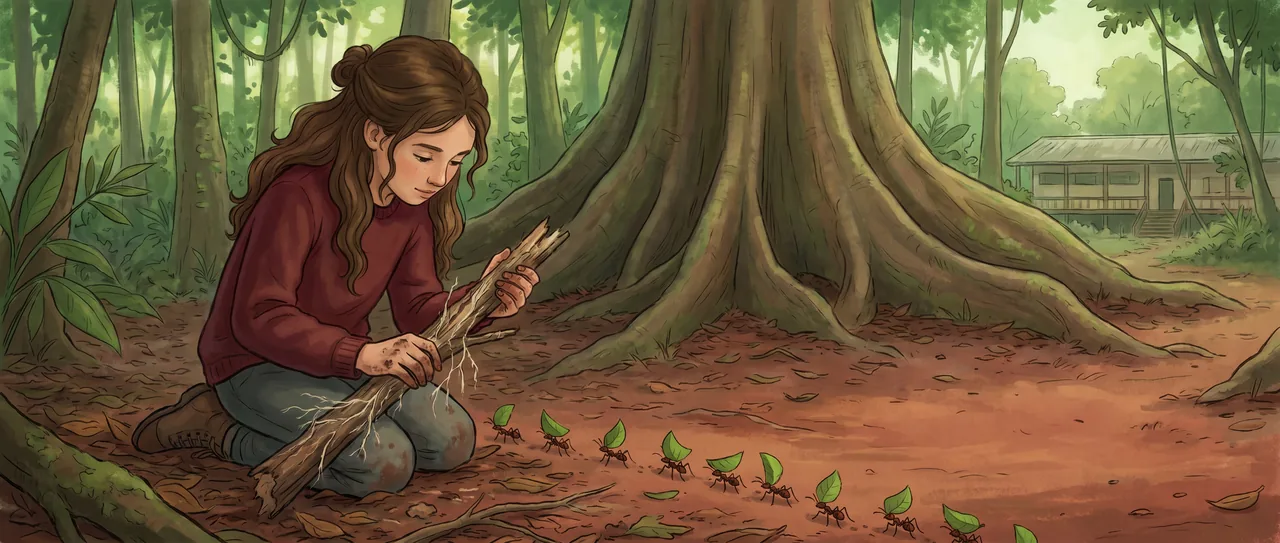
A column of leaf-cutter ants marched past her knee, each one carrying a crescent of green leaf held high like a sail. She watched them vanish into a hole between roots. She had read about leaf-cutters. They didn't eat the leaves. They grew fungus on them, underground, and ate the fungus. Even the ants were not taking nutrients out. They were cycling them. Breaking things down, rearranging them, feeding them back.
Maya picked up a stick. It looked solid, but when she squeezed, it compressed like wet bread. White threads laced through it, finer than hair. Fungus. She pulled the stick apart and the threads connected it to the soil, to a root, to another stick. She pulled gently on the root and felt resistance, like tugging on a net.
And then she understood what she was looking at.
Not dirt with a forest on top of it. Not trees rooted in soil the way she'd always imagined, like candles stuck in a cake.
The forest was eating itself.
Everything that fell was being taken apart so fast, so completely, that nothing accumulated. The nutrients never made it into the soil because they were intercepted. The fungal threads grabbed them. The roots grabbed them. The bacteria grabbed them. A leaf fell and before it could become dirt it was already becoming tree again.
The soil was poor because the forest was efficient. Not in spite of how alive it was. Because of how alive it was.
Maya stood up. She put her hand against the kapok trunk and felt the bark, warm and rough.
The tree was built from its own dead. The whole forest was. It held everything it needed inside itself, cycling and recycling, a closed loop of matter where almost nothing was wasted and almost nothing was stored.
The soil was not failing. The soil was empty because the forest was that good at being a forest.
She walked back to the station, where her mother was packing a cooler of samples.
"Mom. The soil isn't thin because something's wrong."
Her mother looked up. "I know, honey. Tropical soils are naturally nutrient-poor. That's well established."
"No, I mean, you keep frowning at the samples. Like they're disappointing."
Her mother paused. Sat back on her heels. "I'm frowning because the organic layer is even thinner than the models predicted. We're trying to figure out carbon storage, and there's less stored carbon in this soil than we thought."
"Because the carbon isn't being stored," Maya said. "It's being used. The forest doesn't save anything. It spends everything, all the time, immediately."
Her mother looked at her for a long moment. "That's. Yes. That's essentially correct."
"So you can't measure what the forest has by measuring the soil. The soil is like, the opposite of what the forest has. The poorer the soil, the better the forest is at catching everything before it gets there."
Her mother opened her mouth. Closed it. Opened it again. "That's a really interesting way to frame it for the carbon accounting."
"What happens if you cut the trees down?"
Her mother's face did something complicated. "Then the cycle breaks. The nutrients wash out. The rain takes them. There's nothing to catch them anymore."
Maya looked past her mother, into the wall of green. She thought about that. A forest that held all its wealth in its own living body. Where the ground was poor because everything precious was up, in leaf and trunk and root and fungal thread, moving, always moving, never sitting still. Cut the trees and you did not free the nutrients. You lost them. The forest's richness could not survive the forest's death.
It was the opposite of a bank. A bank stores things and they sit there. This was more like a conversation, where the meaning only exists while people are still talking.
She thought about the white threads inside the rotting stick, connecting root to soil to stick to root. She thought about how the poorest dirt in the world held up the richest forest in the world, and how that was not a contradiction. It was the same fact.
"Mom," she said. "Can I take a soil core in a clearing? Where a tree fell? I want to see if the layer is different there, where the cycle got interrupted."
Her mother handed her the coring tool without a word.
Maya walked back into the green, carrying the hollow steel tube, and knelt where the light came through.
Read the interactive version, listen to the narration, and earn a gold star →
A science-verified short story for curious kids · Curiosity Land