Every Cell a Clock
The cells were glowing.
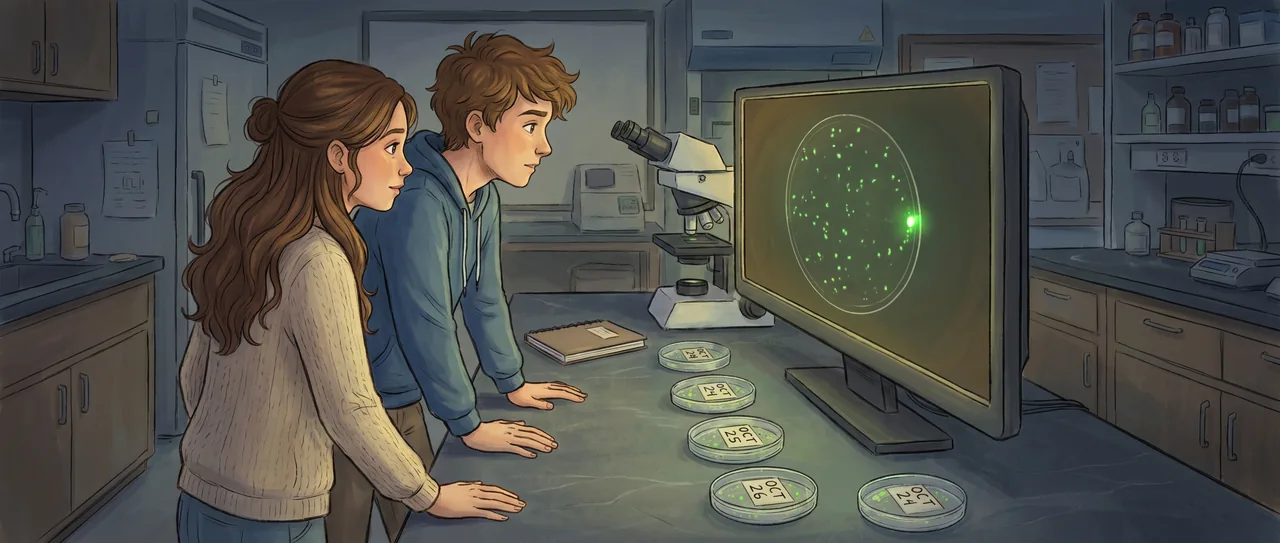
Not all of them. Not all at once. Maya pressed her face closer to the microscope screen and watched the tiny bright pulses move through the dish like a slow, scattered heartbeat. Some cells were bright right now. Others were dim. Others were somewhere in between, climbing toward their own private noon.
"They're skin cells," said the graduate student, already turning away to talk to a family with a toddler who was trying to eat a pipette. "From a biopsy three weeks ago. The fluorescent reporter lights up when their clock genes activate. Feel free to watch."
Then she was gone, and Maya and Soren had the microscope to themselves.
"Three weeks," Soren said. He was reading the index card taped to the bench. "These cells have been in this dish for three weeks. Removed from the body. No blood supply, no brain, no nothing."
"And they're still doing it," Maya said. She couldn't stop watching. The glow wasn't random. It was rolling through the dish in a slow wave, cells lighting and dimming, lighting and dimming. "Soren. They know what time it is."
"They think they know what time it is."
"What's the difference?"
Soren opened his mouth, then closed it. He wrote something in his notebook. Maya saw him underline it twice.
The index card said more. There were four dishes total, arranged in a row, each labeled with a date. Dish one was three days old. Dish two, ten days. Dish three, the one they were watching, twenty-one days. Dish four, thirty-eight days.
Maya moved to dish one. The glow here was almost synchronized. Cells pulsing in near-unison, like a choir breathing together. She moved to dish two. Still rhythmic, but looser. Some cells early, some late, like musicians who could hear the song but not quite the conductor.
Dish three, the one she had been watching. Beautiful disorder. Every cell still cycling, still keeping time, but each on its own schedule now. A city of clocks, none of them set to each other.
She moved to dish four.
"Soren. Come look at dish four."
He looked. The cells were still glowing. Still cycling. Thirty-eight days in a glass dish, and each cell was still turning its genes on and off, on and off, in a rhythm that was close to twenty-four hours.
"They're drifting," Soren said quietly. "Each dish is more out of sync than the last. But they're all still going."
"Because they can't see," Maya said.
Soren looked at her.
"The card says the master clock is in the brain. The supra, the supra something."
"Suprachiasmatic nucleus," Soren read.
"Right. And it uses light. Light through the eyes. That's the signal that keeps all the clocks in your body synchronized. Take the cells out of the body, and they lose the signal. But they don't stop. They just drift."
Soren was quiet for a long time. He moved back through the dishes. Four, three, two, one. Then forward again. One, two, three, four.
"It's like watching them forget what time zone they're in," he said. "But they never forget that time exists."
Maya felt something shift in her chest. She looked at her own hand, flat on the lab bench, and tried to feel it. Right now, underneath her skin, every single cell in her body was keeping time. Liver cells, bone cells, the cells lining her stomach, the cells in the tips of her fingers pressed against cold black countertop. Each one running its own clock. Each one cycling through the same twenty-four-hour program, over and over, genes switching on and off like someone breathing in their sleep.
And the only thing keeping all those billions of clocks in sync was a tiny knot of neurons behind her eyes, no bigger than a grain of rice, reading the light.
"How many cells are in a person?" she asked.
"Something like thirty-seven trillion," Soren said.
"Thirty-seven trillion clocks."
"All set by one."
A man in a university polo shirt walked up behind them. "Finding anything cool?" he asked, in the voice adults use at open houses, bright and slightly aimed over their heads.
"The cells in dish four," Soren said. "Their periods aren't exactly twenty-four hours, are they? Some are running a little fast, some a little slow."
The man paused. Looked at Soren differently. "That's correct. Individual cellular clocks vary. Some run at twenty-three and a half hours, some at twenty-four and a half. In the body, the master clock corrects for that drift every day. In the dish, there's no correction, so they spread out over time."
"What happens if someone's master clock breaks?" Maya asked.
"There are conditions where the SCN is damaged," the man said, slowly, like he was deciding how much to say. "The person's sleep cycle fragments. Organs start running on different schedules. Digestion, hormone release, temperature regulation. All still cycling, but no longer coordinated. It's like an orchestra where every musician is playing the right notes at the wrong time."
He paused again. "Most people at the open house ask me why we study fruit flies."
"We're not most people," Maya said, not boasting, just factual, already looking back at the screen.
The man smiled and moved on.
Soren was staring at dish one again. The youngest cells, still almost in sync, still almost remembering the body they came from.
"Maya. Think about what this means. Even when a cell is completely alone, completely cut off from every signal, it still keeps going. The rhythm is inside each one. It's not being told what to do. It knows."
"Every cell in your body is counting," Maya said.
"Every cell in your body has always been counting. Before you were born. The cells that built you were already keeping time."
Maya looked at dish four again. Thirty-eight days of solitude and the cells were still faithful to their rhythm, still loyal to a cycle they had never been taught, that was simply written into them. They would keep going until they died. Not because anything was telling them to. Because that was what they were.
Soren closed his notebook. He pressed both palms flat on the lab bench, right next to hers, and they stood there together, watching the cells in dish four pulse and dim, pulse and dim, each one alone, each one counting, patient and unsynchronized and absolutely certain that another cycle was about to begin.
On the screen, one cell at the edge of the dish brightened.
Read the interactive version, listen to the narration, and earn a gold star →
A science-verified short story for curious kids · Curiosity Land