Twice the Sky
The thing about Priya was that she never laughed at Tomás when he said something weird. And the thing about Tomás was that he never told Priya to stop when she filled another notebook.
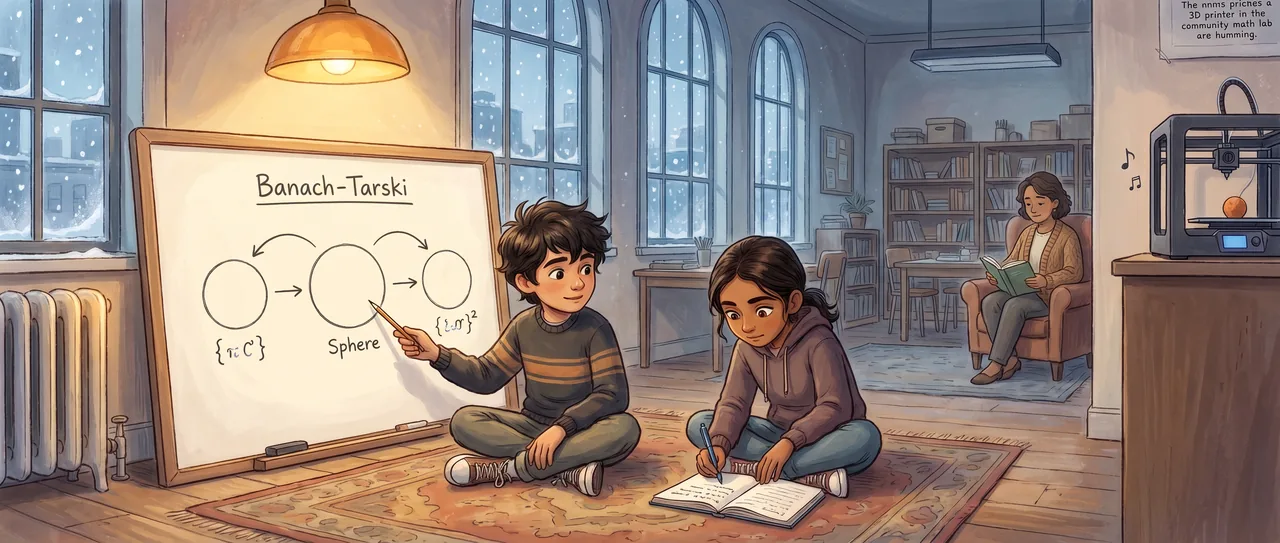
They met every Tuesday and Thursday in the math lab on the second floor of the old Duluth library, which smelled like radiator heat and someone else's coffee. The lab had been a reading room once. Now it had whiteboards on every wall and a 3D printer in the corner that hummed like it was dreaming.
Ms. Alvarado ran the lab, but she had a rule: she would not give answers. She would only give better questions.
"I want to duplicate something," Priya said on a Thursday in February, snow ticking against the tall windows.
Tomás looked up from the tessellation he was sketching. "Like a copy machine?"
"No. I mean mathematically. I want to prove you can take one thing and make two of the same thing without adding anything."
Tomás put his pencil down. "That is not possible."
"See, that is what I thought too. But then I found this." Priya opened her notebook to a page covered in her cramped handwriting. At the top she had written two words and underlined them three times: Banach-Tarski.
Tomás read the page. Then he read it again. Then he said, "This has to be wrong."
"It is a proven theorem."
"You cannot take a sphere, cut it into pieces, and rearrange those same pieces into two spheres the same size as the original. That breaks everything. That breaks conservation of volume. That breaks common sense."
Priya's eyes were doing the thing they did when she was about to drag him into something that would keep him up past midnight. They were bright and a little dangerous.
"It only breaks common sense," she said. "It does not break math."
They started at the whiteboard. Priya drew a sphere. Tomás drew a question mark next to it.
"Okay," Priya said. "The trick is in what kind of pieces you cut. They are not like slicing an orange. You cannot hold them. You cannot even really picture them. They are infinitely scattered, infinitely complex sets of points."
"So they are not physical pieces."
"No. They are mathematical pieces. Collections of points chosen using something called the Axiom of Choice. You reach into infinity and you select, point by point, and you build these sets that have no volume in the normal sense. They are so strange that our usual idea of size does not even apply to them."
Tomás stared at the sphere she had drawn. "So volume is not what we think it is."
"Not at the deepest level. Our everyday idea of measuring things, like saying this ball is so many cubic centimeters, that idea has a boundary. There are sets of points so wild, so infinitely tangled, that measurement cannot hold them. And when you work with those sets, the normal rules release."
Something shifted in Tomás. It felt like standing on a frozen lake and hearing the ice speak beneath him. Not breaking. Just reminding him how deep the water was.
"Show me the rotations," he said quietly.
Priya showed him. You take the pieces, only five of them in fact, and you do not stretch them. You do not scale them. You only rotate and slide them through space. Pure rigid motion. And when you set them down, there are two complete spheres where one had been.
"Five pieces," Tomás repeated.
"Five. And all you do is move them."
They worked for two hours. Tomás kept trying to find where the extra material sneaked in, and Priya kept showing him that it did not. The pieces were not measurable in the ordinary sense. That was the whole engine of the paradox. When you assembled them into spheres, each sphere had normal, well-defined volume again. One ball of clay becoming two, if the clay were made of mathematical points instead of atoms.
"This does not work with real objects," Tomás said.
"No. Atoms are discrete. You cannot choose points from a continuum in a physical object. Matter has a grain to it. But mathematical space does not."
"So the universe is safe."
Priya smiled. "The physical universe. But the mathematical universe just got a lot stranger than you thought it was thirty minutes ago."
Tomás sat down on the old library carpet and looked at the whiteboard full of their arrows and labels. "Priya. If measurement breaks down at that level, what does that mean for all the other things we think we know about space?"
"That is exactly the right question," said Ms. Alvarado from across the room, not looking up from her book.
Priya sat down next to Tomás. Their shoulders almost touched. Outside, snow was burying Duluth one flake at a time, each one a tiny crystal obeying rules of symmetry that Tomás now suspected were floating on top of something much deeper and much wilder.
"You know what gets me?" he said. "People think math is about answers. About getting the right number on a test. But this is the opposite. This is math proving that something impossible is true. This is math breaking its own rules and then showing you the break is the rule."
Priya pulled her knees up to her chest. "Sometimes I feel like the only person who thinks about this kind of stuff."
"You are not," Tomás said. "You are sitting next to another one."
She nodded. For a minute neither of them spoke.
Then Tomás said, "If five pieces can make two spheres from one, what is the minimum number of pieces for three spheres?"
Priya opened a fresh page in her notebook.
"And what happens," Tomás went on, his voice getting faster, "if you apply the same logic to four-dimensional spheres? Does the paradox still hold? Does it get stranger?"
Priya was already writing.
The snow fell. The radiator clanked. The 3D printer hummed its small dream in the corner.
And on the whiteboard, one sphere was still becoming two, patiently, impossibly, waiting for anyone brave enough to ask what it became next.
Read the interactive version, listen to the narration, and earn a gold star →
A science-verified short story for curious kids · Curiosity Land