The Weight of a Thousand Skies
Maya pressed her face against the observation window and counted.
She always counted when she was nervous. The bolts around the porthole glass: thirty two. The seconds between each ping of the sonar: four. The meters between her and the surface of the Pacific Ocean: three thousand, and falling.
Her mother was somewhere above, in the communications module of the Hadal Research Platform, monitoring signals and letting Maya ride along on the weekly instrument drop. Dr. Reyes, the station's chief engineer, sat at the submersible's controls, humming something tuneless. But neither of them was paying attention to what Maya was paying attention to.
The darkness outside was not empty.
Something had flickered past the floodlight at two thousand eight hundred meters. Something pale and quick. Maya had opened her mouth to say so, but the words dissolved. She was eleven. People smiled when she said things. Not mean smiles. Worse. Patient ones.
So she pressed her face closer and watched.
The submersible, Calypso Seven, was a glass-and-titanium teardrop the size of a small car. It descended on a cable toward the instruments they were replacing on the trench floor. The depth counter on the wall clicked past five thousand meters. Six thousand. Seven.
Maya did the math she always did when she was thinking. Mount Everest was eight thousand eight hundred forty nine meters tall. They were already deeper than Everest was high. And they were still falling.
"Dr. Reyes," she said. "How much farther to the bottom?"
"Almost eleven thousand meters to the deepest point," he said. "We are stopping at ten thousand two hundred, where the instrument package sits. Still a ways yet."
Maya stared into the black water. Everest could be standing on the ocean floor beneath them, its peak wrapped in snow and prayer flags, and there would still be more than a mile of water above its summit. A mile of ocean over the tallest mountain on Earth. She tried to hold that thought in her mind and it kept slipping away, too large, like trying to fold the sky into a paper crane.
The pressure gauge read seven hundred atmospheres and climbing. Seven hundred times the weight of the air pushing down on every person walking around on the surface. By the time they reached the bottom it would be over a thousand. A thousand skies, stacked.
Nothing should live down here, Maya thought. Nothing at all.
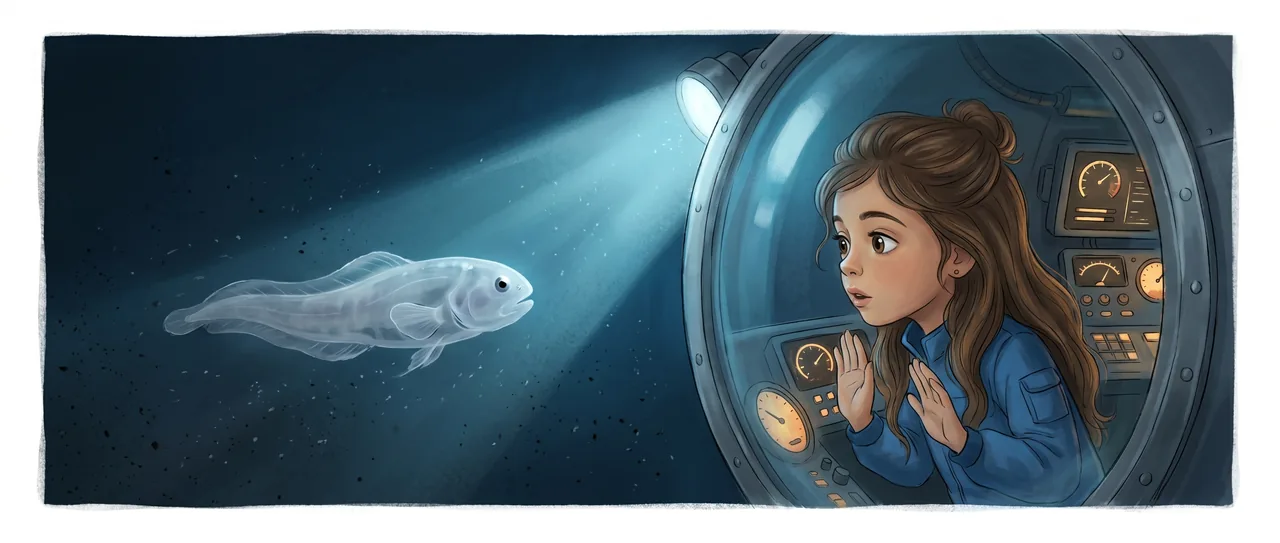
But at nine thousand six hundred meters, the floodlight caught something and Maya grabbed the edge of her seat.
A fish.
It was translucent, almost gelatinous, shaped like a tadpole the length of her forearm. It drifted through the light with a slow, ghostly ripple of its body, then turned, and for one moment its tiny dark eye caught the beam and shone.
"Dr. Reyes," Maya whispered. "There is a fish."
He glanced at the window and nodded. "Snailfish. They have been found deeper than eight thousand meters. Deepest living fish ever recorded."
Maya could not look away. The creature had no scales. No swim bladder. Its bones were barely there, more cartilage than calcium, flexible enough to bend under pressure that would crush a submarine like a paper cup. It did not fight the weight of a thousand atmospheres. It simply was the weight. It had made the impossible into a body.
The fish slipped back into the dark.
Maya's heart was beating fast, but not from fear. Something else. Something she did not have a name for yet.
At ten thousand two hundred meters, they reached the instrument package. Dr. Reyes extended the mechanical arm to detach the old sensor array and mount the new one. The process would take forty minutes. Maya watched, but her mind was somewhere else.
On the sediment below, in the cone of the floodlight, she could see tiny white shapes moving. Amphipods. Shrimp-like creatures, hundreds of them, swarming over something on the ocean floor. They were eating. Living. Thriving in a place where the pressure would flatten a human being into something unrecognizable.
And then she noticed something else.
The old sensor array, the one Dr. Reyes was removing, had a readout panel on its side. Even from inside the submersible, Maya could see the display. It was still running. And the numbers on the microbial density gauge were not just high. They were off the scale.
She leaned forward. "Dr. Reyes. The old sensor. It is still recording."
"Yes, it records until we pull it."
"The microbial count. Look at the number."
He paused the arm and looked. Then he looked again.
"That cannot be right," he said. "That is ten times the density we recorded last quarter."
Maya stared at the sediment beneath them. Ten times the microbes. In three months. At the bottom of the deepest trench on the planet, in a place that should be barren, life was not just surviving. It was multiplying. It was booming.
"Could something have changed?" she asked. "A new vent? A new chemical source?"
Dr. Reyes was already reaching for the radio. "Station, this is Calypso Seven. We need to flag the Hadal microbial data. Possible new chemosynthetic source at site fourteen. The numbers are, well, Maya spotted it. The numbers are extraordinary."
The radio crackled. Maya barely heard it.
She was looking at the amphipods dancing in the light. She was thinking about the snailfish with its soft bones and its dark, knowing eye. She was thinking about pressure. Not as a force that crushes, but as a door. A door to a kind of life that had figured out how to exist where nothing was supposed to.
A thousand skies pressing down. And underneath all of them, something small and translucent, looking back.
Maya pulled her notebook from her jacket pocket. She did not write a conclusion. She wrote a question, the only one that mattered.
If life can solve this, what else has it solved that we have not thought to look for yet?
The submersible began its long ascent. Maya kept her face pressed to the glass, watching the darkness below, which was not dark at all, not really, not if you knew what was living in it.
She was already thinking about the next dive.
Read the interactive version, listen to the narration, and earn a gold star →
A science-verified short story for curious kids · Curiosity Land