The Shape of Breathing
Maya floated upside down, which was the best way to think.
Or maybe there was no upside down on Station Aravind. That was one of those facts she kept rediscovering, the way you keep finding a coin in the same pocket. No up, no down, just Maya and her thoughts tumbling slowly through the protein lab while the Earth rolled blue and silent past the window.
She had a problem.
On the screen in front of her, or behind her, or below her, a hemoglobin molecule turned in slow rotation. It was beautiful. Four bundled chains, each cradling a heme group like a hand holding a marble. She had grown the crystal herself over eleven days in the microgravity crystallizer, and the imaging AI, Rho, had resolved it down to individual atoms.
"Rho, show me the oxygen docking again."
"Playing," Rho said, in that patient way of a friend who has been asked the same question nine times and does not mind being asked a tenth.
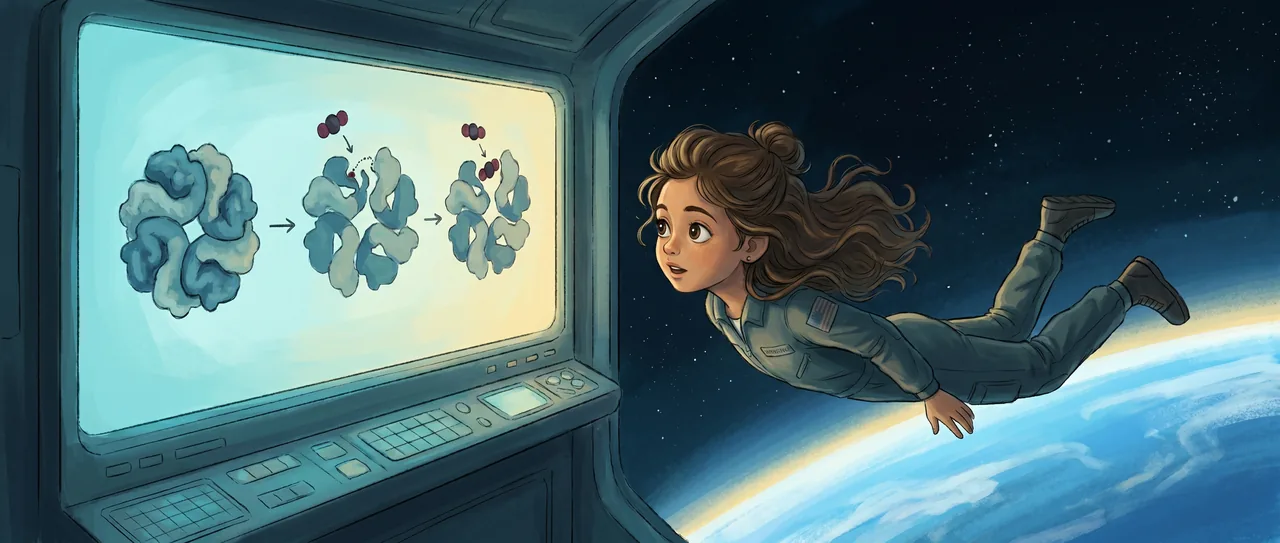
The molecule turned. A single oxygen molecule drifted toward one of the four heme sites and clicked into place. And then the thing happened. The thing Maya could not stop watching.
The whole protein moved.
Not just the spot where the oxygen landed. The whole molecule shifted, like a house settling, like a lock turning. The four chains rearranged themselves around each other, and suddenly the other three heme sites opened wider, as if they were hungry, as if they were reaching.
"One oxygen molecule lands," Maya whispered, "and the whole shape changes so the next three can land easier."
"Cooperative binding," Rho confirmed. "The T-state becomes the R-state. Tense to relaxed."
Maya tapped her fingers against the screen. She had watched this a hundred times. She understood the mechanism. What she did not understand was why it made her chest feel tight.
The problem was not hemoglobin. The problem was the Cascade Project.
Dr. Almeida's team was trying to design a new protein for carbon capture. Something that could grab carbon dioxide molecules from the atmosphere the way hemoglobin grabs oxygen from the lungs. They had the binding site designed. One molecule of carbon dioxide could dock perfectly. But they needed cooperative binding. They needed one capture to make the next capture easier, and the next, and the next, a cascade, the whole protein reshaping itself to become hungrier each time it caught something.
They had been stuck for two months. The designed protein just sat there, catching one carbon dioxide molecule and then clamping shut. No shape change. No cascade.
Maya was twelve. She was on Station Aravind because she had won the Junior Biodesign residency, and she was the youngest person ever to do so. People back home thought this was impressive. Maya thought it mostly meant she spent a lot of time floating upside down, not solving problems.
"Rho, show me the T-state again. Before the oxygen lands."
The molecule snapped back to its tense configuration. The four chains gripped each other tightly. The heme sites were half-hidden.
"Now show me just the contact points between the chains. Where they touch each other."
Rho highlighted them. Little bridges of salt and hydrogen bonds, holding the chains in their tense arrangement.
Maya stared.
"The oxygen does not force the shape change," she said slowly.
"Correct," said Rho.
"The oxygen just breaks one of those little bridges. And then the whole thing relaxes because it was already ready to relax. The tense shape is not the natural shape. It is the held shape. Like a spring."
She could feel something turning in her mind, the way the molecule turned on the screen.
"Rho, pull up the carbon capture protein. The Cascade design. Show me the contact points between its subunits."
The new molecule appeared beside the hemoglobin. Maya looked back and forth between them. The Cascade protein was beautiful too, in its way, but its subunits were built to fit together comfortably. Snugly. Like puzzle pieces in their right places.
"That is the problem," Maya said.
Rho waited.
"The Cascade protein starts relaxed. There is nowhere for it to go. When carbon dioxide docks, nothing changes because the shape is already comfortable. It is already home."
She pushed off the wall and floated to the modeling console.
"We have been designing it wrong. We have been trying to build a shape that opens when carbon dioxide arrives. But hemoglobin does not work that way. Hemoglobin starts locked. Clenched. The T-state is a spring held tight by those little salt bridges. Oxygen does not add energy. It removes a constraint. And the whole molecule unfolds into something that was always waiting to exist."
Her fingers moved fast on the console, pulling the subunits of the Cascade protein apart, rotating them, nudging them into a new arrangement. An uncomfortable arrangement. One held together by fragile little bridges that a single carbon dioxide molecule could snap.
"You are introducing deliberate strain," Rho observed.
"I am introducing potential," Maya said.
It took three hours. She forgot to eat. She forgot that Earth was outside the window. She rebuilt the protein from a place of tension, a coiled thing, a shape that wanted to change. And when she finally ran the simulation and watched a carbon dioxide molecule drift into the first binding site, the whole protein shuddered and opened, and the second site gaped wide, and the third, and the fourth.
Cascade.
Maya hung motionless in the middle of the lab, watching the molecule catch one carbon dioxide after another, each capture making the next one easier, the whole structure blooming like a flower that had been waiting its whole life for a single touch.
She thought about hemoglobin. Billions of those molecules were inside her right now, in her blood, clenching and unclenching, catching oxygen in her lungs and releasing it in her fingertips, and every single one of them worked because it started tense. Because the useful shape was not the comfortable shape. Because the thing that let it do its beautiful, necessary work was the strain.
Maya pressed her hand against the window. Below, the atmosphere was a thin bright line against the dark.
All that air. All that carbon dioxide.
All those molecules, waiting for a shape that was ready to reach.
Read the interactive version, listen to the narration, and earn a gold star →
A science-verified short story for curious kids · Curiosity Land