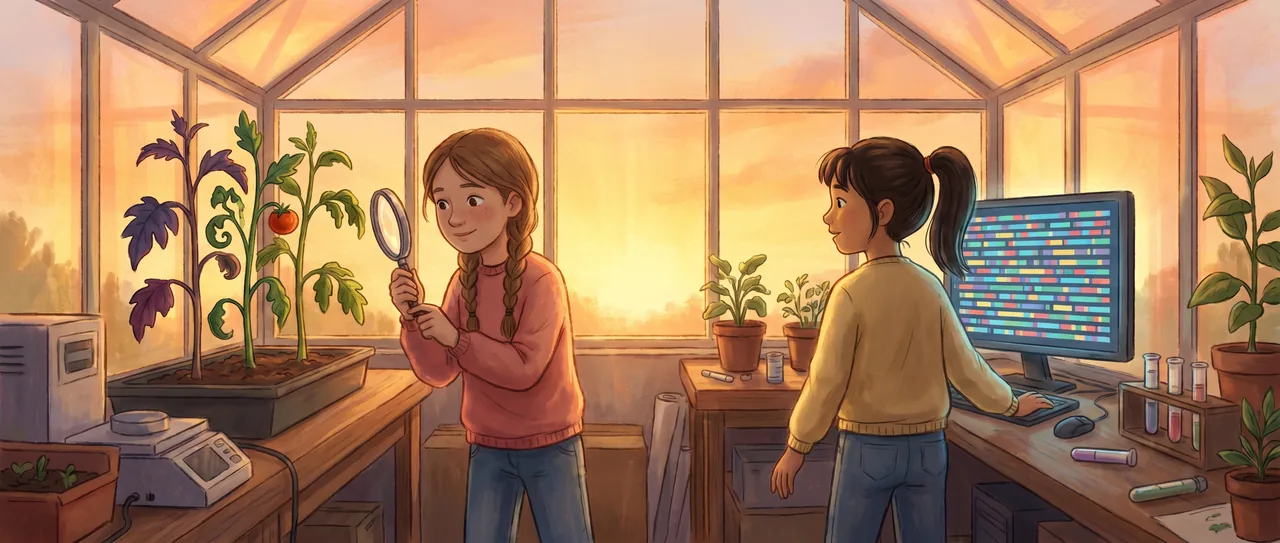
The Repeat Garden
The tomato plant had seven stems.
Not seven branches. Seven stems, all rising from the same root crown like fingers reaching out of the soil. Each one slightly different. One grew leaves so dark they were almost purple. Another had leaves curled tight as fists.
Everyone else in the community lab walked past it. Maren did not.
"Suki," she said. "Come look at this."
Suki was across the greenhouse, hunched over the old sequencing station, running a sample from their pepper plants. She did not look up. "I'm watching the reads come in."
"The reads can wait. This tomato is weird."
That was the word that always worked. Suki pushed back her stool and crossed the greenhouse in four steps. She was tall for eleven, and fast when something was weird.
They stood together over the seven-stemmed plant. Maren had already pulled out her hand lens and was comparing the leaves from different stems.
"These two stems have totally normal leaves," Maren said. "But this one has thicker veins. And this one, look, the edges are almost smooth. Tomato leaves aren't supposed to be smooth."
"Same plant, though," Suki said. "Same roots."
"Same DNA."
"Then why do the stems look different?"
That was the question that kept them in the greenhouse until the afternoon light turned gold.
Suki went back to the sequencing station and pulled up the reference genome for their tomato variety. Maren carefully clipped one leaf from each of the seven stems, labeled them with a grease pencil on small plastic tubes, and brought them over.
"We're going to sequence all seven?" Suki asked.
"We're going to sequence all seven."
The little sequencer hummed. It was not fancy. It was the kind of machine that community labs got donated when universities upgraded. But it worked, and Suki knew how to coax good data out of it.
While they waited, Maren pulled up everything she could find about chimeric plants. Plants that carried more than one genetic identity in a single body. She read out loud while Suki monitored the run.
"It says here that sometimes during cell division, big chunks of DNA get duplicated. Not just one letter changing. Whole sections. Hundreds of genes at once, just copied and pasted."
"Or deleted," Suki added, pointing to a paragraph on the screen.
"Right. Deleted. So one cell might have two copies of a region, and the daughter cell might have zero copies. And then all the cells that grow from each one are different from each other."
Maren sat with that for a moment. "So it's not like a typo in a book. It's like someone photocopied an entire chapter and stapled it in. Or ripped a chapter out."
"And the book still works," Suki said quietly. "Just differently."
The first results came back an hour later. Suki lined up the sequences from stems one through seven against the reference genome, and they both went silent.
Stems one and two matched the reference almost perfectly.
Stem three had a duplication. A region on chromosome five appeared three times instead of twice.
Stem four had the same region only once.
Stem six had a completely different duplication, this time on chromosome nine, carrying a cluster of genes involved in leaf shape.
"That's the smooth-edged one," Maren whispered, checking her labels.
"Maren. These copy number differences. They cover more of the genome than all the single-letter changes combined."
They stared at the screen. The colored bars showed it plainly. The small mutations, the single-letter swaps, were scattered like grains of sand. But the duplications and deletions were landslides. Great swaths of genetic material, doubled or vanished.
"We always hear about point mutations," Maren said. "One letter changes, one gene affected. But this is huge. This is like the plant is rewriting whole paragraphs of itself."
"Not rewriting," Suki said. "Remixing."
Maren looked at the seven-stemmed plant across the greenhouse. It was one organism, rooted in one pot of soil, drinking the same water. But it was carrying seven slightly different versions of its own genome, and each version was building a different kind of leaf, a different shade of green, a different way of being a tomato.
Something shifted in her chest. The plant was not broken. It was exploring.
"Suki. If this happens in plants, it happens in people too, right?"
"It does. Every human genome has copy number variations. Hundreds of them. Some regions duplicated, some deleted. No two people have the same set."
"So we're all carrying around these big structural differences, and most of the time nobody even looks at them because everyone's focused on the single-letter stuff."
Suki smiled. It was the particular smile she made when a pattern clicked into place. "The small changes are easier to find. But the big ones might matter more."
Maren picked up the tube labeled stem five. They had not sequenced it yet. She held it up to the light. The leaf inside was unremarkable. Ordinary green, ordinary shape.
"What do you think this one's hiding?" she asked.
"Only one way to find out."
Maren loaded the sample. The sequencer hummed again.
Outside, the sun had reached the edge of the greenhouse roof. Light poured sideways through the glass, and for a moment every plant in the room glowed, each one holding its own private library of duplications and deletions, written in a language that most people were only just beginning to read.
Maren thought about all the genomes in the world. In every wheat field, every forest, every person walking down every street. All of them carrying these hidden rearrangements. Not errors. Variations. Whole chapters doubled and deleted, each combination producing something that had never existed before.
She did not say any of this out loud. She just watched the data begin to appear on screen, line by line, like a door opening onto a room she had never known was there.
Suki leaned forward.
"Oh," she said softly. "You're going to want to see this."
Read the interactive version, listen to the narration, and earn a gold star →
A science-verified short story for curious kids · Curiosity Land