The Long Way Out
The sunset was almost gone when Priya climbed the ladder to the school roof, and she was annoyed to find someone already there.
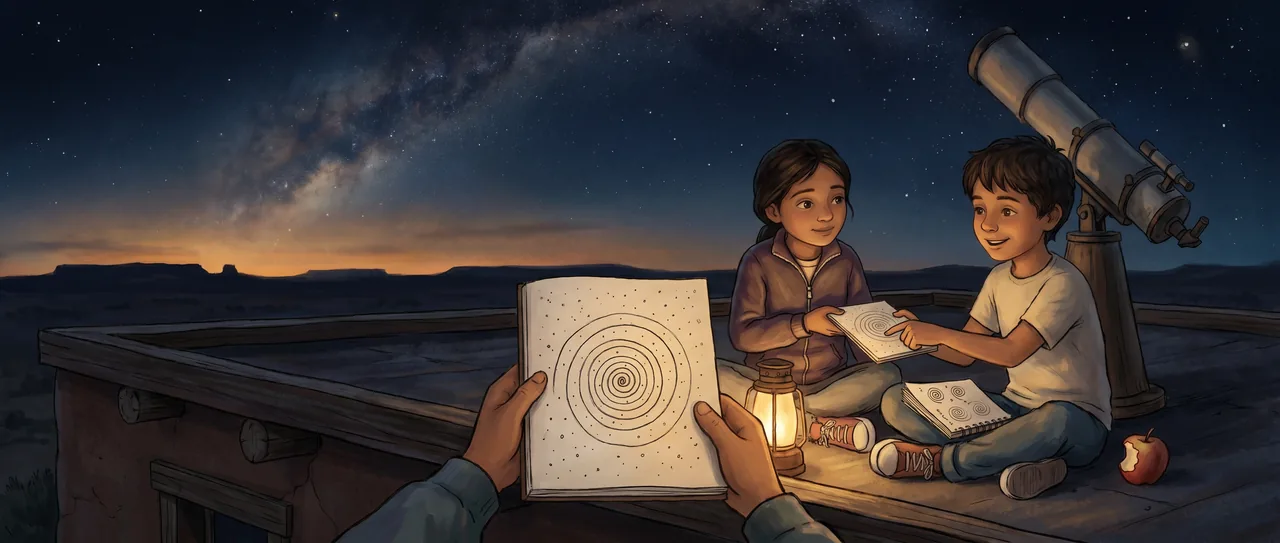
The boy was sitting cross-legged next to the old solar telescope, eating an apple. He had a notebook open on his knee, covered in tiny drawings that looked like spirals.
"Observatory is reserved," Priya said. "I signed up on the sheet."
"I did not know about the sheet," the boy said. He did not move. "I am Tomás. I just transferred here."
"Priya." She set down her bag. "What are you drawing?"
"A thing I cannot stop thinking about." He turned the notebook toward her. The spirals were not random. Each one started from a tight center and wobbled outward through a field of tiny dots, like a ball bouncing through a pinball machine. "Do you know how long it takes sunlight to reach us?"
"Eight minutes," Priya said. Everyone knew that.
"Eight minutes from the surface." Tomás tapped the center of his spiral. "But the photon does not start at the surface. It starts here. The core."
Priya sat down beside him. The last red band of sun was sinking behind the mesa. "So how long from the core?"
"One hundred thousand years."
Priya laughed. Then she saw his face and stopped laughing.
"One hundred thousand years," Tomás repeated. "The inside of the sun is so dense, so packed with atoms, that a photon cannot travel more than a centimeter before it hits something and bounces in a random direction. It gets absorbed. Re-emitted. Absorbed again. Over and over. It takes what physicists call a random walk. Like a person stumbling through the biggest, most crowded room you can imagine, bouncing off shoulders, turning around, going sideways, barely making progress."
Priya looked at the spiral drawing again. The wobbling path from center to edge. "A hundred thousand years just to get out of the sun."
"And then," Tomás said, "eight minutes across ninety three million miles of empty space. Like walking through a wall for a century and then sprinting across an open field."
The air was cooling. The first stars were appearing. Priya pulled her jacket tighter, but she did not feel cold. She felt something else. A kind of dizziness, as if the ground had shifted.
"So the light that just set," she said slowly. "Those photons started their journey when there were no humans. Before language. Before fire, maybe."
"Before this continent looked like this continent," Tomás said.
Priya opened her mouth and then closed it. She stared at the place where the sun had been. The horizon was glowing orange and gold, which meant photons were still arriving, still finishing their ancient, stumbling journey and touching the sky over New Mexico like they had been trying to reach this exact place the whole time.
She grabbed her own notebook.
"What are you doing?" Tomás asked.
"Math." She was writing fast. "Okay. The sun's radius is about six hundred ninety six thousand kilometers. If a photon takes a hundred thousand years to get from the core to the surface, and it travels at the speed of light between each collision, then we can figure out how many times it gets bounced. How many collisions."
Tomás leaned over. "You want to calculate the number of steps in the random walk?"
"Yes."
They worked together. Tomás knew the formula for a random walk, the distance covered equaling the step size times the square root of the number of steps. Priya was faster at the arithmetic. They passed the notebook back and forth, and the stars came out around them like an audience gathering.
The number they arrived at was so large Priya had to count the zeros twice. Roughly ten to the twenty fifth power. A one followed by twenty five zeros. That was how many times a single photon was absorbed and re-emitted before it reached the surface.
They sat with the number between them.
"It never gave up," Priya said. She knew a photon was not a person. She knew it did not have feelings or intentions. But she also knew what she meant, and Tomás nodded.
"Every single bounce was random," he said. "No direction. No map. Just one more step. And after enough steps, it got out."
"And then it crossed space in eight minutes and hit my face," Priya said.
Tomás laughed, and it was the kind of laugh that meant yes, exactly, you understand.
Priya had never had a friend who did math for fun. She had never met someone who sat on a roof drawing the paths of photons. The kids at school asked her why she always carried a notebook, why she stayed after class to ask questions, why she cared about things that were not on the test. She had started to wonder if they were right, if caring too much about strange things was a kind of mistake.
But Tomás had climbed to the roof too. Tomás had a notebook too.
"Do you think about this stuff a lot?" she asked. "Things nobody else seems to think about?"
"Every day," Tomás said. "My mother says my brain is like one of those photons. Going in every direction. Taking a long time to get anywhere."
"Maybe that is how it works, though," Priya said. "Maybe you have to bounce around for a long time before you break through."
The sky was fully dark now. The Milky Way was visible, which meant they were looking at light that had taken not a hundred thousand years but thousands and millions of years to arrive, each photon carrying its own secret history of collisions and escapes.
Priya thought about all that light raining down on them, ancient and patient and relentless. She thought about random walks, about how something with no direction and no plan could still, given enough time, cross impossible distances.
"Tomás," she said.
"Yes."
"Same time tomorrow?"
He closed his notebook and looked up at the stars, and the stars looked back, and their light was older than anything either of them could name.
"I will bring a bigger notebook," he said.
Above them, light that had started its journey before the pyramids were built was just now touching the Earth, and somewhere deep inside the sun, new photons were beginning their first billion bounces toward a surface they would not reach for another hundred thousand years, heading toward a world they could not imagine, where two children on a rooftop were already waiting for them.
Read the interactive version, listen to the narration, and earn a gold star →
A science-verified short story for curious kids · Curiosity Land