The Frequency of You
The first thing Deshi noticed about the new girl was that she flinched when someone laughed too loud.
Not a big flinch. Not even a flinch most people would catch. But Deshi noticed things like that. He noticed that Mr. Kazarian always touched the doorframe before entering a room. He noticed that the cafeteria milk was colder on Tuesdays. He noticed so many things that his mother once said, gently, "Deshi, not everything needs to be observed," and he had nodded politely and gone right on observing.
The new girl's name was Sable, and she sat three seats away from him in the Saturday Brain Lab at the university. Twelve kids had signed up. Deshi had signed up because the flyer said "See your own neurons fire in real time," and that was the kind of sentence that made his heart beat faster.
Sable, he suspected, had signed up for a different reason.
Dr. Owusu ran the lab. She was small and quiet and never once told them to pay attention, which made Deshi pay more attention than he ever did at school. Today she placed two chairs facing each other in front of a wide screen connected to a portable brain scanner.
"I need two volunteers," she said. "One to do something. One to watch."
Nobody raised a hand. Deshi raised his hand. After a moment, across the room, Sable raised hers.
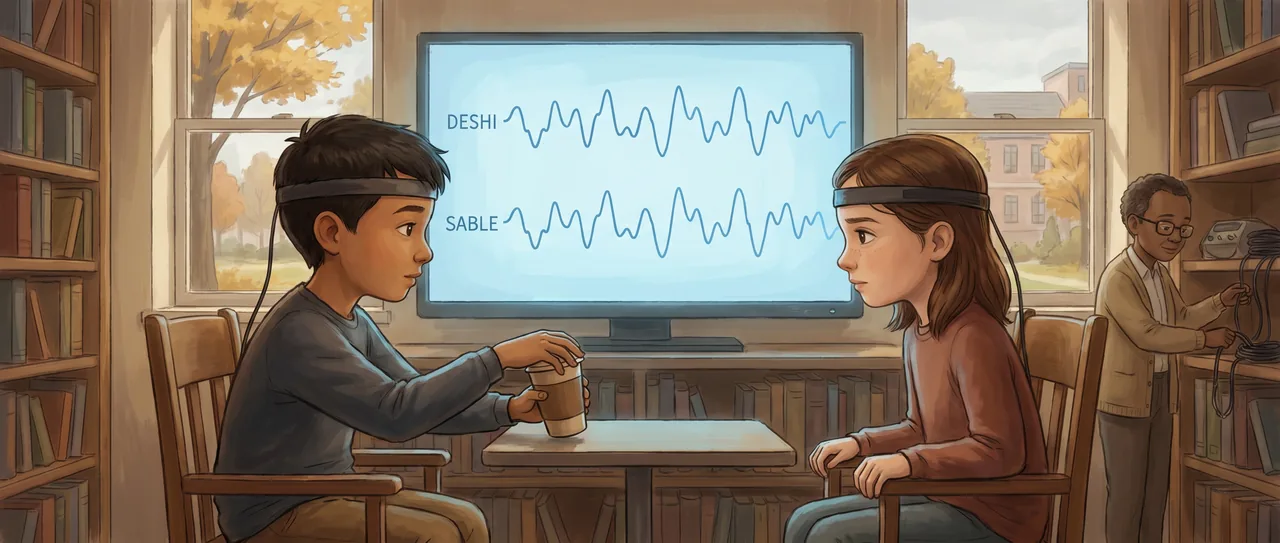
They sat facing each other. Dr. Owusu fitted a lightweight band around each of their foreheads. "These read electrical activity in a part of your brain called the premotor cortex," she said. "Deshi, I want you to pick up this cup. Sable, I want you to do absolutely nothing. Just watch him."
Deshi reached out and picked up the paper cup.
On the screen behind them, two waveforms appeared. One was labeled DESHI and the other SABLE. The twelve kids in the room went silent.
The waveforms were nearly identical.
"I didn't do anything," Sable said.
"Your hand didn't move," Dr. Owusu agreed. "But part of your brain did the same thing his brain did. You have neurons that fire when you act and when you watch someone else act. They're called mirror neurons."
Deshi stared at the screen. His pattern and Sable's pattern pulsed together like two versions of the same song played half a beat apart.
"Do it again," he said.
He picked up the cup. The waveforms bloomed.
He set the cup down. They settled.
He picked it up with his left hand. Sable's pattern shifted, following his.
"It's like her brain is practicing," he said slowly.
"That is exactly what some researchers believe," Dr. Owusu said. "When you watch a person do something, your mirror neurons simulate the action internally. It may be how babies learn to smile back at their parents. How you learn to throw a ball by watching someone else throw first. How you wince when you see someone stub their toe, even though your toe is fine."
Sable was quiet. Then she said, so softly that only Deshi and the microphone caught it: "Is that why it hurts?"
Dr. Owusu tilted her head.
"When someone else is hurting," Sable said. "Is that why I feel it too? In my actual body?"
The room was very still.
"Many scientists think so," Dr. Owusu said. "Mirror neurons are one proposed mechanism behind empathy. Your brain may literally be running a copy of what it sees in other people."
Deshi looked at Sable. Sable looked at the waveforms.
"My mom says I'm too sensitive," she said. "She says I take on other people's feelings and it isn't healthy."
Deshi said nothing for a moment. Then he picked up the cup again, very carefully, very gently, and watched the screen.
Two patterns. Dancing together.
"You're not too sensitive," he said. "Your mirror neurons might just be really, really good at their job."
Something happened in Sable's face. Not a smile, exactly. More like a door opening.
After the session, the other kids filed out for juice boxes and granola bars, but Deshi and Sable stayed by the screen. Dr. Owusu let them. She was across the room organizing equipment and did not hover.
"Do you think animals have them?" Sable asked.
"Mirror neurons?" Deshi thought about it. "Dogs always seem to know when you're sad."
"What about octopuses?"
"I don't know. That's a good question."
"What about trees? Like, not neurons, but what if there's something else? Fungi networks or something?"
Deshi's mind lit up. He had read about mycorrhizal networks, the vast webs of fungal threads that connected tree roots underground, letting them share nutrients and chemical warning signals. A whole forest, quietly mirroring itself beneath the soil.
"What if mirroring isn't just a brain thing?" he said. "What if it's a pattern? A pattern that shows up everywhere living things are connected?"
Sable stared at him. He could feel the hum of an idea too big to hold, pressing against the walls of his skull like something trying to hatch.
"Because empathy can't just be in here," Sable said, tapping her forehead. "It's too big to only be in here."
Deshi looked at the screen, now dark. He thought about how his waveform and Sable's had moved together. Two strangers who had never met, and their brains had recognized each other instantly, effortlessly, without being taught.
He thought about every time he had noticed someone else's small, hidden flinch and felt it echo inside his own chest. Every time a teacher had told him he was paying attention to the wrong things. Every time the noticing felt like a burden.
But it wasn't a burden. It was the oldest technology in the living world. Cells learning to listen to other cells. Organisms learning to feel what their neighbors felt. A web stretching from mirror neurons in a Saturday lab to fungal threads beneath a forest to something out there he couldn't name yet.
"You know what I think?" Sable said.
"What?"
"I think we're not too much. I think most people are just not paying attention."
Deshi grinned. Sable grinned back. And somewhere in both their brains, the very same pattern fired.
Outside the lab, the autumn campus stretched wide and gold, full of people walking and talking and gesturing with their hands, and neither Deshi nor Sable could look at a single one of them the same way now, because behind every face there were neurons quietly rehearsing the world, and the world was so much bigger than two kids in a lab, and so much more connected than either of them had words for yet.
Read the interactive version, listen to the narration, and earn a gold star →
A science-verified short story for curious kids · Curiosity Land