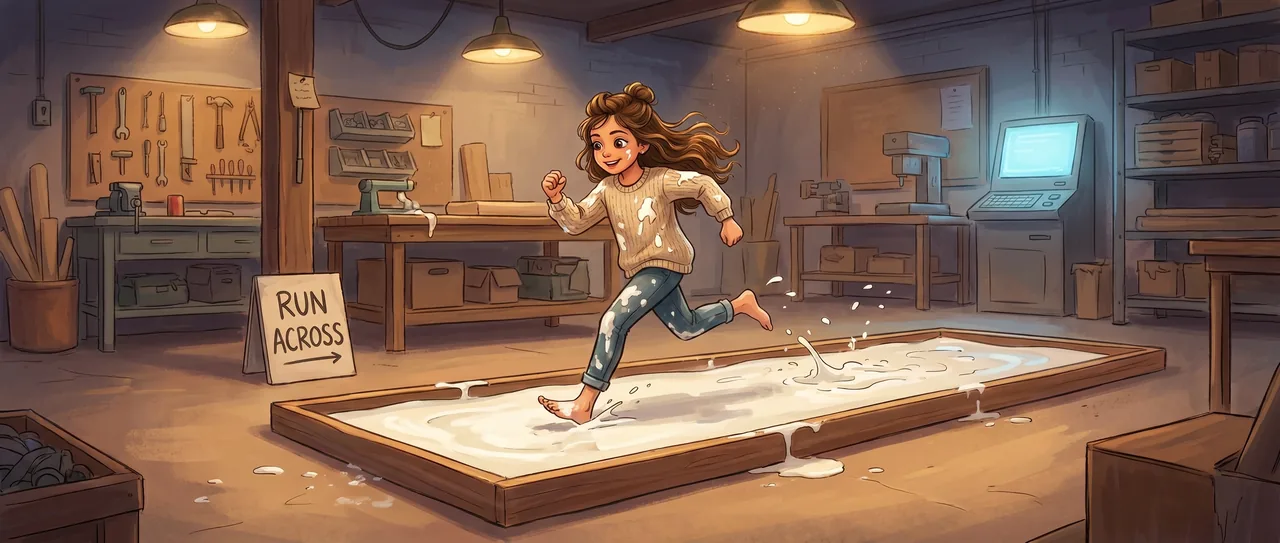
The Floor That Fought Back
Maya had been staring at the puddle for eleven minutes.
She knew it was eleven minutes because she had started a timer on her watch when she first noticed something wrong. The cornstarch mixture in the shallow tray was supposed to be simple. Four parts cornstarch, one part water, food coloring for visibility. She had mixed it for the science showcase display, just a boring demonstration with a poster and some bullet points.
But Maya did not do things in a boring way. That was, according to her last three teachers, both her gift and her problem.
She dragged one finger slowly through the white mixture. It parted like cream, flowing around her fingertip, cool and silky. Then she slapped the surface with her open palm.
Her hand bounced.
The liquid had gone solid. Not sort of solid. Solid like a table. Solid like a locked door. And the instant she stopped pressing, it relaxed back into a milky pool as if nothing had happened.
"That is so strange," she whispered.
She hit it again. Solid. She stirred it gently. Liquid. She rolled a marble across the surface slowly, and it sank. She flicked the marble fast, and it skipped across the top like a stone on a lake.
Maya pulled out her notebook. She did not write down what happened. She wrote down what she did not understand.
Why does speed change everything?
The makerspace was mostly empty at this hour. A few older kids were welding something in the back room. The overhead lights buzzed. Maya liked being here when it was quiet. Quiet was when things talked to her, if she listened.
She poured more mixture into the tray until it was two centimeters deep. She stepped into it with her bare foot, slowly, and her foot sank to the bottom. Then she tried something that any reasonable person would have called ridiculous.
She ran across it.
Her feet hit the surface fast, one after another, and the mixture held. It held her weight. She was running on top of a liquid. The moment she stopped moving, her feet began to sink, and she jumped off the edge of the tray laughing and dripping white goo on the concrete floor.
"Okay," she said to the empty room. "Okay, okay, okay."
She sat on the floor with her notebook and thought.
The mixture was mostly tiny cornstarch particles floating in water. When she moved slowly, the water had time to flow between the particles, letting them slide past each other. Everything stayed loose. Liquid.
But when she moved fast, when she hit it or ran on it, the particles jammed together before the water could get out of the way. They locked into a rigid structure, like a crowd of people suddenly pressing together in a doorway. Nobody could move. Solid.
The speed of the force decided whether it was liquid or solid.
Maya stared at what she had written. Then she added: What if you could build something that was soft and flexible when you moved normally, but turned hard the instant something hit it?
She thought about bike crashes. She thought about her cousin Dez, who had fractured his wrist skateboarding last summer because his wrist guard was too stiff to wear comfortably, so he had taken it off. She thought about how every piece of safety equipment she had ever seen asked you to choose: be protected or be comfortable.
What if you did not have to choose?
Maya pulled up a reference database on the makerspace terminal and searched for shear thickening applications. What she found made her stand up from her chair.
Engineers were already doing it. They were soaking flexible fabrics in shear-thickening fluids to create armor that draped like cloth but hardened on impact. Researchers had tested materials that stayed soft while a soldier walked and ran and crouched but became rigid enough to stop a projectile the instant something struck. The material responded in milliseconds. No electronics. No power source. Just physics.
The science had been there the whole time, hiding inside a puddle of cornstarch and water on a Wednesday afternoon.
Maya looked back at her tray of white goo. She looked at her poster, half finished, with its neat bullet points and tidy diagrams. Then she picked up the poster and set it on the floor, blank side up.
She was not going to explain shear thickening at the showcase.
She was going to build a floor.
She worked for three hours. She found a shallow wooden frame in the scrap pile. She lined it with plastic sheeting. She mixed batch after batch of the cornstarch solution and poured it in. She made a sign that said two words: RUN ACROSS.
When Marcus, one of the older kids, wandered over and asked what she was doing, she just said, "Step on it. Slowly."
He did. His foot sank.
"Now step on it fast."
He stomped. His foot bounced. His eyes went wide.
"How," he said.
"The particles jam," Maya said. "Speed changes everything."
Marcus stomped again. Then gently pressed. Then stomped. He called two friends over. Within twenty minutes, there were seven people taking turns walking slowly into the goo and then sprinting across it, every single one of them making the same face Maya had made, that face that said the world had just become a stranger and more interesting place.
Maya sat cross-legged beside her tray and watched them, and she felt something she could not quite name. Not pride. Bigger than pride. It was the feeling of realizing that a puddle in a plastic tray contained the same principle that could one day make a jacket that protected you from a car crash while feeling like a sweater.
She opened her notebook to a fresh page.
If speed changes whether something is rigid or fluid, she wrote, what else in the universe is waiting to be one thing or another, depending on how you touch it?
She did not have an answer.
She had something better.
Read the interactive version, listen to the narration, and earn a gold star →
A science-verified short story for curious kids · Curiosity Land