Sixteen Windows
The dead coral looked gray to everyone except Priya.
"It is not gray," she said, for the third time that morning. "There is something on it. Like a shimmer."
Her lab partner, Tomás, squinted at the monitor showing the underwater camera feed. He saw gray coral, gray water, gray sand. "Priya. It is gray."
They were the youngest researchers at the Kimbe Bay field station, both twelve, both selected from six hundred applicants for the Junior Marine Fellows program. The adult scientists were kind enough, but busy. The two of them had been assigned a simple cataloging task: photograph every organism in Quadrant Eleven of the reef shelf and log its species.
Simple. Boring. Exactly the kind of work no one else wanted.
Priya tapped the screen. "Can you adjust the camera filter? Shift it toward ultraviolet?"
"We are not supposed to change the equipment settings."
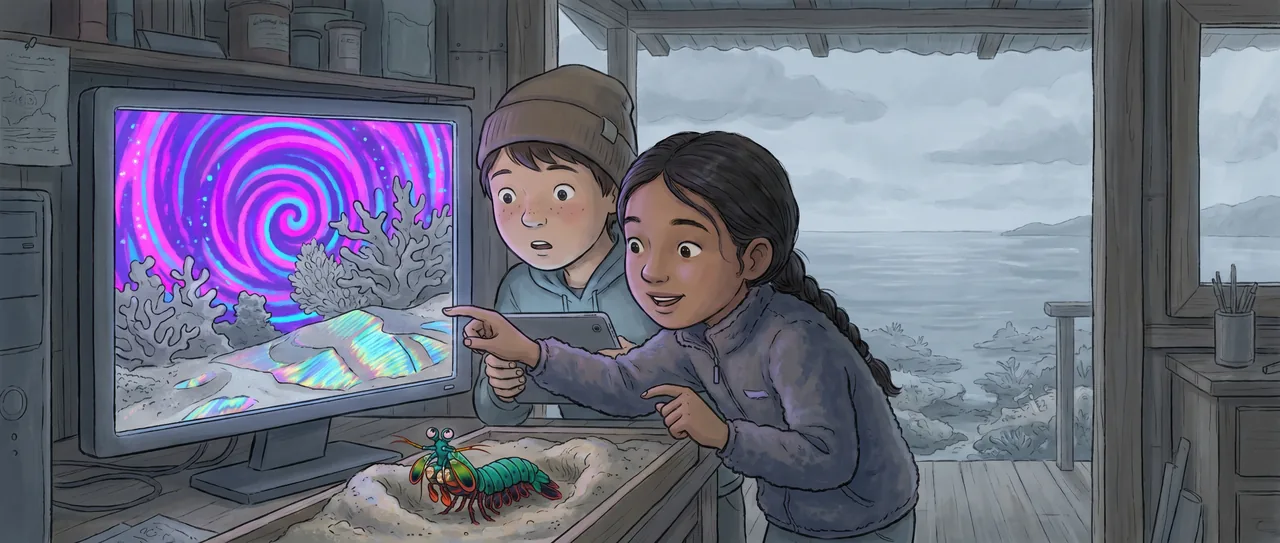
"I know. But look." She pointed at the edge of the frame where a mantis shrimp sat motionless in its burrow, two stalked eyes rotating independently. Its body was the size of a crayon. Its colors were absurd. Emerald and tangerine and a deep, electric blue that looked almost painted on.
"Why," Priya said slowly, "would an animal need to be that colorful if the reef around it is gray?"
Tomás opened his mouth. Closed it. Opened it again.
"Maybe it is not gray," he said.
"Maybe it is not gray to the shrimp," she said.
They looked at each other the way they had started looking at each other on the second day of the program, when they realized they were both the kind of person who could not stop asking why. Back at their schools, this had not made either of them popular. Here, it was the only thing that mattered.
Tomás pulled up the station's species database on the old tablet. He found the entry for Odontodactylus scyllarus. Peacock mantis shrimp. And then he found the line that changed everything.
"Sixteen," he whispered.
"Sixteen what?"
"Photoreceptors. Types of photoreceptors. In their eyes." He turned the tablet so she could read. "Humans have three types of color receptors. Cones. Red, green, blue. Everything we see is built from those three signals mixed together. This shrimp has sixteen."
Priya stared at the little animal on the screen. It stared back with eyes that moved like twin radar dishes.
"It can see ultraviolet," Tomás continued, reading faster now. "Multiple bands of ultraviolet. And polarized light. It can see whether light waves are vibrating horizontally or vertically or in circles. We cannot see any of that. We do not even have the hardware."
The reef on the monitor still looked gray.
But Priya was no longer seeing the monitor. She was seeing the reef the way it might actually exist, the version of it that was always there, blazing with information her eyes simply could not decode.
"The coral," she said. "If it reflects patterns in polarized light or ultraviolet, we would never know. Our camera would not show it. Our eyes would miss it completely. The reef could be covered in signals, in patterns, in whole languages of light, and to us it just looks like a gray rock."
"So the coral I marked as dead in the log," Tomás said.
"Might not be dead."
They sat very still.
The station had a UV imaging attachment. It was stored in a case under Dr. Nakamura's bench, used only for specialized research. They were not supposed to touch it. But they were supposed to catalog every organism in Quadrant Eleven, and if the reef was communicating in wavelengths they could not see, their catalog was wrong. Every entry. Every photo.
Tomás found the attachment. Priya calibrated it using the manual, which took forty minutes and a lot of muttering. They mounted it on the underwater camera drone and sent it back down.
The monitor flickered. The filter shifted.
And the gray reef lit up.
Patterns blazed across surfaces that had looked bare moments ago. The dead coral was tattooed with spirals of fluorescence, ultraviolet pigments produced by organisms so small they were invisible to the naked eye. Microbial colonies. Living ones. The sand itself shimmered with polarization patterns that shifted as the current moved, a flowing map of water direction and speed that any creature with the right eyes could read as easily as a highway sign.
The mantis shrimp sat in its burrow, watching all of it. It had always been watching all of it.
"We see three channels," Priya said quietly. "And we thought we were seeing the whole world."
"Imagine sixteen," Tomás said.
"I cannot. That is the point. I literally cannot imagine it. My brain does not have a place to put those colors. They do not exist in my experience. There are colors on this reef right now that no human has ever seen or will ever see. Not because they are hidden. Because we are not built for them."
Tomás saved the new images. Frame after frame of a world that had been right in front of them, visible to every mantis shrimp, invisible to every scientist who had ever studied this reef with human eyes and human cameras set to human wavelengths.
Their catalog was not just incomplete. It was a drawing of a house by someone who had never seen a house, only heard one described.
When Dr. Nakamura came by that evening, she found two twelve-year-olds surrounded by printouts, rebuilding their entire survey from scratch. She looked at the UV images. She looked at the polarization data. She pulled up a chair.
"How did you think of this?" she asked.
"The shrimp was too colorful for a gray reef," Priya said. "That did not make sense."
Dr. Nakamura nodded slowly. She did not say anything else for a long time.
That night, Priya and Tomás sat on the dock, watching the dark water. Somewhere below, the reef was blazing with light no human would ever directly see. Thirteen extra channels of reality, flowing through the ocean like music played on instruments that had not been invented yet for human ears.
"Do you think," Tomás said, "there are things like that everywhere? Not just in oceans? Signals we walk past every single day because we only have three little windows?"
Priya looked up at the stars, which burned in the wavelengths she could see, and also in radio, and X-ray, and infrared, and others she could not name.
"I think," she said, "we have barely started looking."
Read the interactive version, listen to the narration, and earn a gold star →
A science-verified short story for curious kids · Curiosity Land