The Sound Beneath the Ice
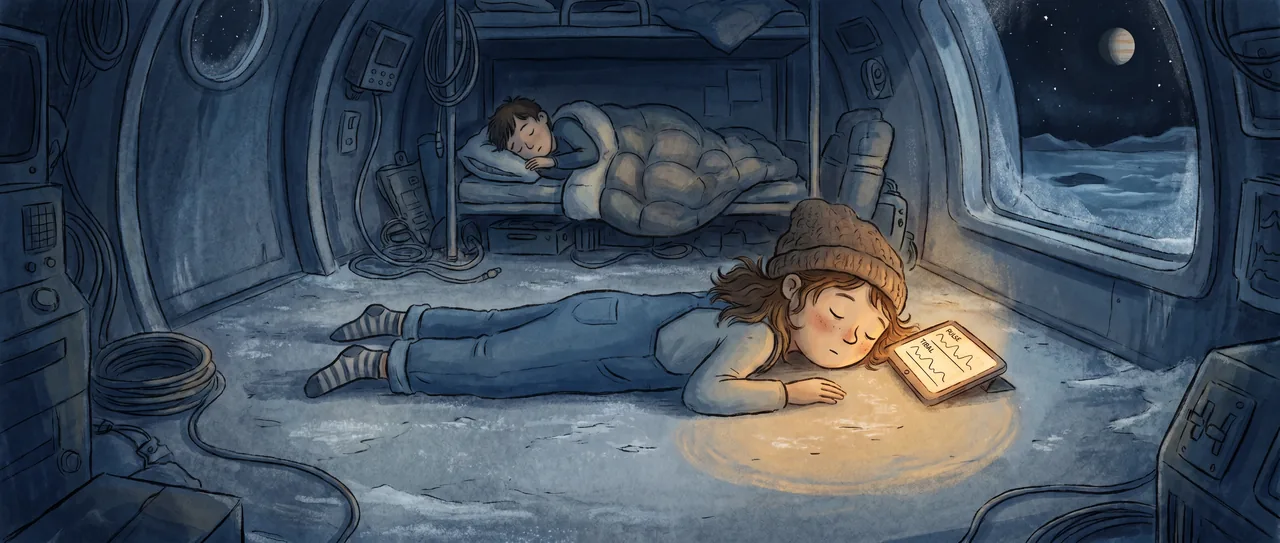
Maren pressed her ear against the floor of Habitat Seven and listened.
She did this every morning before anyone else woke up. The floor was cold composite layered over Europa's ice, and if she held perfectly still and breathed very slowly, she could hear something. Not a sound exactly. More like the memory of a sound. A deep, slow pulse that came from somewhere far below.
Her mother said it was tidal flexing — Jupiter's gravity squeezing the moon like a fist, warming the ice from underneath. Her father said it was probably just the heating system.
Maren didn't think it was the heating system.
She recorded it every morning on her handheld, a little device the mission had given every kid on the habitat so they could keep journals. Most of the other children used theirs for games or drawing. Maren had forty-seven recordings of the floor.
"You're doing it again," said her brother Pim, age thirteen, standing in his socks in the doorway.
"I'm listening."
"To the floor."
"To what's under the floor."
Pim rolled his eyes in the specific way that older brothers have perfected across all of human history, and shuffled toward breakfast.
That afternoon, Dr. Okaro gave the weekly science briefing for the habitat kids. Maren sat in the front row, as always. The other seven children sat further back, in the territory of whispered conversations and kicked chair legs.
Dr. Okaro pulled up a cross-section of Europa on the wall screen. A thin bright line on top — the ice crust. Below it, a vast dark blue region that went down and down.
"Who can tell me how deep Earth's deepest ocean is?" she asked.
"Eleven kilometers," Maren said. "Mariana Trench. Approximately."
"Good. Now." Dr. Okaro tapped the screen. Numbers appeared beside the blue region. "Europa's ocean is estimated to be sixty to one hundred and fifty kilometers deep. And it wraps around the entire moon. The total volume of liquid water beneath us right now is roughly two to three times all the water in every ocean, lake, river, and raindrop on Earth. Combined."
Maren's hand froze halfway to her chin.
She looked down at the floor. Beneath the composite. Beneath the landing struts. Beneath maybe fifteen kilometers of ice. An ocean three times bigger than everything she'd ever imagined an ocean could be. It was like learning that your closet had a door in the back, and through the door was a country, and the country was bigger than the world you already knew.
She couldn't breathe for a second. Not from fear. From the size of it.
"Dr. Okaro," Maren said. "If Jupiter's gravity is flexing the ice and heating it — would the ocean have currents?"
"Almost certainly. Tidal forces would drive massive circulation patterns."
"Would currents make sound?"
Dr. Okaro paused. "They would. Very low frequency. Infrasound, mostly. Why?"
Maren's heart was beating so fast she could feel it in her fingertips. "I've been recording something through the habitat floor. Every morning. For forty-seven days."
The room went quiet in the way rooms go quiet when something real has entered them.
Dr. Okaro knelt beside Maren's desk. "Can I hear one?"
Maren played recording number thirty-one, the clearest one. She'd picked it because on that morning she'd held her breath for almost a full minute and the habitat's air system had been between cycles. The handheld's tiny speaker produced a sound like a slow, deep heartbeat — almost below hearing, more felt than listened to.
Dr. Okaro's expression changed. Not dramatically. Just a slight opening around her eyes, like a window letting in unexpected light.
"Maren, this rhythm. It's periodic?"
"It changes. I've been graphing the intervals." Maren swiped to her notes. Forty-seven data points, plotted by hand on the handheld's drawing app. The intervals between pulses grew longer and shorter in a pattern that almost repeated but never quite did.
"This correlates with Jupiter's tidal cycle," Dr. Okaro said softly. She wasn't talking to Maren anymore. She was talking to the data.
Maren pulled up a second graph — one she'd made last week after stealing twenty minutes on the habitat's shared database. Jupiter's tidal force on Europa over the same forty-seven days. She held the two graphs side by side.
The curves matched. Not perfectly. But close enough that coincidence would have to work very, very hard.
"You compared them yourself," Dr. Okaro said.
"I wanted to know if the floor was just the heating system."
"It's not the heating system."
"I know."
Dr. Okaro stood up. She looked at Maren for a long moment, and Maren saw something in the scientist's face she recognized — the expression of someone whose idea of the world had just gotten rearranged. Maren knew that expression. She wore it herself most days.
"I'd like to bring this to the oceanography team," Dr. Okaro said. "Your recordings and your graphs. Would that be all right?"
Maren nodded.
"You may have captured the first acoustic signature of Europa's tidal currents from the surface. Do you understand what that means?"
Maren understood what it meant to her: the ocean was talking and the floor was thin enough to hear it. An entire world of water, heaving and sighing under the pull of a planet so large it didn't even know this little moon existed. And she'd heard it because she'd pressed her ear to the ground and wondered.
That night, after the lights dimmed and Pim was asleep, Maren lay on the floor one more time. She pressed her cheek to the cold composite and closed her eyes.
The pulse came. Low. Patient. Enormous.
Somewhere beneath her — beneath the ice, beneath the dark — a hundred and fifty kilometers of ocean moved in its slow, ancient rhythm, driven by the gravity of a giant. And it occurred to Maren, with a shiver that started in her chest and didn't stop, that no one yet knew what was at the bottom.
Read the interactive version, listen to the narration, and earn a gold star →
A science-verified short story for curious kids · Curiosity Land