The Other Direction
The first thing Maren noticed was that the message was backwards.
Everyone else in the BioSaturday workshop had already moved on. They were laughing, sliding their gel trays into the electrophoresis tanks, watching the blue dye creep through the agarose like slow lightning. But Maren was still staring at the screen where Dr. Kapoor had displayed the two DNA strands side by side.
Two strands. Running in opposite directions. Like two lanes of a highway, one going north and one going south.
"If the cell can only read in one direction," Maren said, not really to anyone, "how does it read the other strand?"
No one answered. The workshop hummed with the small electric sounds of eleven-year-olds doing science — pipette clicks, nervous giggles, the whir of the mini centrifuge. Maren's lab partner, Jordan, was already loading their DNA sample.
"Maren, come on. We're going to be last."
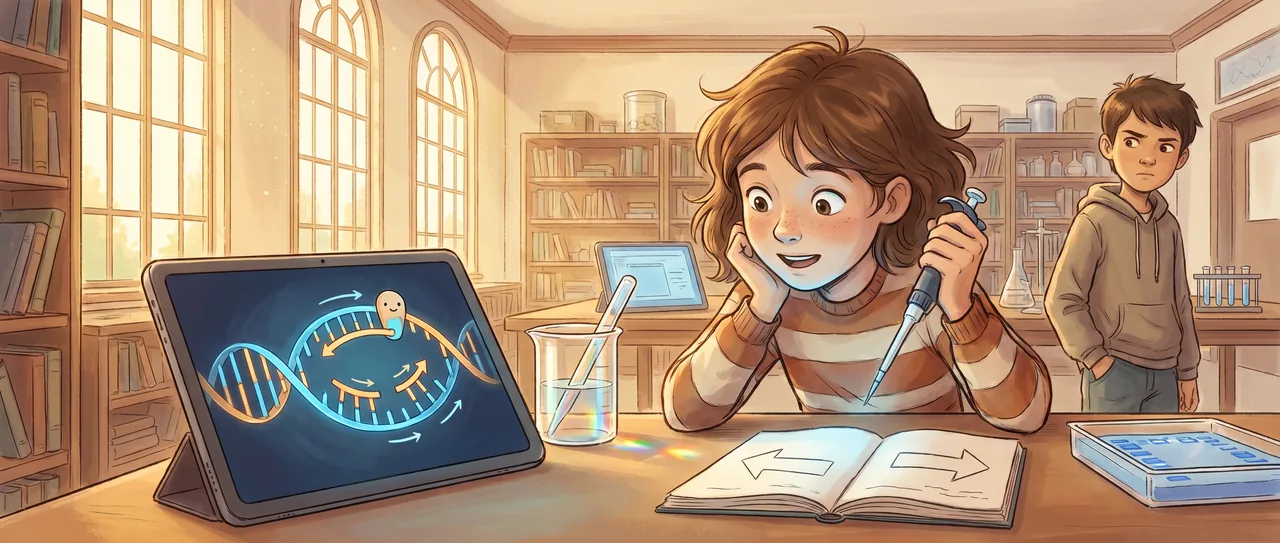
"But look." Maren pointed at her notebook where she'd drawn the two strands as arrows. One arrow pointed right. One arrow pointed left. "The molecular machinery — the polymerase — it only travels one way. Five-prime to three-prime. So on this strand" — she tapped the rightward arrow — "it just zooms along. Easy. But this other strand is pointing the wrong way."
Jordan squinted. "So... it can't read it?"
"It has to. Both strands get copied every time a cell divides. Every single time. So how—"
Maren pulled up the simulation app on the workshop tablet. She'd been using it all morning to visualize the double helix unwinding, the way an enzyme called helicase split the two strands apart like unzipping a jacket. On the top strand, a little animated polymerase chugged happily along, laying down new nucleotides in a smooth continuous ribbon.
But the bottom strand — the one running the wrong direction — was different.
The polymerase couldn't just follow the unzipping. It had to wait. Then it would build a short stretch backwards — well, not backwards, in its own five-prime-to-three-prime direction, but away from the unzipping point. A small fragment. Then it would leap back, wait again, build another fragment. Then another.
Maren watched the animation loop three times.
"It's building it in pieces," she whispered.
"That seems... harder," Jordan said.
"It is harder." Maren's voice had gone quiet in that way it did when something enormous was fitting together inside her head. "The cell has to make these little chunks — and then another enzyme comes along and glues them all together. Every time. Every single cell division. In every cell in your body."
She looked at her own hand. She thought about the trillions of cells in her body, each one having divided from a parent cell, each division requiring this intricate backward-and-forward dance on one stubborn strand that ran the wrong way.
"Why didn't evolution just... fix it?" Jordan asked. "Make both strands go the same direction?"
Maren opened her mouth. Closed it. Opened it again.
"Maybe it's not a problem," she said slowly. "Maybe it's a feature."
She was thinking about something Dr. Kapoor had mentioned offhandedly that morning — how the lagging strand, the difficult one, had a slightly higher mutation rate. A tiny bit more room for error each time those fragments were stitched together. Not much. Just enough.
"What if," Maren said, and she could feel the idea forming like a bubble rising through water, "what if the imperfection is part of how life changes? How it evolves? The little mistakes in the stitching — most of them get fixed by repair enzymes, but some slip through, and those are the variations. The raw material."
Jordan stared at her.
"You're saying life evolves partly because DNA is annoying to copy?"
Maren laughed — a sudden, bright sound that made two other kids look over. "I'm saying that the difficulty is the point. If it were perfect, if both strands copied the same easy way with zero errors, nothing would ever change. We'd still be bacteria."
She sat very still for a moment. The workshop buzzed around her. Someone's gel was running beautifully, bright bands separating like rungs of a ladder made of light. The September sun came through the tall library windows and caught the edge of a micropipette, turning it into a tiny prism.
Maren thought about the size of it. Not just her body — every living thing. Every oak tree. Every sparrow. Every weird deep-sea fish with a lantern on its head. All of them running this same strange, elegant, imperfect system. Two strands, opposite directions, one easy and one hard, and the hard one whispering just enough change into the world to make everything — everything — possible.
Her eyes were stinging and she didn't know why.
"Maren?" Jordan said gently. "You okay?"
"I just realized something." She looked at Jordan with an expression that was hard to describe — half joy, half vertigo. "We're not reading the DNA today in this workshop. The gel, the sequencer — we think we're learning to read it. But it's been reading itself for almost four billion years. We're just... finally looking over its shoulder."
Jordan was quiet for a long moment. Then: "We should load our gel before Dr. Kapoor comes over."
"Yeah," Maren said. "Yeah."
She picked up the micropipette. Her hand was perfectly steady. She loaded the sample into the tiny well, watched it sink into the gel like a secret settling into place.
But as the current began to pull the DNA fragments forward — always forward, always in one direction — Maren was already thinking about what she wanted to look up when she got home. Okazaki fragments. That was the name. The little pieces on the lagging strand. She wanted to know who discovered them. She wanted to know what other beautiful problems were hiding inside things that looked, at first, like mistakes.
The blue dye crept through the gel, and Maren leaned closer, watching it move in the only direction it could, carrying the code of every living thing that had ever been — toward whatever came next.
Read the interactive version, listen to the narration, and earn a gold star →
A science-verified short story for curious kids · Curiosity Land