The Garden Inside
Maren had been counting things her whole life. Ceiling tiles during assemblies. Rivets on the ferry hull. The hexagonal cells in a single slice of honeycomb (she'd gotten to 412 before her mother gently took the honey jar away).
So when she arrived at the Coral Equinox — the floating research station where her aunt studied reef microbiomes — the first thing Maren did was count the polyps on the fragment of staghorn coral in the welcome lab.
She was at 1,847 when her aunt's research assistant, Deshi, walked in.
"They're not individual animals," he said, not looking up from his tablet. "I mean, they are. But they're also a colony. One organism made of thousands of tiny mouths."
"I know," Maren said. She kept counting.
Deshi glanced at her. "Most visitors just say 'pretty.'"
"It is pretty. It's also 1,903 polyps. So far."
He almost smiled. "You're going to like what your aunt's working on."
Maren's Aunt Reena was the kind of scientist who forgot to eat lunch and then got excited about forgetting, because it reminded her of a paper she'd read about hunger signaling in the gut-brain axis. She was studying why some coral colonies bleached during heat events while genetically identical colonies right next to them survived. The answer, she believed, was in the bacteria.
"Every coral has its own microbiome," Aunt Reena explained that evening, pulling up a holographic display over the dinner table. Thousands of colored dots swarmed across a three-dimensional coral model. "Bacteria, archaea, fungi, viruses — all living inside the coral tissue. The colonies that survive heat stress have different microbial communities than the ones that die."
"So the coral isn't really one thing," Maren said slowly.
"Nothing alive is really one thing." Aunt Reena looked at her with that particular expression adults got when they were deciding how much to say. "Including you."
Maren set down her fork.
"Your body contains roughly 38 trillion bacteria. Give or take a few trillion. That's about equal to the number of human cells you're made of."
Maren felt something shift. She looked down at her own hand — at the skin that she'd always assumed was just her, just Maren, a solid border between inside and outside.
"Half," she whispered.
"What?"
"I'm only half human cells. The rest is... them."
Aunt Reena's eyes brightened. "And those bacteria in your gut — they produce neurotransmitters. Serotonin, dopamine, GABA. They talk to your brain through the vagus nerve. They influence your mood, your immune system, how clearly you think. You aren't a person carrying bacteria around. You're a collaboration."
That night, Maren couldn't sleep. She lay in her narrow bunk on the station, feeling the gentle sway of the ocean beneath her, and pressed her palm against her stomach. Thirty-eight trillion. An ecosystem she'd never seen, never thanked, never even known was there, humming along in the dark, keeping her alive. Keeping her — her.
She wondered if the bacteria knew about her.
The next morning, Maren found the lab in quiet chaos. Deshi was running sample analyses on his tablet, frowning. Aunt Reena was talking rapidly into a comm link.
"What happened?" Maren asked.
Deshi sighed. "Your aunt's main experiment — the transplanted coral fragments on the east reef. She's been seeding them with microbiome cultures from heat-resistant colonies, trying to see if you can make vulnerable coral tougher by changing its bacteria. But the latest readings show the transplanted microbes aren't establishing. They're dying off within 48 hours."
"Every single sample?" Maren asked.
"Every one. Six months of work."
Maren looked at the data flowing across Deshi's screen. She didn't understand most of it, but she understood patterns. She'd been reading patterns her whole counting life.
"Can I see the water chemistry logs? For the transplant sites?"
Deshi raised an eyebrow but handed her the tablet.
Maren scrolled. Numbers. Timestamps. Temperature, salinity, pH, dissolved oxygen. She counted, the way she always counted — not looking for anything specific, just letting the numbers wash over her until something snagged.
It snagged.
"The pH drops," she said. "Every night. Just at the transplant sites."
"That's normal," Deshi said. "Reefs respire at night, release CO2. pH dips."
"But it dips more at the transplant sites than the control sites. Look — 0.3 units more. And it starts two hours earlier." She turned the tablet around.
Deshi stared. He pulled up the control data. Compared. Pulled up the site maps.
"The transplant sites are all downstream of the new monitoring pylons," he said slowly. "The ones they installed in March."
"What are the pylons made of?" Maren asked.
"Concrete and steel."
"Does concrete change water pH?"
Deshi's mouth opened. Closed. Opened again. "Fresh concrete leaches calcium hydroxide. It raises pH during the day when water flows over it. Then at night, when the buffering drops..." He was already typing. "The swing would be amplified. The microbes aren't dying from heat. They're dying from pH instability. The new pylons are changing the local water chemistry just enough to crash the transplanted colonies."
Aunt Reena appeared in the doorway. "What are you two—"
"Your niece just saved six months of research," Deshi said. He still hadn't looked up.
Maren felt something warm bloom in her chest. She wondered — just for a second — if that warmth was her, or her bacteria, or whether there was even a difference.
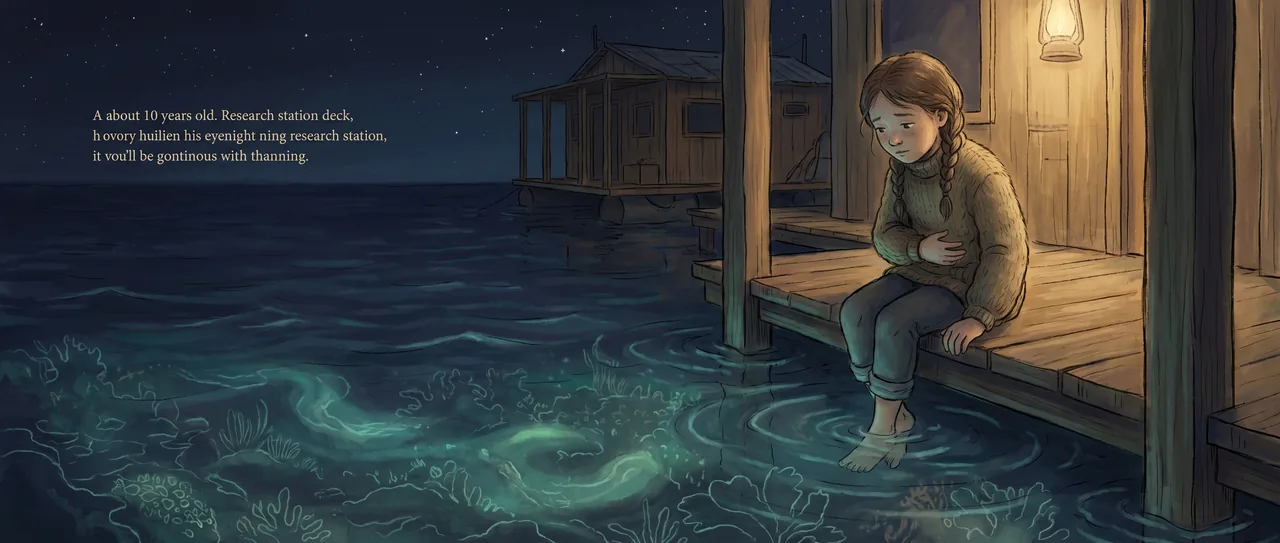
That evening, Maren sat on the station's observation deck, dangling her feet above water that glowed faintly with bioluminescence. Aunt Reena had already submitted a request to relocate the transplant sites. The experiment would continue.
"How did you see it?" Aunt Reena asked, sitting down beside her.
"I just count things," Maren said. "Numbers feel like they're trying to tell me something, and usually people want me to stop before I hear what it is."
Aunt Reena said nothing. Just sat with her.
Below them, the reef breathed. Billions of polyps feeding, billions of bacteria collaborating, an entire civilization in the dark water doing what civilizations do — surviving together, adapting, becoming something that no single part could be alone.
Maren pressed her hand to her stomach again. Thirty-eight trillion. She thought about every mood she'd ever had, every clear bright morning when her mind felt sharp, every heavy afternoon when it didn't. All of it a conversation between her cells and her creatures.
She was not one thing. She was a reef.
And she was only beginning to learn what that meant.
Read the interactive version, listen to the narration, and earn a gold star →
A science-verified short story for curious kids · Curiosity Land