The Proofreader
Maren had a habit that annoyed everyone: she counted things.
She counted the bolts in the corridor ceiling (two hundred and twelve, Section J, port side). She counted the seconds between the air recycler's clicks (fourteen, unless humidity spiked). She counted the freckles on her left arm every morning, because once, when she was eight, a new one appeared and nobody else noticed for a week.
So when the bio-lab's display showed a red bloom spreading across Genome Tank Four, Maren was the only apprentice who stopped to count the cells.
"It's just chlorella die-off," said Tomás, already pulling on his gloves. "Dr. Vasquez said to flush the tank and restart."
"But look at the rate," Maren said. She pressed her fingertip to the display, dragging the timeline back. "Yesterday there were nine dead clusters. This morning, forty-one. That's not linear."
Tomás shrugged. "So it's exponential. Algae does that. Can we just flush it?"
Maren didn't move. She was staring at the tank — a glass cylinder taller than she was, filled with green water that fed the ship's oxygen loop. One of sixteen tanks that kept twenty-two hundred people breathing between the stars. The green was dimmer today. Paler at the edges.
"What if the new cells are wrong?" she said.
"Wrong how?"
She didn't know yet. That was the part she liked — the not-knowing, the leaning forward into the question like leaning into a wind.
She pulled up the sequencer interface. Dr. Vasquez had taught them to use it last month, and Maren had stayed late three nights running, sequencing everything she could find — her own cheek cells, a bread culture, the moss on the ventilation grate. Tomás had called her obsessed. She'd said thank you.
Now she pipetted a sample from the dying edge of Tank Four, slid it into the sequencer port, and waited.
The display filled with letters. Not really letters — representations of base pairs, adenine-thymine, guanine-cytosine, scrolling past in rivers of color. Maren had learned to let her eyes go soft, to watch for patterns the way you watch for a face in clouds.
"Maren, Dr. Vasquez said to flush—"
"Look at this."
She'd frozen the display on a comparison: the reference genome for their chlorella strain on the left, the new sample on the right. Highlighted differences glowed amber.
"There are seventeen mutations," Maren said. "In one generation of cells."
Tomás leaned in despite himself. "Is that a lot?"
Maren's pulse was doing something strange. She pulled up the numbers she'd memorized weeks ago, the ones from the old Earth biology archives that she read at night when she couldn't sleep.
"Every time a cell divides," she said slowly, "it has to copy its entire genome. For our chlorella, that's about sixty million base pairs. The copying machinery is so precise that it makes fewer than one mistake per billion pairs copied. One per billion, Tomás. So in a chlorella cell, you'd expect almost no errors at all — maybe one mistake every fifteen or twenty divisions. That's how good the proofreading is."
She gestured at the amber highlights.
"Seventeen errors in sixty million pairs isn't the cell's copying machinery. Something else is breaking the DNA after it's copied. Something in the tank."
Tomás was quiet for a moment. "The water recycler," he said. "They replaced the UV sterilization unit last week."
"Exactly." Maren was already moving, pulling up the maintenance log. The new UV unit was rated for water purification — but its emission spectrum peaked at 254 nanometers. Hard ultraviolet. Perfect for killing bacteria in pipes. Devastating to exposed DNA in an open culture tank.
The UV light was sterilizing the water supply line and then continuing to shine into the tank itself through the inlet port. Killing the algae softly, invisibly, one broken bond at a time.
"We don't need to flush the tank," Maren said. "We need to shield the inlet. The cells are fine. The copier is fine. It's the light that's breaking them after they're built."
She found a UV-opaque filter sleeve in the supply cabinet — a simple black polymer ring — and fitted it over the inlet where the water line entered Tank Four. It took eleven seconds.
Tomás watched her, then looked at the sixteen tanks stretching down the bio-lab corridor. "Maren. They replaced the UV unit on all the water lines."
Her stomach dropped. She counted the tanks. Sixteen. She counted the days since the maintenance cycle. Six. She pulled up Tanks One through Sixteen and saw it: the same pale edges, the same slow dimming, in every single one. Tank Four had just shown symptoms first because it was closest to the water inlet.
They spent the next hour fitting filter sleeves to all sixteen tanks. By the time Dr. Vasquez arrived for the evening shift, the work was done.
"You were supposed to flush Tank Four," Dr. Vasquez said, reading the log.
"The tank wasn't the problem," Maren said, and explained.
Dr. Vasquez was quiet for a long time. Then she said, "Do you know what would have happened if we'd flushed and restarted all sixteen tanks without finding this?"
"The new cultures would have started dying too," Maren said. "And we'd have lost weeks of growth. Maybe enough to affect oxygen output for the whole ship."
Dr. Vasquez looked at her. "You read the old Earth biology archives at night, don't you?"
"Sometimes I can't sleep," Maren said, as if that explained it.
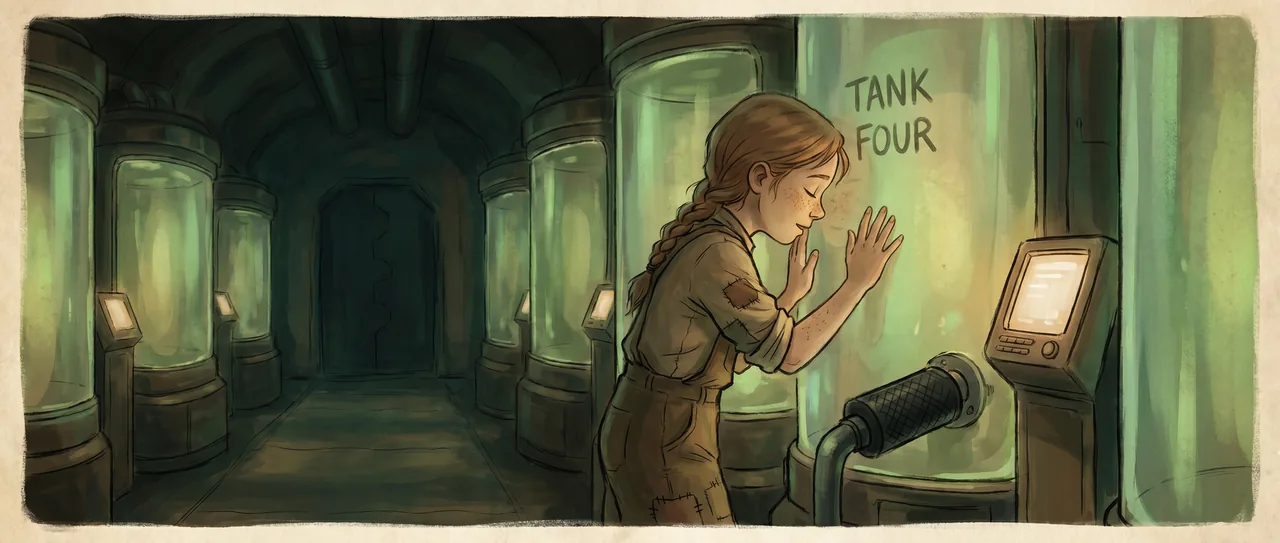
Later, alone in the bio-lab, Maren pressed her hand against Tank Four's warm glass. Inside, trillions of cells were dividing in the dark, each one copying its sixty million letters with almost perfect fidelity, molecular machines proofreading every bond, catching almost every error — a precision so deep it felt like devotion.
And she thought: every cell in me is doing that right now. But not sixty million pairs — three billion. Fifty times more letters, every time a cell in my skin or blood or gut divides. Three billion pairs, copied and proofread, with that same impossible accuracy — fewer than one mistake per billion. My cells are copying entire libraries and barely misplacing a comma.
The ship hummed around her. The algae glowed green. And Maren stood there, trembling, aware for the first time that she was not a single thing but a library copying itself — billions of volumes, trillions of nearly perfect pages — all of it happening silently inside her, without her ever having to ask.
She pressed her forehead to the glass and whispered, "What else are you doing that I don't know about yet?"
The tank didn't answer. But somewhere inside her, three billion letters turned another page.
Read the interactive version, listen to the narration, and earn a gold star →
A science-verified short story for curious kids · Curiosity Land