The Mice Who Needed Their Multitudes
Maya was not supposed to be in the lab on Saturday.
But Soren's mother was finishing a grant proposal upstairs, and the campus was quiet, and Maya had discovered weeks ago that if she and Soren sat very still on the stools by the observation window, nobody told them to leave. The graduate students just assumed they belonged to someone else's research group.
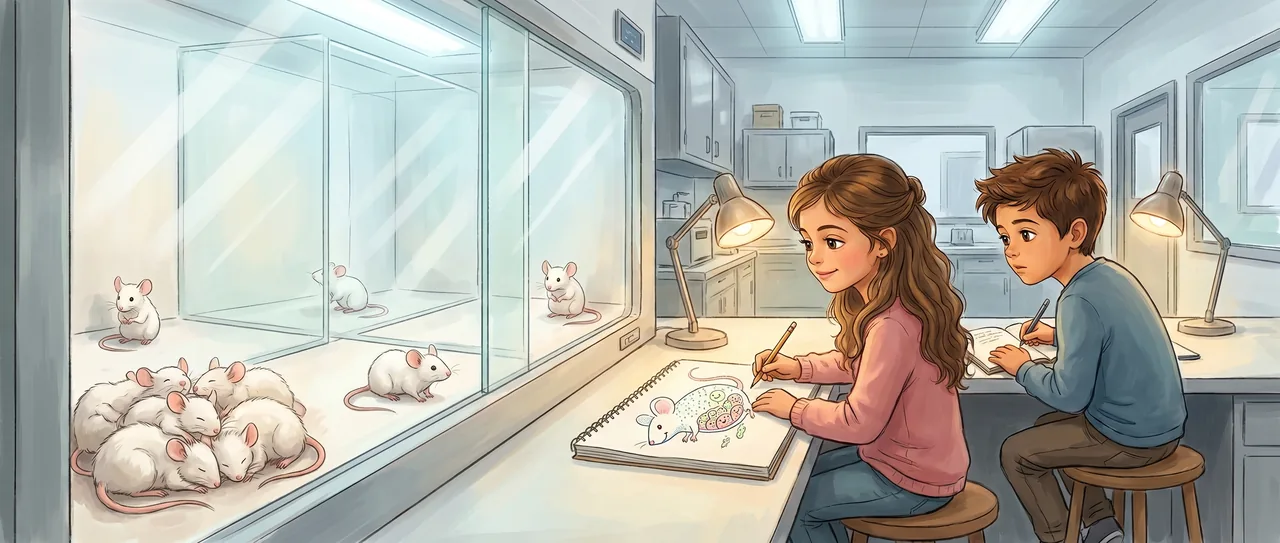
Maya pressed her nose to the glass. Two sets of mice. Same age, same white fur, same twitching pink noses. But they didn't act the same at all.
The mice on the left tumbled over each other, grooming, nosing, piling into warm heaps. The mice on the right lived behind a second layer of glass, inside what the label called an isolator. They sat apart from each other. When one approached another, it would stop short, turn away, circle back to its own corner.
"Something's wrong with the right ones," Maya said.
"Wrong how?" Soren asked. He already had his notebook open.
"They want to go to each other. Watch their heads. They keep orienting toward the group and then stopping. Like the signal gets interrupted."
Soren watched. He counted. After four minutes he said, "You're right. Seven approaches, seven reversals. Zero completed contacts."
They had been coming for three Saturdays now. Soren's notebook held the data because the difference between the two groups bothered both of them, but in different ways. Maya felt it like a crooked picture frame. Something was wrong and it had a shape. Soren wanted to measure the shape until it had a name.
Saturday one, Maya had noticed the isolated mice startled more. Soren timed it. A door closed down the hall and the isolated mice froze for eleven seconds. The regular mice barely flinched.
Saturday two, Maya noticed the isolated mice would not explore new objects. A cardboard tube placed in their enclosure sat untouched for the full hour. Soren logged it. The regular mice shredded theirs in nine minutes.
Saturday three. Today. Maya noticed something new. When a graduate student drew blood samples, the isolated mice had subtle inflammation around their joints. The regular mice did not.
"Anxious," Maya said, counting on her fingers. "Antisocial. Inflamed."
"But they're genetically identical," Soren said. He had checked the posted protocols on the wall three times, reading every word he could understand and guessing at the rest. "Same parents. Same food. Same light cycle."
"So what's different?"
Soren pointed at the one word printed on the isolator label. "That."
GERM-FREE.
Maya stared at it. "They don't have any bacteria."
"That's the only variable," Soren said. He underlined it twice in his notebook.
Maya pulled out her tablet and searched. The university's open-access database let her in, and for the next forty minutes they fell down a tunnel of papers they only half understood. But the half they understood changed something inside both of them.
The germ-free mice had been born by cesarean section into sterile isolators. They had never touched an unsterilized surface. Never breathed unfiltered air. Never encountered a single bacterium. And because of that, because of what was missing, their immune systems had never learned to calibrate. Their stress hormones ran too high. Their brains developed differently. They could not read social signals from other mice.
It was not what was attacking them. It was what had never arrived.
"Soren," Maya said. She put the tablet down.
"I know."
"Do you, though? The number."
He read it aloud from the paper. "The human body carries roughly thirty-eight trillion bacterial cells. Almost as many as the roughly thirty trillion human cells that make up the rest of a person."
They sat with that. Maya stared at her own hands. Soren stared at his notebook. Thirty-eight trillion. Not invaders. Residents. An entire civilization nearly matching their own cells in number, tucked into every fold and surface, doing work the body could not do alone.
"We're not just us," Maya said. The lab was very quiet. "We're everyone. We're a whole city."
Soren wrote it down. Not because she told him to. Because the inside of his head felt too small for something that enormous, and he needed somewhere to put it.
Maya looked at the lonely mice again, and her expression changed. "They're not broken," she said. "They just never met the partners they were built to carry."
That was when Soren noticed the second set of labels on the isolator. Small, color-coded stickers they had both ignored before. Four of the germ-free mice had green dots. He checked the protocol sheet on the wall.
"Green means scheduled for microbiome transplant," he said. "Monday."
Maya's eyes went wide. "They're going to give them bacteria."
"A normal gut microbiome. To see what happens."
"I know what's going to happen," Maya said.
"Predict it," Soren said. He flipped to a clean page and held his pen ready.
Maya spoke and Soren wrote. "The green-dot mice will start grooming other mice within one week. Their stress freeze will drop below five seconds within two weeks. The inflammation will decrease."
She paused. Soren waited. He could see she was not finished.
"But it might not fully reverse," she said slowly. "Because maybe some of the development windows have already closed. Maybe the bacteria needed to be there from the beginning to do their deepest work."
"That's a good hypothesis," Soren said. "We don't know the answer."
"I know," Maya said. And she was smiling. The not-knowing was the part that thrilled her.
Soren photographed the page and emailed it to both of them with the subject line: CHECK IN TWO WEEKS.
When Soren's mother found them an hour later, Maya was sketching a diagram of a mouse with tiny dots filling its gut, hundreds of them, each one drawn with a different expression, like a crowd of commuters on a microscopic subway. Soren was cross-referencing her drawing with the protocol sheet, adding annotations in his careful handwriting.
"What are you two drawing?" his mother asked.
"A city," Maya said. "Inside a mouse. It's not a metaphor. It's actually a city."
His mother looked at the drawing, then at the mice, then at Soren's open notebook full of three Saturdays of data. She did not say anything for a long moment.
"Most people walk past this window," she said.
"We know," Soren said. He did not mean it as anything special. It was just true. Most people walked past, and they didn't, and neither of them had ever been able to explain why, only that the not-knowing pulled at them like gravity.
That night, in her own room, Maya pressed her hand flat against her stomach. She imagined the trillions of organisms inside her, digesting, signaling, teaching her immune cells what to fight and what to welcome. She imagined them like a chorus, each voice too small to hear alone, together making something that sounded like health. Like calm. Like the ability to reach toward another person without turning away.
She was not one thing. She was a collaboration.
And somewhere in a sterile isolator across town, four mice with green dots were about to meet their missing partners for the first time. Maya could not wait to see who they would become. And she realized, with a shiver she could not quite name, that she did not yet know who she was still becoming, either.
Read the interactive version, listen to the narration, and earn a gold star →
A science-verified short story for curious kids · Curiosity Land