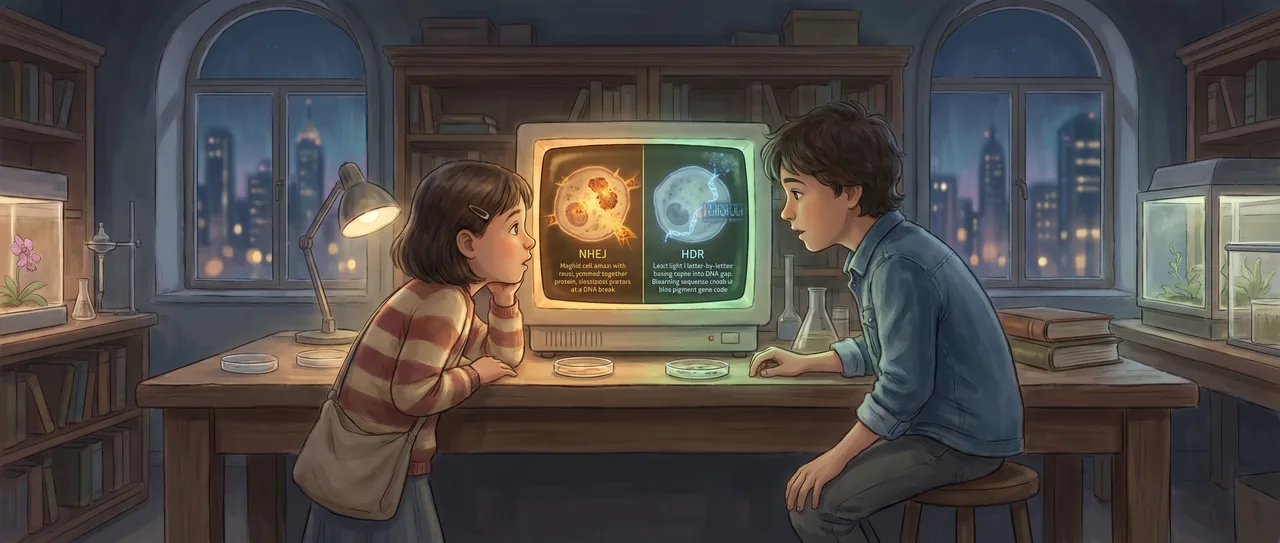
The Two Paths of Mending
Lúcia had broken the orchid's DNA on purpose, and now she couldn't stop watching.
The community biolab stayed open late on Thursdays. Most of the other kids had gone home after the lesson, but Lúcia remained at bench station four, her cheek nearly touching the monitor that displayed the cell's interior in soft, luminous magnification. The CRISPR system had done its work twenty minutes ago — the guide RNA had found its target, the Cas9 protein had cut both strands of the double helix, clean as scissors through ribbon — and now the cell was alone with its wound.
"You're still here," said Tomás, the twelve-year-old from the Thursday advanced group, sliding onto the stool beside her. He smelled like the cafézinho his grandmother always packed for him.
"The cut's done," Lúcia said. "But the interesting part is what happens next. The cell has to fix itself."
"So? It fixes itself. That's what cells do."
Lúcia shook her head, eyes never leaving the screen. "But how? That's the whole question. There are two completely different ways it can go, and nobody told the cell which one to pick."
She'd been thinking about this all week, ever since Dr. Aline had mentioned it during the Tuesday talk and then moved on too quickly, the way adults sometimes skipped past the most astonishing things as if they were ordinary. Two repair pathways. Two entirely different outcomes from the same break. Lúcia had read everything she could find.
On the monitor, proteins were already swarming toward the cut site like emergency workers arriving at a collapsed bridge.
"Watch," Lúcia whispered. "This is the fast one. Non-homologous end joining. NHEJ."
The cell's own machinery grabbed both broken ends of the DNA and pressed them back together, quick and rough. The visualization software painted the repair in amber light.
"It just... glues them?" Tomás leaned closer despite himself.
"Basically. It's fast, but it's messy. Sometimes it loses a few letters of the code, or adds some that weren't there before. The gene gets scrambled. Knocked out." Lúcia pulled up the sequence readout. Sure enough — three base pairs were missing from the junction. "See? The orchid gene for producing anthocyanin pigment in the petals — it's broken now. If this cell grew into a flower, the purple wouldn't happen. The cell chose speed over precision."
Tomás frowned. "Chose? Cells don't choose."
"No. But something determines which pathway wins. Timing. The phase of the cell cycle. Whether there's a template nearby." Lúcia pulled up her second orchid cell — the one she'd prepared differently. This one she'd given a gift: along with the CRISPR components, she'd delivered a short piece of donor DNA, a template carrying a new sequence. A sequence that coded for a blue pigment that orchids had never made before.
"This cell got the same cut," she said. "Exact same place. But I gave it a template to copy from. So now it has a second option. Homology-directed repair. HDR."
They watched. The proteins arrived at the break again, but this time, instead of jamming the ends together, the machinery paused. It found the template Lúcia had provided. It read it like a builder reading a blueprint, carefully copying the new sequence into the gap, letter by letter, precise as calligraphy.
"It's using your code," Tomás said, and his voice had changed — gone quiet, the way voices go when something clicks.
"Not my code. I just offered it. The cell did all the building. The cell's own repair enzymes. I didn't stitch anything. I just... gave it a path and a pattern, and it chose precision this time."
The sequence readout bloomed on screen. The new gene was integrated perfectly. If this cell divided, and divided again, and became a petal — it would be blue. A blue that no orchid had ever worn.
Lúcia sat back. Her heart was doing something strange.
"Same break," she said. "Same scissors. Two completely different futures. And the cell decides."
Tomás was quiet for a long time. Then: "So when people talk about CRISPR editing genes — they're not really editing anything. They're just making the cut. The cell does the rest."
"Yes."
"We're not rewriting life. We're — "
"Asking it to rewrite itself. And it already knew how. It's been repairing its own DNA for billions of years. Long before us. We just learned where to make the cut."
The biolab hummed around them — the soft whir of centrifuges, the green glow of growth chambers where fifty different student projects were quietly becoming something new. Through the tall arched windows that still looked like a library, São Paulo glittered, vast and alive.
Lúcia thought about the orchid cell, alone in its dish, running molecular machinery so complex that humanity had only understood it for a few decades. She thought about all the cells in her own body, right now, this second, finding breaks in their DNA from sunlight and copying errors and ordinary chemical damage — and fixing them. Thousands of repairs, every day, in every cell, in silence.
Her body was a cathedral of constant mending, and she had never once felt it happen.
"Lúcia," Tomás said. "What are you going to do with the blue orchid?"
She looked at the screen. The cell had finished its repair. It was preparing to divide — to become two cells, both carrying the new sequence, both carrying the blueprint for a color this species had never known.
"I'm going to give it the second cut tomorrow," she said. "Different gene. Different template. I want to see if I can get the petals to shift color with temperature — blue in the cold, violet in the heat. There's a gene in morning glories that does something like that. I want to offer it to the orchid and see what the cell builds."
Tomás stared at her. "You know most people in the advanced group haven't even done their first edit yet."
Lúcia shrugged. She didn't know what to do with that information. She only knew that the orchid cell had two paths in front of it and had chosen the one where something new became possible, and that tomorrow she'd come back and make another cut, and the cell would choose again.
She turned off the monitor, packed her bag, and walked out into the warm night, where ten million cells inside her were quietly, perfectly, mending.
Read the interactive version, listen to the narration, and earn a gold star →
A science-verified short story for curious kids · Curiosity Land