The Slow Ones
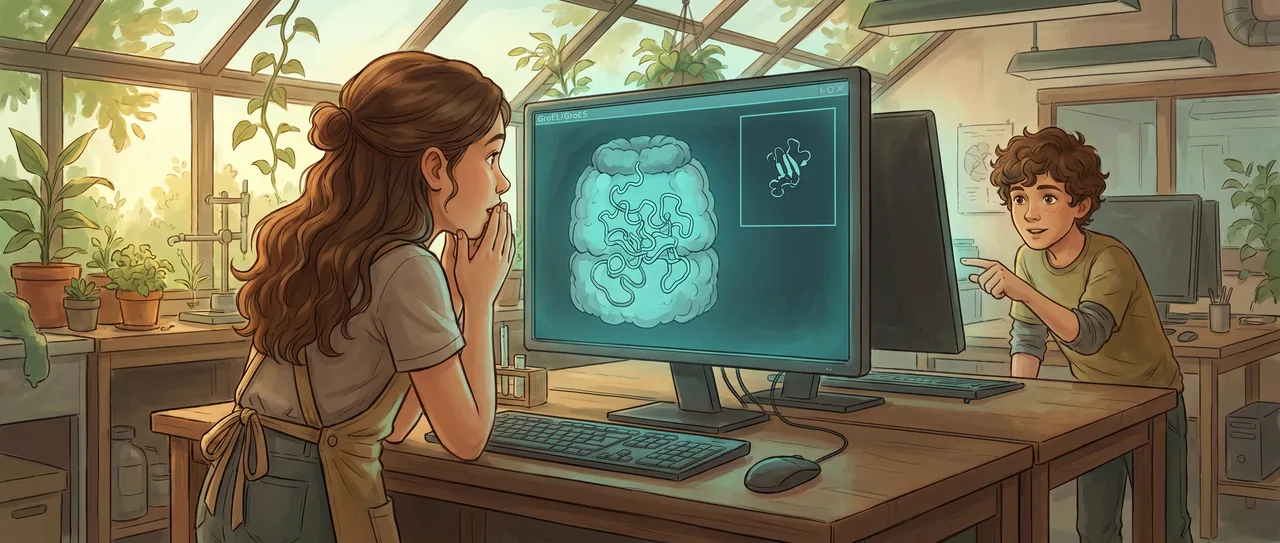
The protein on Maya's screen wouldn't fold.
Everyone else in the BioSaturday workshop had already moved on to the design challenge. Their amino acid chains snapped into neat spirals and sheets — click, click, done — like origami cranes made by someone who'd folded a thousand. But Maya's protein just sat there, a long wobbly string, twitching at the edges like it was thinking about it.
"Yours is broken," said Jonah from the next station, not meanly. Just factually. Jonah was always factual.
"It's not broken," Maya said. She didn't elaborate. She zoomed in. The amino acids were all there, all connected. The sequence was valid. The simulation was running. It just wasn't finishing.
Dr. Reyes walked between the stations, her sneakers squeaking on the greenhouse floor. She glanced at Maya's screen but didn't stop. Didn't fix it. That was the rule at BioSaturday: you could ask questions, but nobody touched your screen.
Maya pulled up the protein's specs. It was longer than the others — 847 amino acids instead of the usual 90 or 120 the workshop sequences used. She'd picked it herself from the extended library because something about its shape in the thumbnail had looked like a seashell. Not a reason anyone else would have accepted. But Maya had learned to trust the itch — the feeling that something didn't fit, that a pattern was hiding just past the edge of what she could explain.
She watched the simulation clock. Thirty simulated seconds. A minute. Two minutes. The chain was moving — she could see that now — but slowly, like it was feeling its way through the dark. Parts of it would start to curl, then uncurl, then try again from a different angle.
"Why are you slow?" she whispered.
She opened the comparison tool and pulled up Jonah's protein beside hers. His was tiny. Seventy-one amino acids. In the replay, it had folded in what the simulator labeled 0.00004 seconds. Forty microseconds. Faster than a camera flash. Faster than a hummingbird's wingbeat.
Forty microseconds versus two minutes and counting.
The itch sharpened. Not confusion — hunger. Something was wrong with the picture, and Maya could feel the shape of it before she had the words. The small protein didn't need anything. Her protein needed something it wasn't getting.
She opened the search panel and typed: why do some proteins fold slowly?
The biolab's AI, Lumi, answered in the sidebar — not with a wall of text, but with an animation. A long protein chain started folding, got tangled in itself, unfolded, tried again. Got tangled worse. The chain was so long that one end didn't know what the other end was doing. It was like trying to tie your shoes in the dark while wearing mittens, except the mittens were also part of the shoe.
Then something new appeared in the animation. A large, hollow shape — like a barrel made of protein — drifted close. The struggling chain slipped inside it. And inside that barrel, protected from everything, the chain finally folded. Correctly. Calmly.
The label read: GroEL/GroES — chaperone complex.
"Chaperone," Maya said aloud. Like at a school dance. Someone who's there to make sure things go right.
She looked back at her own simulation. The long wobbly chain was still struggling, and now she understood why — and why she'd felt something was off before she could name it. It had no chaperone. The simulation was running it naked, alone, in open virtual water. Of course it couldn't finish. It was a protein that needed help folding, and she'd given it none.
Maya opened the molecular tools and searched the chaperone library. There were dozens. Hsp60, Hsp70, Hsp90 — named for heat shock, Lumi explained, because cells made more of them when stressed, like sending extra helpers during a storm. She selected the GroEL complex and dropped it into the simulation.
The barrel drifted toward the struggling chain. The chain entered. The barrel closed.
And inside that tiny sheltered space, the protein began to fold. Not fast — not in microseconds like Jonah's small quick one — but steadily. Deliberately. Like it had always known the shape it wanted to be. It just needed a quiet room to find it.
The final structure bloomed on her screen and Maya's breath caught. It was more intricate than any of the fast-folders. Loops within loops. A shape so complex it looked like a cathedral made of ribbon. The seashell she'd seen in the thumbnail, but better — because now she knew what it had cost.
"Whoa," said Jonah, leaning over. "How'd you get that?"
"It needed a chaperone." Maya kept her sentences short — she was still thinking. "Too long to fold alone. Gets tangled. So the cell builds these barrels. The protein folds inside where nothing can bump into it."
Jonah looked at her, then at the screen, then back at her. "The cell knows it can't do it alone? And sends help?"
"Every time," Maya said. "For billions of years."
Something shifted in her chest when she said it. She thought about all the proteins folding right now inside her own body — thousands per second, some finishing before a sound wave could cross a room, others taking patient minutes inside their quiet barrels. She thought about how a cell the size of nothing contained both kinds. Speed and patience. Quick snaps and slow blooms. And the helpers that made the slow ones possible.
Dr. Reyes was across the greenhouse, helping someone else. She hadn't intervened. She hadn't needed to.
Maya saved her structure and stared at the cathedral-shaped protein rotating slowly on the screen. She added it to the list she kept in her head — the running list of things that didn't make sense yet, and things that finally did. This one had just moved from one column to the other, and the moving felt like light.
She thought about all the other long sequences in the extended library — hundreds of them, maybe thousands — each one too complex to fold alone, each one waiting for someone to notice what it needed.
She thought about how she'd always been the one who moved faster than explanation. Not because she couldn't think — she'd always known that — but because her questions had more folds than other people's questions. They tangled. They needed room.
Maya opened the extended library and scrolled. There were so many unfolded shapes in there. So many seashells and cathedrals that no one had built yet because no one had thought to figure out what they needed.
She picked the next one.
It was longer than the first.
Read the interactive version, listen to the narration, and earn a gold star →
A science-verified short story for curious kids · Curiosity Land