The Second Brain
Maya had always talked to her stomach.
Not out loud — she wasn't weird about it. But when she felt that fizzy, rising feeling before a thunderstorm, or the heavy sinking before a bad day at school, she'd press her palm flat against her belly and think: What are you trying to tell me?
Her mother said it was anxiety. Her father said it was imagination. Her grandmother said it was intuition, which was just a fancy word for the body knowing things the mind hadn't caught up with yet.
None of them were exactly right. Maya found that out the summer she was eleven, on a genomics station called the Daphne, anchored three hundred meters above the Pacific Ocean.
The Daphne was shaped like a silver seed — wide in the middle, tapered at both ends — and it drifted with the trade winds while families aboard sequenced the DNA of everything they could swab, scrape, or politely spit into a vial. Maya's mother was a marine chemist. Her father stayed home in Tacoma. Maya had begged to come because the Daphne had the only youth-access metagenomics lab in the western hemisphere, and she had questions.
So many questions that Dr. Achebe, the station's lead bioinformatician, had stopped being surprised when Maya showed up at the lab at six in the morning, before even the coffee printer was warm.
"You're sequencing yourself again," Dr. Achebe observed on the ninth day, glancing at Maya's workstation.
"My gut microbiome." Maya didn't look up. "Third sample this week. I want to see if the populations shift."
"And do they?"
"Everything shifts," Maya said, which was the truest thing she knew.
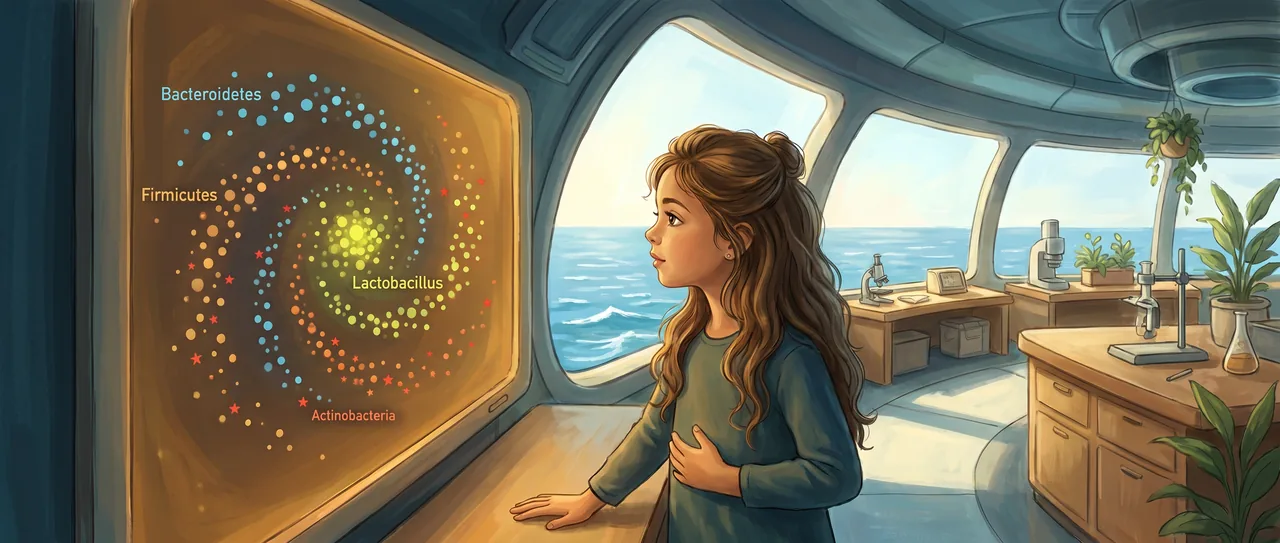
The lab's AI, called Lumen, projected her results as a slowly rotating galaxy of colored dots — each dot a species of bacterium, each color a phylum. Maya's gut was a universe. Bacteroidetes in cool blue. Firmicutes in warm amber. Tiny flares of Actinobacteria like distant red stars.
"Lumen, can you overlay yesterday's sample?"
The galaxy doubled. Two constellations, almost identical, but not quite. A bloom of Lactobacillus had appeared near the center.
Maya leaned closer. Something didn't fit. Yesterday's sample should have looked like the day before — same meals, same schedule. Except it hadn't been the same. She'd eaten yogurt. One cup. And the whole constellation had answered.
"Eleven percent increase in Lactobacillus rhamnosus," Lumen confirmed warmly. "A single dietary change can measurably alter microbial populations within twenty-four hours."
Eleven percent. From one cup of yogurt. Maya's mind was already three steps ahead of the data, running down a corridor she couldn't see the end of yet.
"Lumen. These bacteria — do any of them make chemicals that affect my brain?"
A pause. Not because Lumen didn't know, Maya thought, but because the answer was so large it needed a moment to organize itself.
"Many of them do," Lumen said. "Several species in your gut produce gamma-aminobutyric acid. Others produce dopamine and norepinephrine. But the most remarkable molecule your gut microbes help produce is serotonin."
"Serotonin." She knew the word. It was the one her mother's doctor had mentioned once, in a hallway, when her mother thought Maya wasn't listening. The happiness chemical. The mood-steadier.
"Approximately ninety percent of the serotonin in your body is produced not in your brain, but in specialized cells in your gut lining — enterochromaffin cells — and the bacteria living alongside them directly influence how much is made."
Maya's hand drifted to her stomach.
Ninety percent.
The room went strange and large. She looked at the rotating galaxy of her own microbiome and felt something shift inside her, not in her gut this time but in her understanding — a door swinging open onto a room she hadn't known was part of the house.
Her feelings. Her moods. The fizzy rising and the heavy sinking. They weren't just in her head. They were being co-written — by trillions of organisms so small that a thousand of them could sit on the period at the end of a sentence. She was not a single creature. She was a collaboration.
"That's why," she whispered.
"Why what?" Dr. Achebe asked from across the lab.
"Why gut feelings feel like feelings."
Dr. Achebe set down her coffee and looked at Maya for a long time. "That," she said quietly, "is a very good sentence."
But Maya was already somewhere else. The pattern had cracked open and revealed five more patterns nested inside it like seeds in a pod. She could feel them — the questions lining up in that running list she kept in her head, the one that never made her uncomfortable, only more awake.
Because if gut bacteria shaped mood — if they helped write the chemical language of emotion — then what happened when they changed? What happened during illness, or travel, or a new diet? Were the shifts in Maya's own moods partly a conversation between her brain and her belly's tiny citizens? Could you map that conversation?
She pulled up her three samples side by side. Three galaxies. Three days.
"Lumen, I also logged my mood each morning in my journal. Can I — can we correlate them?"
"You can. It would be a very small dataset. Not enough to prove anything."
"But enough to see a pattern?"
"Enough to ask a better question," Lumen said. "Which is usually the point."
Maya worked through breakfast. She worked through the lunch chime. She built a simple graph — microbial diversity on one axis, her self-reported mood score on the other. Three data points. Nothing publishable. Nothing provable.
But the line tilted upward. On the day her gut was most diverse, she had written: Woke up feeling like the sky was made for me.
She sat back.
The Daphne hummed around her. Below, the Pacific stretched in every direction, full of its own invisible galaxies — plankton, archaea, creatures with no names yet. And inside Maya, another ocean, just as vast, just as alive, just as consequential.
She thought about every time someone had told her she was too much. Too many questions. Too fast. Too intense. She thought about pressing her hand to her belly and asking, What are you trying to tell me?
Maybe the answer had always been: We are trying to tell you everything. You just didn't know we were here.
"Lumen," she said. "If I sampled every day for the rest of the summer — mood, diet, microbiome — would eighty data points be enough?"
"Enough for what?"
Maya looked at the galaxy of herself, still slowly turning on the screen.
"Enough to start learning the language."
She picked up a fresh vial. Outside the curved window, the sun was doing something extraordinary to the ocean, turning it into a field of light so bright it looked like the water was thinking.
Maya's hands were steady. Her gut was fizzing.
She knew exactly what that meant now — or rather, she knew she was finally asking the right question about what it meant, which was better. Which was the beginning of everything.
Read the interactive version, listen to the narration, and earn a gold star →
A science-verified short story for curious kids · Curiosity Land