The Same Beginning
The bee landed on Maya's wrist, and she didn't flinch.
She never flinched. That was the thing about Maya that made the other kids at the science center step back from her during rooftop sessions — she'd hold perfectly still while a honeybee walked across her skin, its legs leaving tiny impressions like punctuation marks on a sentence she was still learning to read.
Soren watched from a half-step back, not afraid exactly, but respecting the margin. "It's checking you for nectar," he said, writing something in his notebook without looking down.
"It won't find any." Maya tilted her wrist slowly, watching the bee's antennae trace the air. "But look how it searches. It's so sure there's something here."
Dr. Vasquez had given them the assignment that morning: observe the brood frames, sketch what they saw, and answer one question — how does the hive decide who becomes a queen? The other pairs had already gone downstairs, sketches finished, answers written in neat paragraphs copied from the learning wall. But Maya was still up here, because her sketch had led to a question, and the question had led to another question, and now Soren was on his fourth page of notes and the afternoon light was going amber.
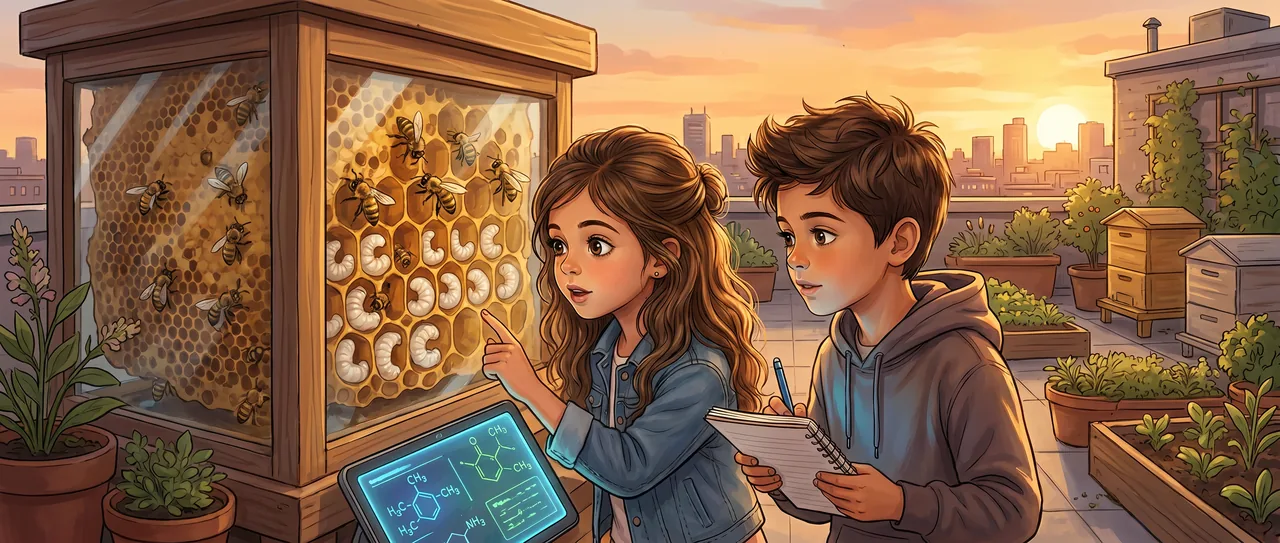
"Look at this," Maya said, beckoning Soren closer to the observation hive — a glass-walled frame that let them watch the colony's interior without disturbing it. She pointed to a row of cells near the bottom. "See those larvae? The little white curls?"
Soren leaned in, studying them carefully. "They all look identical."
"Exactly." Maya pressed her fingertip against the glass. "They are identical. Dr. Vasquez said the queen lays identical fertilized eggs in worker cells and queen cells. Same DNA. Same genome. Same everything." She paused. "But something's wrong with that."
Soren looked where she was looking. In the cells Maya indicated, nurse bees were depositing a glistening white substance — pooling it around the larvae until they floated in it.
"Royal jelly," Soren said. He flipped back a page in his notebook. "The queen-cell larvae get it continuously. But the worker-cell larvae only get it for about three days, then they're switched to pollen and honey." He looked up. "Same starting code. Different food."
"Completely different outcome," Maya finished.
Soren opened the epigenetics module Dr. Vasquez had uploaded that morning. He'd read it twice already, and Maya had read it three times. The diagrams showed methyl groups attaching to DNA like tiny flags, silencing some genes, activating others. Not changing the code itself — just changing which parts of it got read.
"It's like having two copies of the same book," Maya murmured, "but someone highlighted different chapters in each one."
Soren tested the idea the way he tested everything — by pushing it. "Same words on every page. But one book tells the story of a queen. Larger ovaries, longer body, different behavior. The other tells the story of a worker. And the only variable is what they were fed in the first days." He wrote that down, then underlined it. Then underlined it again.
But Maya had already moved past the bees. Soren could see it — the way her eyes unfocused slightly, the way her sentences got shorter. She was following something.
"Does it happen in us?" she said.
Soren didn't answer immediately. He pulled up the research module and typed: *Do epigenetic changes happen in humans?* The answer came back dense with links. He read. Maya read over his shoulder. His eyes went wide first. Hers followed.
Human identical twins. Same genome. But as they aged, their epigenetic markers diverged — influenced by what they ate, where they lived, what they experienced. One twin might develop a condition the other never would. Same book, different highlighted chapters. The environment was holding the pen.
"Soren," Maya whispered.
He looked up from the screen.
"It's not just bees." Her voice had a tremor in it that wasn't fear. "Our genes aren't just a fixed blueprint. They're more like a — a piano. All the keys are there from the start. But what gets played depends on which keys get pressed. And the things around us — the food, the air, the experiences — they're the hands on the keys."
Soren was quiet for three full seconds. Then he said, "Let me check something." He scrolled through the research links, reading carefully, cross-referencing. Maya waited. She knew this part — Soren wasn't doubting her. He was building the floor under her leap.
"It holds," he said finally. "The Fraga twin study. Identical twins start with nearly indistinguishable epigenetic profiles. By middle age, they're dramatically different. Diet, stress, environment — all of it leaves marks on which genes express." He closed the tablet slowly. "The piano metaphor actually works."
Maya stood up and looked out over the city. The rooftop garden stretched around them, pollinators drifting between lavender and sunflowers. Below, the streets hummed with electric buses and the soft chime of crossing signals. Somewhere in every building, in every person walking below, trillions of cells were reading their own highlighted chapters, playing their own music from the same ancient keys.
The hive hummed beside them. Sixty thousand bees, all daughters of one queen, their fates written not in their genes but in what surrounded them in their first days of life.
"Do you know what this means?" Maya asked. "It means who you become isn't just locked in. The world participates in making you."
Soren wrote that in his notebook. Word for word. Then he said, "My dad always says I was born stubborn."
Maya laughed. "Maybe. But maybe something in your environment pressed the stubborn key really, really hard."
He grinned. "So what do we write for the assignment?"
Maya looked back at the observation hive. The nurse bees were still tending the larvae, depositing royal jelly with a precision that was almost tender. A whole future, she thought. They're feeding those larvae a whole future.
Soren was already writing — not just the answer to Dr. Vasquez's question, but the new question behind it. Maya watched his pen move and started dictating the parts he couldn't see yet: if environment could change which genes expressed, then what were the signals in human life that pressed the keys? Could you find them? Could you understand them? Could knowing this help people — not by rewriting their code, but by learning which chapters were waiting to be read?
They wrote for twenty minutes without stopping. Soren filled six pages. Maya paced and talked and occasionally grabbed the pen to draw arrows between his notes.
When they finally went downstairs, Dr. Vasquez glanced at Soren's notebook and raised an eyebrow. "This is considerably more than the assignment asked for."
"We know," Maya said. "But the assignment asked the wrong question."
Dr. Vasquez studied them both for a long moment, and something shifted in her expression — not surprise, but recognition. She handed the notebook back to Soren. "Then keep asking the right ones."
That night, Maya lay in bed with her window open, listening to the city breathe. She thought about the larvae in their wax cells, identical and waiting. She thought about the piano keys in every one of her own cells, some pressed, some silent, some maybe waiting for a signal that hadn't arrived yet.
She pressed her hand flat against her chest and felt her heartbeat — steady, insistent, the rhythm of a book still being highlighted, a song still being composed, a beginning that had not yet decided what it wanted to become.
Read the interactive version, listen to the narration, and earn a gold star →
A science-verified short story for curious kids · Curiosity Land