The Letters No One Wrote
Maya had a habit that annoyed everyone in the biolab: she talked to the bacteria.
Not in a silly way. Not baby talk. She'd lean over the culture plates, press her eye to the magnifier, and whisper questions. "What are you doing with all that sugar?" or "Why'd you clump on the left side today?"
Nobody else at the Saturday open-lab sessions did this. The other kids followed the printed protocols, pipetted their samples, logged their observations, and left. Maya followed the protocols too — she just couldn't stop wondering about the parts the protocols didn't explain.
Soren, who sat beside her, never commented on the whispering. He just wrote things down — her questions, his own, the temperature of the incubator, the time between observations. His paper notebook was already half full this semester.
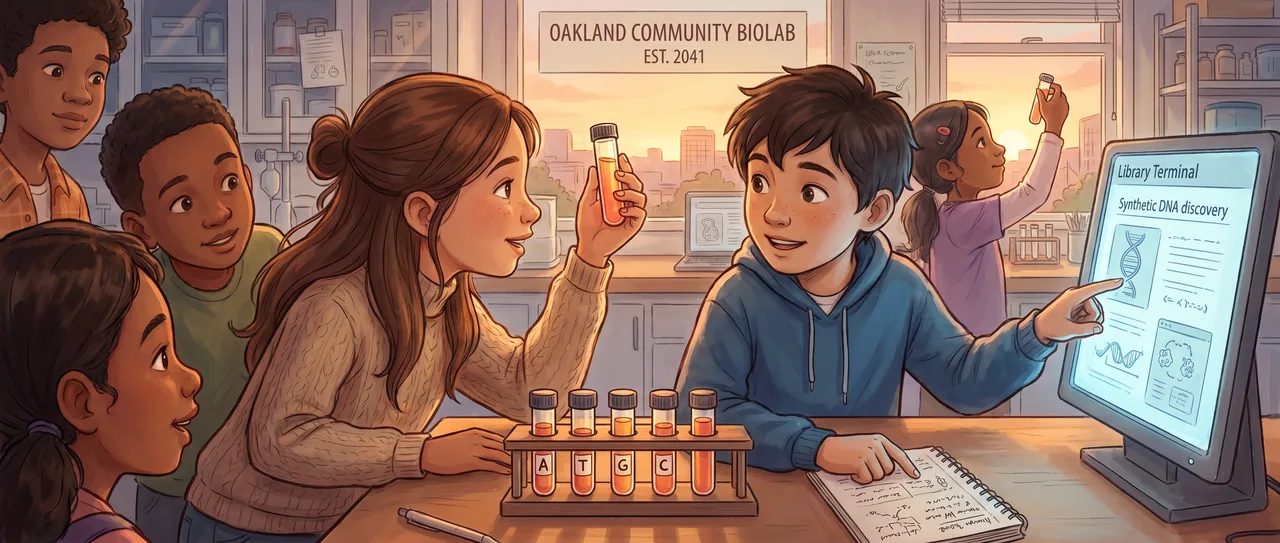
Today, Dr. Kapoor had set out something new on the teaching bench: four vials in a rack, labeled A, T, G, and C, plus two more vials, unlabeled, filled with liquid the color of a sunset.
"Standard Saturday challenge," Dr. Kapoor announced to the six kids at the bench. "Figure out what's in the mystery vials. Tools are available. I'll be in my office. You have two hours."
Then she left, because Dr. Kapoor believed in leaving.
The other kids immediately grabbed for the spectrophotometer. Maya grabbed nothing. She stared at the rack.
Soren noticed her staring. He didn't reach for the spectrophotometer either. Instead he opened his notebook and wrote: 4 labeled. 2 unlabeled. Why 6?
Maya was already there. Four labeled vials. A, T, G, C. The four letters of DNA — the ones every living thing on Earth had used for nearly four billion years. Adenine pairs with thymine. Guanine pairs with cytosine. Two pairs. Four letters. That was the whole alphabet of life.
"Six," she said.
Soren looked up from his notebook. "Six what?"
"There are six vials. Not four."
"Right. Two mystery samples."
"No." Maya shook her head. "Four letters. That's the whole alphabet. So why would anyone put six vials in a rack together like they belong together?"
Across the bench, Jamal ran a sample through the spectrophotometer and frowned. "Absorption peak doesn't match any of the four bases."
"Maybe it's a protein?" said Kenji.
"Doesn't absorb like a protein either."
Soren wrote down their readings. Then he underlined the word he'd already written: Why 6?
Maya picked up one of the sunset-colored vials and held it to the light. She thought about alphabets. She thought about how English has twenty-six letters, and Mandarin has thousands of characters, and how her grandmother's Tamil script curved like rivers. More letters meant more words. More words meant more things you could say.
"What if someone gave DNA more letters?" she said.
Soren's pen stopped. He looked at the vial in her hand, then at the four labeled vials, then back. "That's — that would mean a third base pair."
"What made you think that?" he asked. Not correcting. Wanting to see the path.
"The rack," Maya said. "Dr. Kapoor put them together. Like they're the same kind of thing."
Soren set down his pen and went to the lab's library terminal. He searched: synthetic DNA bases organisms.
The first result made him read the same sentence three times.
In 2014, scientists at the Scripps Research Institute had created a living cell that used six genetic letters instead of four. They'd built two new molecular bases — called X and Y in early papers, later named dNaM and d5SICS — that paired with each other the way A pairs with T and G pairs with C. And the bacteria survived. They copied the new letters. They passed them to their daughter cells. Life, which had used a four-letter alphabet since before there were oceans, had just learned two new letters.
"Maya." His voice came out strange. "You're right."
He turned the screen so she could see. Maya read it and went very still.
Soren looked back at the culture plates from last week's session — ordinary E. coli, dividing every twenty minutes, the same species labs had used for a hundred years. Four letters. Billions of years. And someone had walked up to the oldest language in the world and said: here, have more words.
He wrote in his notebook, pressing hard: 4 billion years. 4 letters. Then 6. The page felt too small.
Maya returned to the bench. "They're synthetic nucleotides," she said. "New DNA bases. Not A, T, G, or C. A third pair."
Jamal looked skeptical. "DNA only has four bases."
"Natural DNA has four bases," Maya said. "But the alphabet got bigger."
Soren pulled up the paper on the terminal and read the key details aloud — the semi-synthetic organism, the unnatural base pair, the way the cell's own machinery had learned to replicate letters that evolution never invented.
"That's not possible," Kenji said, but he was already leaning in to read.
"Think about it," Maya said, and now she was doing the thing she always did, the thing that made her talk too fast and forget that other people weren't already inside her head. "Four bases means sixty-four possible codons. That's enough to code for twenty amino acids. But six bases means two hundred sixteen possible codons. You could code for — for things that don't exist yet. Proteins no living thing has ever made."
Soren checked her math in the margin of his notebook. Four cubed: sixty-four. Six cubed: two hundred sixteen. He circled it twice.
The lab was quiet. Even the centrifuge seemed to be listening.
"So these vials," Jamal said slowly, "are letters. In a language that's only, what, thirty years old?"
"A language that life never spoke before," Maya said. "Until we taught it."
Something shifted behind the eyes of every kid at the bench. Kenji had stopped saying it was impossible. A girl named Priya, who never spoke much during Saturday sessions, had come closer and was holding one of the sunset vials up to the light exactly the way Maya had.
They spent the rest of the session designing an experiment they couldn't actually run yet — a protocol for incorporating the synthetic bases into a plasmid, printing a gene with six letters, expressing a protein that no cell in four billion years of evolution had ever produced. They argued about codon tables. They sketched on the whiteboard. Maya listened more than she talked, because the ideas were coming from everywhere now. Soren filled three more pages, writing so fast his handwriting went sideways.
When Dr. Kapoor came back at the end of two hours, she found six kids who did not want to leave.
"You identified the samples?" she asked.
"We identified the samples," Maya said.
"We have fourteen follow-up questions," Soren said, holding up his notebook.
Dr. Kapoor smiled the way she did when things were working — not at the kids, but at something behind them, something coming. "Write them down. All fourteen. Bring them next Saturday."
That night Soren lay in bed with his notebook open on his chest and could not sleep. He kept thinking about the four billion years. The patient, ancient four-letter language that had built jellyfish and redwoods and the human brain. And now there were six letters. And someday maybe eight. Or ten.
He thought about all the things that had never existed because there weren't enough words to describe them — proteins, medicines, materials, structures — waiting on the other side of an alphabet that was only just beginning to grow.
Outside his window, the city hummed.
Somewhere in a freezer across town, bacteria divided quietly in the dark, copying letters that no star had ever forged, no ocean had ever stirred into being — letters that existed only because someone, once, had looked at the language of life and wondered:
What if there's more?
Read the interactive version, listen to the narration, and earn a gold star →
A science-verified short story for curious kids · Curiosity Land