The Four Million Doors
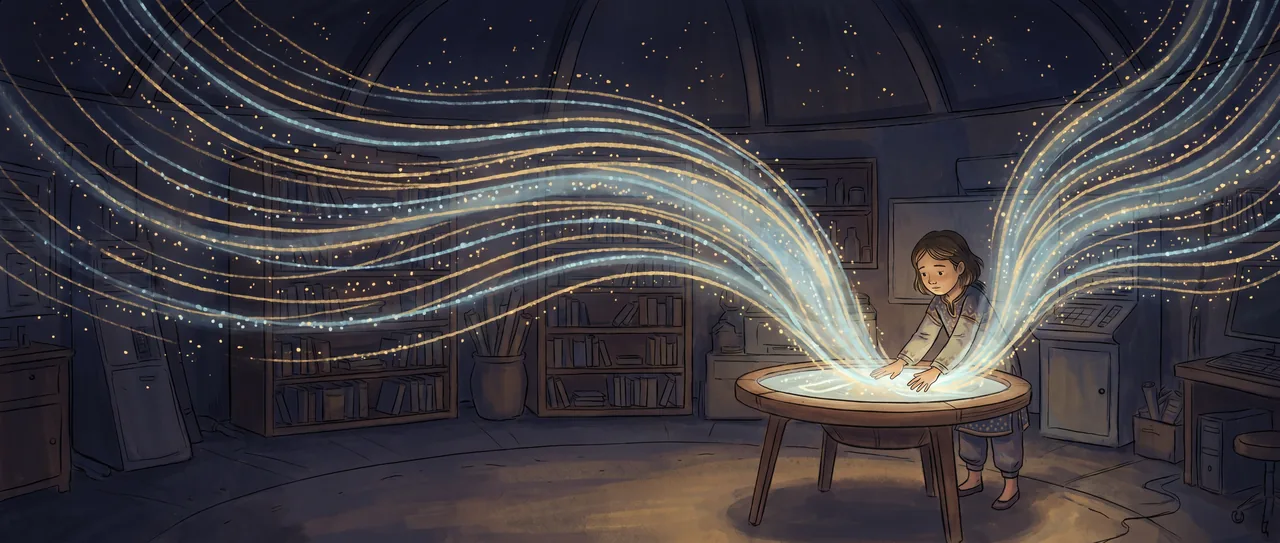
The holotable displayed Lina's genome as a river of light — three billion letters long, scrolling so fast it looked like rain falling sideways.
"Okay," said Lina. "Show me where I'm different."
The AI tutor, Helios, spoke from everywhere and nowhere, the way it always did — like a thought arriving just before you had it yourself. "Different from what?"
Lina drummed her fingers on the edge of the table. Other kids would have said *normal*. She knew better. "Different from the reference genome. The composite one built from the first thousand people who ever got sequenced, back on Earth."
"There she is," Helios said, and something in its voice sounded almost proud. The river of light changed. Millions of points flared gold, scattered across the stream like sparks kicked from a fire.
Lina stared. She'd expected a few hundred. Maybe a thousand.
"Four million, seven hundred and twelve thousand, nine hundred and one," Helios said. "Give or take the structural variants I'm still cataloguing."
"That can't be right."
"It's right for everyone. Your mother carries about four million, eight hundred thousand. Your father, four million, six hundred thousand. Commander Achebe on the bridge — four million, nine hundred thousand. Every human who ever lived carried millions of differences. It's what makes a genome a *your*-nome."
Lina leaned closer. She'd come here for a specific reason, the one she hadn't told anyone yet. The reason she'd been quiet at dinner for three nights running. She touched a cluster of gold sparks on chromosome six. "What do these ones do?"
"Unknown."
She touched another cluster on chromosome eleven. "These?"
"Unknown."
"These? These? What about *these*?"
"Unknown. Unknown. Beautifully, stubbornly unknown."
Lina pulled her hand back. "How can that be? We've had genomics for two hundred years."
"And we've catalogued the function of perhaps fifteen percent of human variation with any confidence. The rest is — unread mail. Letters the universe wrote to us that we haven't opened yet."
Lina sat down on the lab stool and pulled her knees up. The generation ship *Mayflower III* hummed its low hum around her, the one you stopped hearing after a while unless you were the kind of person who listened for things other people forgot. Lina was that kind of person. It was exhausting sometimes.
"Helios. The screening report said I have a variant on BRCA-adjacent region 4 that's never been seen before. Not in anyone in the ship's database. Not in the Earth archives. Dr. Vasquez told my parents it's 'a variant of uncertain significance.' My mom cried."
Helios paused. Not a processing pause — Lina knew the difference. A *choosing-words* pause. "Your mother loves you."
"I know she does. But she cried because she doesn't know what it means. And Dr. Vasquez doesn't know what it means. So I came here to find out what it means."
"And what have you found?"
Lina looked at the river of light, all those millions of gold sparks, and something shifted in her chest. She slid off the stool and walked around the holotable slowly, the way she walked around the observation deck when she was thinking hard.
"I found... that almost everyone's genome is full of things nobody understands yet. Millions of things. Not just mine."
"Yes."
"So my one variant — it isn't a flaw in a finished blueprint. It's one more unopened letter in a mailbox that's already stuffed with four million, seven hundred and twelve thousand other unopened letters."
"Nine hundred and one. But yes."
Lina stopped walking. She pressed her palms flat on the holotable and watched the light stream between her fingers. "Helios. Can I set up a longitudinal study? On myself?"
Another pause. "What would you track?"
"Everything I can. Gene expression profiles every month. Protein levels. How the variant behaves as I grow. If it does anything at all. I want to be the one who opens that letter."
"That's a ten-year commitment, minimum. Possibly a lifetime one."
"We're on a ninety-year voyage. I've got time."
Something in the room changed. Lina felt it the way she felt the ship's hum — not with her ears, but with her attention. Helios projected a new display. Not just her genome now, but the genomes of everyone aboard, two thousand streams of light running parallel, each one burning with its own millions of gold sparks.
"Lina. Look."
She looked. Two thousand rivers of fire, each one carrying millions of mysteries. She did the math in her head without meaning to — it was just how her brain worked. Two thousand people times roughly four and a half million variants each. Nine *billion* individual differences aboard this single ship, sailing through the dark between stars. And the vast majority of them — no one had ever studied. No one had ever asked *what do you do?*
The scale of it hit her like stepping onto the observation deck for the first time. Not frightening. Not small-making. The opposite. The universe had written nine billion letters to the people on this ship alone, and almost none of them had been read.
"There's enough work here for every kid on this ship," she whispered.
"For every kid on this ship, and their children, and their children's children, all the way to Proxima Centauri and beyond."
Lina straightened up. She knew what she was going to do tomorrow. She was going to find Tomás, who was too shy to raise his hand in class but who kept a secret notebook full of protein-folding doodles. And Priya, who asked so many questions that their teacher had once, gently, asked her to save some for next time. And Fen, who sat alone at lunch because he said things other people didn't understand yet.
She was going to tell them what she'd found: that the human genome was an ocean of unopened doors, and no one — no adult, no AI, no ancient scientist back on Earth — had the keys.
Not yet.
She pulled up a blank research log and typed the date. Then the title:
*Project Unopened Letters — Entry One.*
Her hands were shaking a little. Not from fear. From the size of what she didn't know, and the feeling — bright, electric, almost too big for her chest — that not knowing was exactly where the best things started.
Read the interactive version, listen to the narration, and earn a gold star →
A science-verified short story for curious kids · Curiosity Land