The Map of Grudges
Devi had been keeping the notebook for two hundred and thirteen days.
Not because anyone told her to. Not for school. She kept it because the crows on Ankeny Street were doing something she couldn't explain, and she was the kind of person who couldn't leave that alone.
It had started in October when she noticed that the big roost — maybe three hundred American crows that gathered each evening in the Douglas firs behind the community solar array — didn't treat all people the same. Most walkers passed beneath without incident. But when Mr. Tierney from 4412 walked his dog, the crows exploded. They dove. They screamed. They followed him two blocks, trading off in pairs like relay runners.
No one else on the whole street got that treatment. Not one.
Devi had written in her notebook: WHY TIERNEY?
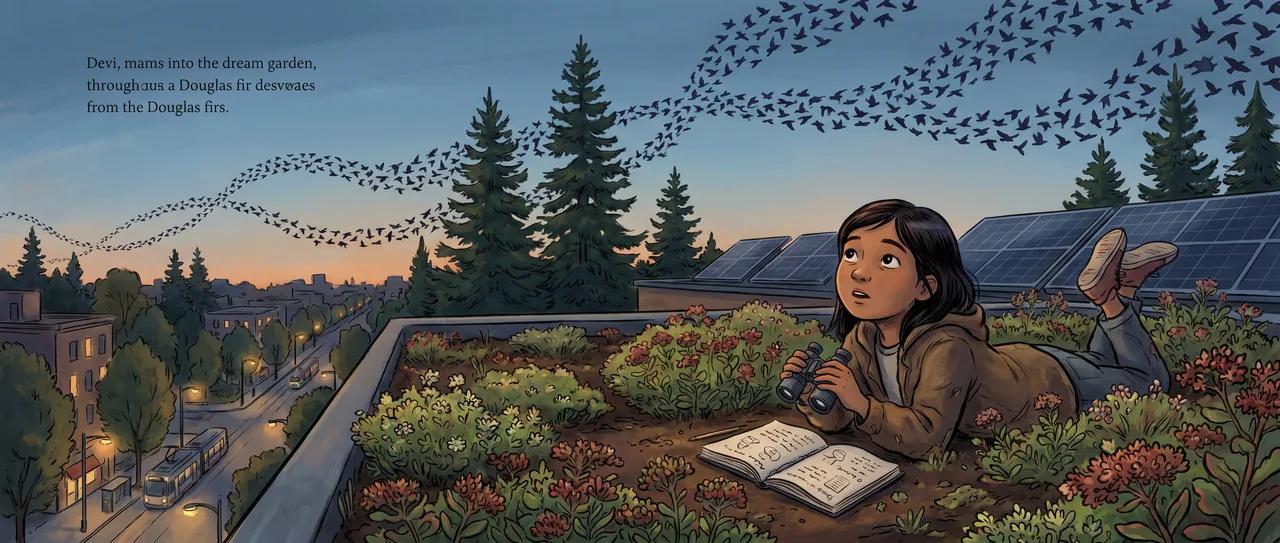
She'd started mapping it. Every afternoon she climbed the access ladder to her family's green roof, lay flat on her stomach among the sedum plants with her binoculars, and logged which humans triggered alarm calls and which didn't. She gave every crow she could identify a name based on distinguishing marks — Notch, White-Tip, Lefty, Big Beak.
By December she had a chart. Seven people on the four-block stretch got mobbed. Everyone else was ignored.
She interviewed the seven. Six of them admitted, when pressed, that they had at some point chased crows away from their gardens or trash. Mr. Tierney had once, three years ago, trapped a crow in his garage and "roughed it up a little" before releasing it.
Three years. The crows still remembered his face.
But here was the part that made Devi's scalp prickle. She'd been watching long enough now to know the juveniles — the ones born that spring, identifiable by the pinkish lining still visible inside their mouths when they cawed. Those juveniles had never been alive when Mr. Tierney trapped that crow.
They mobbed him anyway.
She wrote in her notebook, pressing so hard the pen nearly tore the page: THEY'RE TEACHING EACH OTHER WHO TO HATE.
That was the line that changed everything.
In January, Devi designed an experiment. She asked her neighbor Aarav — twelve, tolerant of her obsessions — to walk the route wearing a specific rubber mask she'd bought: a cartoonish dog face. For one week, Aarav walked the route in the mask, and each time he passed under the roost, he waved a broom handle in the air. Not hitting. Just threatening.
The crows went berserk.
Then Devi had four different people — her mom, Aarav's sister, the mail carrier, a kid from school — walk the same route wearing the same mask.
Every single time: alarm calls, diving, scolding.
But when those same four people walked the route with their own faces showing? Nothing. Silence. Complete indifference.
The crows weren't reacting to body shape, or gait, or clothing. They had memorized the face of the mask. They'd filed it under DANGEROUS. And they'd told each other.
Devi sat on the roof that evening with the notebook in her lap and felt the strangest sensation — like the street below her had peeled open to reveal a second street underneath, one she'd been walking over her whole life without seeing. The crows weren't just birds. They were running a society. They had enemies lists. They held court. They passed judgment down through generations, parent to chick, a living grudge that could outlast any single crow's lifetime.
Which meant the roost on Ankeny Street contained a kind of memory. Not written down. Not stored in any machine. Exposed to weather and predators and time, and surviving anyway. A cultural memory encoded in behavior, transmitted by attention, carried in the specific neural architecture of a brain that weighed barely half an ounce.
She thought: how far back does it go? How many human faces are stored in this flock right now? Are there grudges in there from people who moved away years ago — faces filed under DANGER that will never walk this street again, kept in crow memory like a library book nobody will ever check out?
And then a thought so big it made her dizzy: what else is being passed down in animal cultures, right now, all around us, that we've never bothered to notice because we never thought to watch?
Devi brought her findings to the Spring Science Showcase. She expected polite nodding. She got Dr. Maren Olowe, a behavioral ecologist from Portland State who'd been in the audience, kneeling by her poster board, asking questions for forty minutes.
"Your methodology is rough," Dr. Olowe said. "Your sample size is tiny. Your controls need work." She paused. "But your question is exactly right. And you asked it before anyone told you to. That matters more than you know."
"Can I fix the methodology?" Devi asked.
"I'll teach you. If you want."
"I want."
Dr. Olowe smiled. "I had a notebook like yours. When I was ten. Pigeons, not crows. Everyone thought I was strange."
"Everyone thinks I'm strange," Devi said.
"Good," said Dr. Olowe, and that single word felt like a door swinging open onto a room Devi hadn't known existed.
That night, Devi climbed the roof ladder one more time. The roost was settling in for the evening, thousands of dark shapes pouring across the sky in long braided rivers, calling to each other in a language made of alarm and recognition and memory. She watched them and thought about all the invisible networks layered over every city, every forest, every reef — information flowing between minds that had no written language, no technology, nothing but the ancient, astonishing machinery of paying attention to each other.
She opened her notebook to a fresh page.
At the top she wrote: WHAT ELSE ARE THEY SAYING THAT WE HAVEN'T LEARNED TO HEAR YET?
Below her, the crows kept arriving, kept calling, kept remembering. The sky was full of voices she was only beginning to understand, and the list of questions in her notebook was growing faster than the list of answers, and Devi thought that might be the best feeling in the world.
Read the interactive version, listen to the narration, and earn a gold star →
A science-verified short story for curious kids · Curiosity Land