The Light She Left Behind
The first thing Paloma noticed about the new observatory was that it breathed.
Not literally. But the dome's slats rotated in slow, quiet intervals, adjusting to the atmosphere like lungs filling and emptying. The telescope inside — a twenty-meter mirror polished to within a billionth of a meter — sat perfectly still while everything around it shifted and compensated. Paloma pressed her hand against the warm metal railing and felt the vibration of a dozen systems working together to hold one steady eye on the sky.
"You can look, but don't touch the console," said Dr. Rojas, already walking away toward the control room. "Your grandmother would haunt me."
Paloma's grandmother had been the third director of this observatory. She had died fourteen months ago, and in her will she'd left Paloma one thing: a single night of telescope time. Not a necklace. Not a letter. One night, and a set of coordinates.
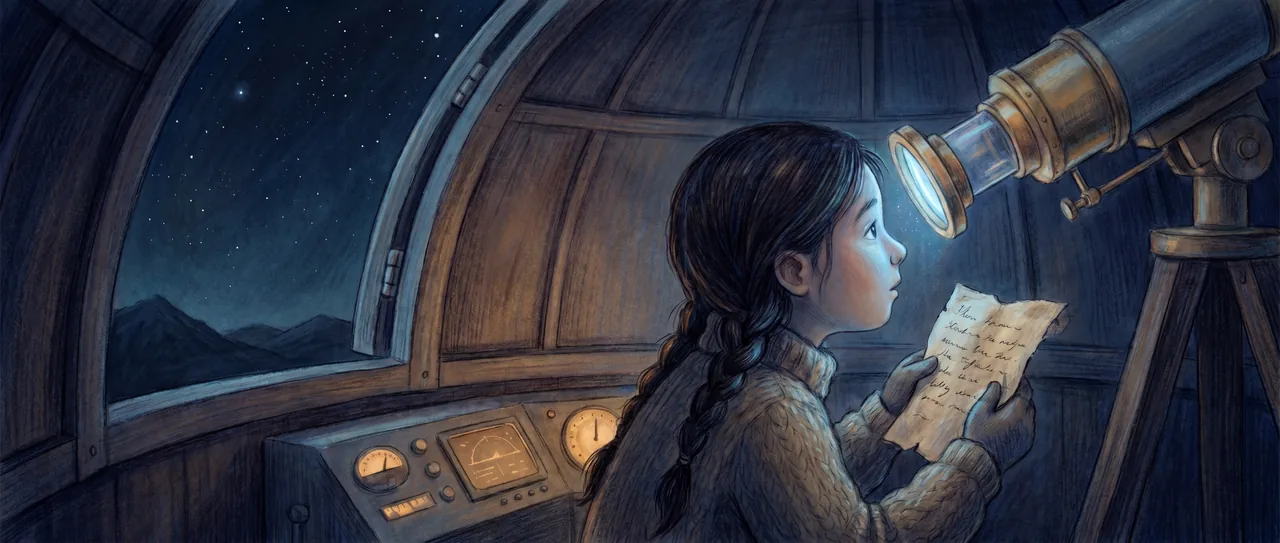
Paloma unfolded the paper — actual paper, her grandmother's handwriting, the ink a little smudged. A right ascension. A declination. And underneath, in her grandmother's neat script: *Look here. Then think about what you're really seeing.*
The observatory's AI, which everyone called Lumi, spoke gently from a speaker near the eyepiece. "I've slewed to your coordinates, Paloma. Whenever you're ready."
"What's there?" Paloma asked.
"Why don't you look first?"
Paloma leaned in.
The eyepiece wasn't glass anymore — it was a high-resolution display calibrated to match what the mirror collected, but sharpened, the atmosphere's distortion peeled away in real time. And there, centered in a field of lesser stars, was a single point of light. Blue-white. Steady. Bright enough to make her catch her breath, though she couldn't have said why.
"That's a star called HD 168913," Lumi said. "Spectral type B. Very hot. Very luminous. About nine thousand times brighter than your sun."
"It's beautiful," Paloma whispered.
"It is. Your grandmother spent three years studying it."
Paloma stared at the light. It didn't flicker. It just — was. Present and calm and impossibly bright against the dark.
"Lumi, how far away is it?"
"Just over four thousand light-years."
Paloma's hand tightened on the railing. She'd learned about light-years in school, but she'd learned them the way you learn that the ocean is deep — as a fact, not a feeling. Now, looking at this particular light, the feeling arrived.
"So this light..."
"Left that star around two thousand BCE. Give or take."
Paloma pulled back from the eyepiece. The Atacama wind moved across the mountaintop, dry and ancient and smelling of dust and nothing.
"I'm looking at something that happened four thousand years ago," she said. Not a question. A reckoning.
"Yes."
"So — is it still there? Right now, I mean. The actual star."
"That," Lumi said, "is a genuinely wonderful question."
Paloma waited.
"Stars like HD 168913 are massive. They burn fast. Their lifetimes are measured in millions of years, not billions. This one is old for its type. It may still be burning right now. Or it may have collapsed or exploded centuries ago. There is no way to know. The most recent information we can ever receive from it is four thousand years old. That's the fastest anything in the universe can travel."
Paloma sat down on the cold concrete floor, still looking up at the dome's opening, where real stars — unaided, unprocessed — burned in the black.
She thought about her grandmother. About how when someone you love dies, you keep finding things they left behind — a coffee mug, a note, an expression you catch in the mirror. Evidence of light that was already traveling before it stopped being made.
And then a thought hit her so hard she stood up.
"Lumi. Every star I can see right now — I'm seeing it as it was, not as it is."
"Yes."
"So the sky isn't a picture of now. It's a picture of... a million different thens. All arriving at the same moment. Every star is a different page of history, and I'm reading them all at once."
Lumi was quiet for a moment. "Your grandmother said almost exactly that, the first night she used this telescope. She was nineteen."
Paloma's throat hurt. She unfolded the paper again. *Look here. Then think about what you're really seeing.*
She was really seeing the past, alive. Light that had outlived its source, carrying information across an emptiness so vast that the star itself might be gone, and yet here was its light, still arriving, still warm against a mirror on a mountain in Chile, still capable of making a twelve-year-old girl sit down on a cold floor and rethink everything.
Nothing that shines ever completely disappears. Not really. Not as long as the light is still traveling.
She pressed her eye to the display one more time. The blue-white star burned, steady and old and possibly already gone.
"Lumi," Paloma said. "Can you show me the next nearest massive star? Same type?"
"Of course. There are eleven B-type stars within six thousand light-years that your grandmother flagged but never had time to study. I have her notes."
"She left notes?"
"Detailed ones. She seemed to be building toward a question she never finished asking."
Paloma looked at the paper in her hand, then at the sky full of ancient light, then at the telescope that breathed.
"Show me the first one," she said.
The dome shifted. The mirror moved. New light, from a different millennium, poured in.
Paloma leaned forward, and somewhere between the eyepiece and the stars, she felt it — the edge of a question so large she couldn't see its shape yet, only its shadow, stretching ahead of her like a road made of light that had been traveling since before she was born, arriving exactly now, exactly here, as if it had been meant for her all along.
She had eleven stars to look at. She had her grandmother's unfinished question.
She had all night.
Read the interactive version, listen to the narration, and earn a gold star →
A science-verified short story for curious kids · Curiosity Land